

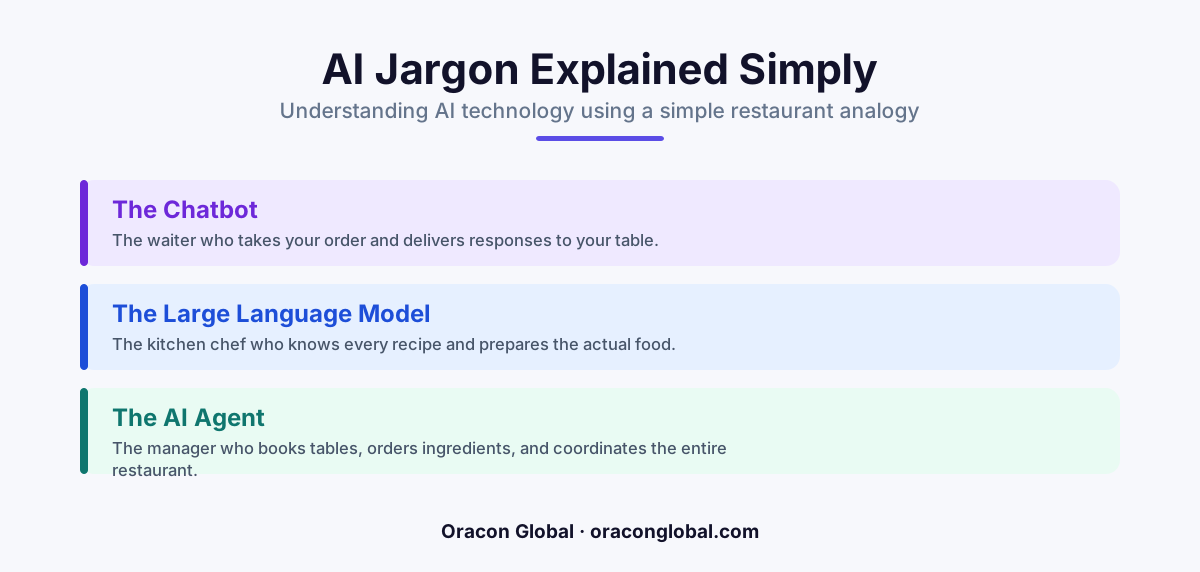
An LLM is the raw intelligence (the chef), a chatbot is the simple interface you talk to (the menu ordering kiosk), and an AI agent is an autonomous worker that can actually execute tasks for you (the waiter who takes your order, coordinates with the kitchen, and processes your payment). Understanding these differences helps business leaders choose the right technology for their actual needs.
If you feel like every business meeting and news article is filled with confusing AI jargon, you are not alone. Terms like "LLM," "chatbot," and "AI agent" are thrown around constantly, often as if they mean the exact same thing. But they do not.
When you are trying to figure out how to improve your business operations, clear up customer service bottlenecks, or automate repetitive tasks, confusing AI terminology is the last thing you need. You do not need a computer science degree to make smart technology decisions.
To help you confidently navigate the world of custom software, we are going to get our AI jargon explained using a simple, everyday analogy we all understand: a restaurant. Let us break down what these terms actually mean, how they connect, and why the differences matter to your business.
The Kitchen Analogy: Meeting the Crew
Before we define the technical terms, let us step inside an imaginary restaurant. To get a hot meal on your table, three distinct elements must work together:
- The Chef: The brilliant mind in the back kitchen who knows thousands of recipes, understands flavors, and knows how to cook.
- The Self-Service Ordering Screen: The simple digital kiosk at the front door where you tap buttons to view the menu or read pre-written descriptions of the dishes.
- The Waiter: The active coordinator who takes your order, checks the kitchen inventory, tells the chef what to make, pours your water, brings your food, and processes your credit card.
In the world of artificial intelligence, these three restaurant roles align perfectly with the three most common pieces of AI jargon. Let us look at each one.
1. What is an LLM? (The Master Chef)
An LLM stands for Large Language Model. To put it simply, an LLM is a highly advanced computer program trained on massive amounts of written text so it can understand, predict, and generate human language.
Think of the LLM as our Master Chef. The chef has read every cookbook in existence. If you ask the chef how to make a chocolate cake, they can instantly recite the recipe. If you ask them to write a poem about pasta, they can do it in seconds because they understand how words fit together.
However, the chef has a limitation: they are stuck in the kitchen. On their own, they cannot see the customers, they cannot walk to the cash register, and they do not know if your table needs more water. They possess the raw intelligence and the knowledge of language, but they need tools and interfaces to interact with the outside world.
A real-world example: When you use a raw LLM, you are asking a giant brain to write an email, draft a blog post, or translate a paragraph. It is highly intelligent, but it only processes the text you give it.
2. What is a Chatbot? (The Ordering Screen)
A chatbot is a simple software application designed to converse with humans, usually through text boxes on a website.
In our restaurant, a traditional chatbot is the Self-Service Ordering Screen. It is programmed with a specific set of rules. If you press "Burgers," it shows you the burger menu. If you ask, "Do you have gluten-free options?" it searches its pre-written text files and displays the answer.
Chatbots are excellent for basic communication, but they are generally rigid. If you ask the ordering screen a question that is not on its pre-programmed list—like "Can you ask the chef if they can make a custom dish from my hometown?"—the screen will simply say: "Sorry, I do not understand."
A chatbot is simply a front-end communication window. Some older chatbots do not even use modern AI; they just follow simple "if-then" rules written by programmers.
A real-world example: The little chat bubble in the bottom corner of an airline website that helps you find the "refund policy" link is a chatbot. It does not actually process your refund; it just points you to the right web page.
3. What is an AI Agent? (The Fully Autonomous Waiter)
Now we arrive at the most exciting development in modern technology. An AI agent is an intelligent software assistant that uses an LLM as its "brain," but is also equipped with "hands" and "feet" to take action, make decisions, and complete multi-step workflows without human intervention.
In our restaurant, the AI agent is the fully autonomous waiter. The waiter uses their brain (the LLM) to understand your requests. But they also have access to the restaurant's computer systems, the physical kitchen, and the payment terminal.
If you tell the waiter, "I have a peanut allergy, what should I get?" they do not just read a pre-written list. They go to the kitchen, check the exact ingredients with the chef, confirm that the prep area is clean, recommend a safe dish, place the order, and ensure it is delivered to your table. They solve your problem from start to finish by taking independent actions.
An AI agent does not just talk; it does work.
A real-world example: Instead of just telling you the refund policy, an AI digital employee acting as an agent can verify your identity, look up your purchase history in the company database, evaluate if your request meets the return criteria, process the refund through the payment gateway, and send you a confirmation email.
Comparing the Three: A Quick Reference
To make the difference between chatbot and AI agent clearer, let us compare how these three technologies handle the exact same business task.
Imagine a customer wants to reschedule a flight:
- The LLM (The Brain): If you ask the LLM, "How do I reschedule a flight?" it will write a beautifully polite paragraph explaining the general steps passengers usually need to take. But it cannot access the airline's database to change your actual ticket.
- The Chatbot (The Interface): If you type "change flight" into the chatbot, it will recognize the keyword and share a link to the flight booking page. You still have to click the link and do all the manual work yourself.
- The AI Agent (The Doer): You tell the agent, "Change my flight to tomorrow morning." The agent looks up your ticket number, checks available flights for tomorrow, calculates the price difference, asks for your confirmation, updates the airline database, charges your saved card, and sends your new boarding pass to your phone.
Why Understanding This Matters for Your Business
Many business owners approach custom AI development assuming they just need a simple chatbot. They often end up disappointed when the tool they build can only talk but cannot actually help run their business operations.
When you partner with a senior software development team, you can build systems where these technologies work together seamlessly. For example, on our own website at Oracon Global, we have a live assistant named Aria. Aria is not just a basic chatbot repeating canned answers; she is powered by an LLM to understand context, helping visitors learn about our custom app development services in a conversational, helpful way.
For modern enterprises, the real return on investment comes from building custom AI agents that integrate directly with your company's custom ERP systems, databases, and existing software tools. This allows the AI to handle complex, repetitive office workflows, freeing up your human team to focus on high-value strategy and relationship building.
Choose the Right Tool for Your Goals
Now that you have this basic AI terminology down, you can look at your business workflows with fresh eyes. You do not need to learn how to write code to leverage these tools. You just need to identify where your team is spending too much time on manual, repetitive tasks that a digital assistant could handle.
Are you looking to build a custom AI agent, a modern web or mobile app, or an AI-native business system? Our senior in-house team at Oracon Global builds tailored software and AI systems that help companies worldwide scale their operations, while ensuring our clients maintain 100% ownership of their code and intellectual property.
Get in touch with us at Oracon Global today to discuss how we can turn your business workflows into smart, automated systems.
===Frequently asked questions
What is the main difference between a chatbot and an AI agent?
A chatbot is designed to talk and answer questions based on predefined rules or text, while an AI agent can actually take action, use external tools, and complete multi-step tasks autonomously.
Do I need a custom LLM to build an AI agent for my business?
No, you do not need to build an LLM from scratch. Custom AI development usually involves connecting existing, powerful LLMs to your company databases and systems so they can act as smart agents.
Can an AI agent replace my existing business software?
An AI agent does not replace your software; instead, it acts as a digital worker that uses your existing software, databases, and APIs to automate manual tasks.
How do I know if my business needs a chatbot or an AI agent?
If you only need to answer frequent customer questions, a chatbot is sufficient. If you need to automate workflows like updating inventory, processing refunds, or scheduling appointments, you need an AI agent.
Read next
Beyond Chatbots: How to Build AI Agents That Actually Do Work for Your Business
Most businesses use AI to answer questions. Here is how to build custom AI agents that actually take action, connect to your internal tools, and handle complex workflows.
Beyond the Wrapper: How to Build Custom AI Agents for Business That Actually Work
Many businesses invest in basic AI wrappers only to find they lack the security and context needed for real work. Here is how to build custom AI agents that integrate deeply with your workflows and databases.
Enterprise AI Maintenance Costs: Budgeting for Year Two and Beyond
Building an AI system is only half the battle. Discover the practical, ongoing operational costs of enterprise AI, including token management, model drift, and continuous security audits.
Oracon Global builds production-grade AI agents, automation and apps — and you own the code and IP. Tell us what you want to automate.
Book a call →See our work