

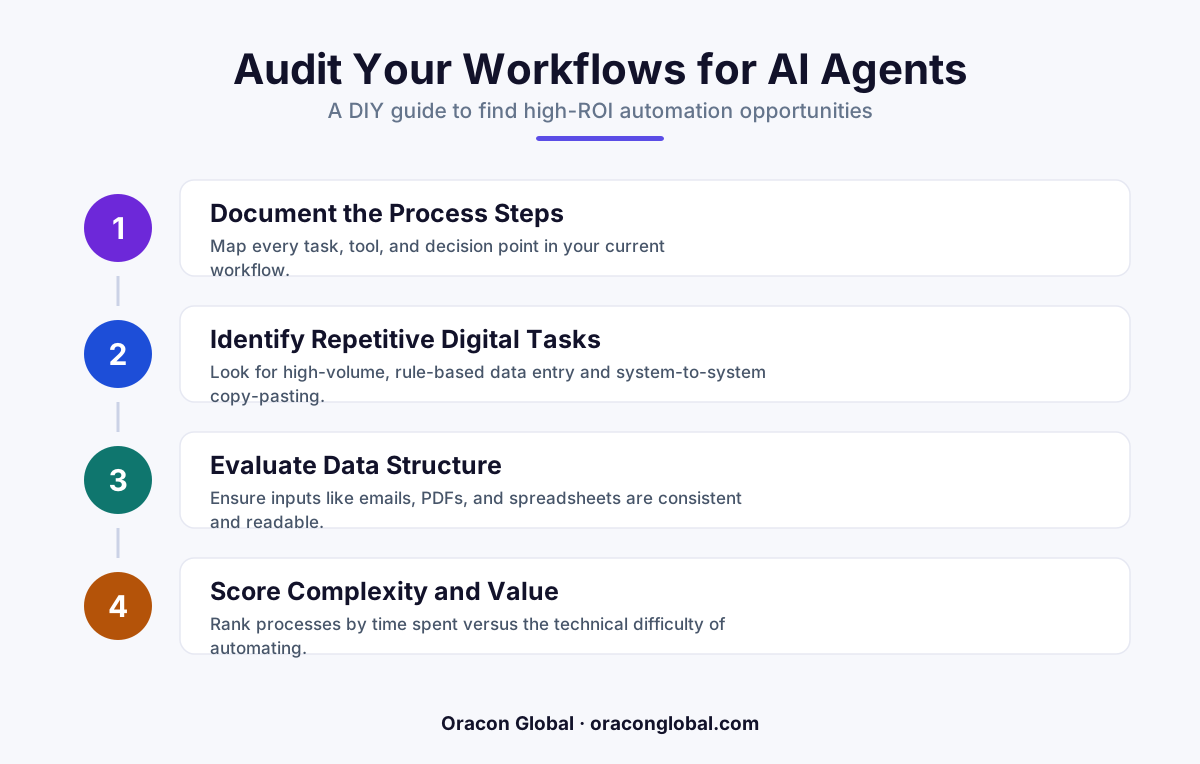
You do not need to pay management consultants six figures to find out where AI fits in your business. By mapping your processes based on data structure, decision complexity, and system integration points, you can pinpoint the exact workflows ready for custom AI agents today.
There is a common misconception that preparing your business for the era of AI digital employees requires a squad of high-priced management consultants. These firms typically charge six figures to produce beautiful slide decks that tell you what you already know: your team spends too much time copy-pasting data between legacy software platforms.
The truth is, nobody knows your operational bottlenecks better than the people running them every day. You do not need an external agency to tell you where the friction lies. By using a straightforward, developer-approved framework, you can audit workflows for AI agent readiness yourself, saving both time and budget for the actual development of your systems.
Here is a practical, step-by-step guide to assessing your internal operations and identifying the highest-ROI opportunities for AI-native automation.
The Three Pillars of AI Agent Readiness
To evaluate if a business process is ready for an AI agent, you must look past the hype of what artificial intelligence can theoretically do. Instead, analyze the process through three highly objective lenses: data structure, decision complexity, and system access. This framework helps determine your overall AI agent readiness without complex formulas.
1. Data Structure (The Inputs)
AI agents thrive on information, but the format of that information dictates the complexity of the build. Look at the primary inputs of your workflow:
- Highly Structured: Databases, clean spreadsheets, and standardized API payloads. These are exceptionally easy for AI systems to process.
- Semi-Structured: Invoices, bills of lading, purchase orders, and standard PDFs. These require parsing layers but are excellent candidates for semantic extraction.
- Unstructured: Casual Slack conversations, handwritten notes, and long-form video meetings. These are more complex and require additional pre-processing before an agent can act reliably.
2. Decision Complexity (The Logic)
An AI agent is only as good as its operating instructions. If a task requires deep, creative human intuition, it is not ready for automation. If the task relies on a set of identifiable, repeatable rules, it is prime for an agentic workflow. Ask yourself: Can a new hire learn this process in an afternoon by following a standard operating procedure (SOP)? If yes, an AI digital employee can likely handle it.
3. System Access (The Integration)
An agent must be able to perform actions, which means it needs to interact with your software stack. Assess whether your current tools (ERPs, CRMs, internal databases) have accessible APIs or if they require manual screen-scraping. Workflows running on modern, API-first software are significantly cheaper and safer to automate than those locked inside legacy desktop software.
How to Map Your Workflows for Automation
To begin your audit, select a single department—such as customer support, logistics, or finance—and map out their high-frequency tasks. Avoid looking at the department as a whole; instead, break their daily operations down into micro-workflows. This granular approach is the secret to successful business process automation.
For every micro-workflow your team performs, document the following four elements:
- Trigger: What starts the process? (e.g., An email arriving with an invoice attached).
- Search: Where does the employee go to find supporting information? (e.g., Checking the ERP to see if the purchase order matches the invoice).
- Action: What decision or physical action is taken? (e.g., Approving the payment or flagging a discrepancy).
- Output: Where does the completed work go? (e.g., Updating a row in a SQL database and sending a Slack notification).
The Golden Rule of Workflow Audits: Never try to automate a process that is already broken. If your team does not have a consistent, documented manual path for a task, building an AI agent for it will only generate faster, automated errors. Clean up the manual process first, then build the code.
Ranking Your Workflows: Quick Wins vs. Complex Builds
Once you have mapped your micro-workflows, plot them on a simple matrix of impact versus technical feasibility. This step ensures your team focuses on high-value, realistic projects first, maximizing your operational efficiency without wasting resources on overly ambitious R&D experiments.
The ideal first project is a "Quick Win"—a workflow that is highly repetitive, relies on structured or semi-structured data, uses modern APIs, and has a clear set of rules. Common examples include invoice reconciliation, routing incoming support tickets based on sentiment and content, or syncing multi-vendor inventory lists with a central database.
Avoid starting with complex, multi-step workflows that require autonomous decision-making across highly sensitive customer-facing channels. Save those for phase two, once your team has built confidence and baseline infrastructure.
Transitioning from Audit to Development
Conducting your own audit gives you a massive advantage when you eventually sit down with software developers. Instead of presenting a vague idea like "we want to use AI to improve operations," you can present a highly structured document detailing inputs, systems, rules, and triggers.
This level of clarity eliminates the expensive discovery phases that agency partners often charge just to understand your business. You control the IP, you understand the business logic, and you define the success metrics from day one.
At Oracon Global, our senior in-house engineering team builds custom AI agents, AI-native ERP integrations, and workflow automation systems designed to fit seamlessly into your existing operations. We deliver production-grade software where you own 100% of the code and intellectual property.
If you have mapped out your manual workflows and are ready to discuss how to turn them into reliable, production-grade AI digital employees, contact Oracon Global today to speak directly with an expert builder.
Frequently asked questions
Do I need a technical background to audit my business workflows for AI?
No. A successful AI readiness audit relies on understanding how data flows and how decisions are made in your daily operations, which is business logic rather than code.
How long does a self-guided AI readiness audit typically take?
For a mid-sized department, a thorough audit can be completed in a few days by focusing on high-frequency, repetitive tasks first.
What is the main indicator that a workflow is ready for an AI agent?
The best indicator is a process that relies on structured or semi-structured data, follows clear operational rules, and requires manual data entry or search across multiple software systems.
How do we avoid building an AI agent for a broken process?
Never automate a workflow that does not have a reliable, documented manual path; if your team cannot consistently execute the process manually, an AI agent will only accelerate the errors.
Read next
Beyond Chatbots: How to Build AI Agents That Actually Do Work for Your Business
Most businesses use AI to answer questions. Here is how to build custom AI agents that actually take action, connect to your internal tools, and handle complex workflows.
Beyond the Wrapper: How to Build Custom AI Agents for Business That Actually Work
Many businesses invest in basic AI wrappers only to find they lack the security and context needed for real work. Here is how to build custom AI agents that integrate deeply with your workflows and databases.
Enterprise AI Maintenance Costs: Budgeting for Year Two and Beyond
Building an AI system is only half the battle. Discover the practical, ongoing operational costs of enterprise AI, including token management, model drift, and continuous security audits.
Oracon Global builds production-grade AI agents, automation and apps — and you own the code and IP. Tell us what you want to automate.
Book a call →See our work