

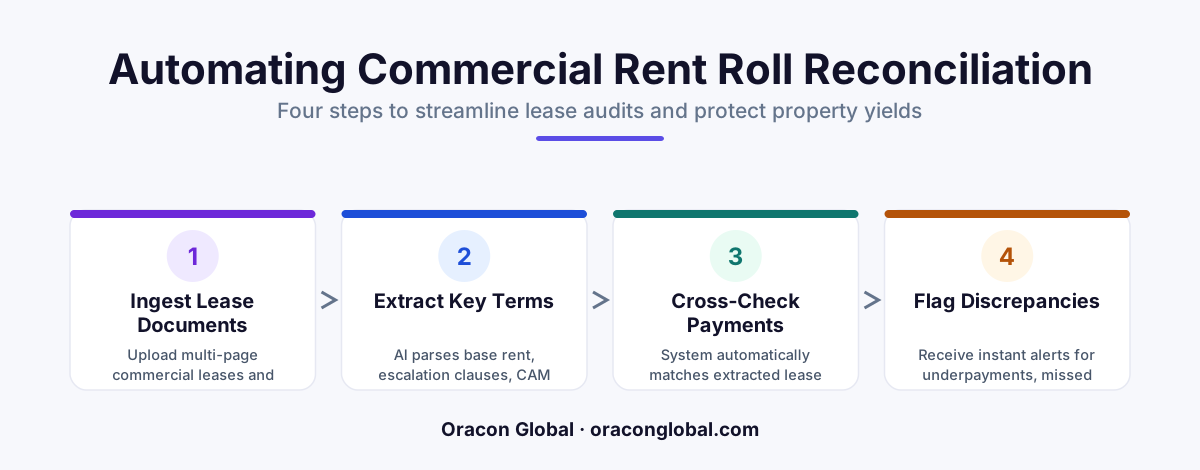
Reconciling complex commercial rent rolls against disparate lease documents manually creates financial leaks and operational bottlenecks. Custom AI data pipelines continuously parse unstructured lease clauses, match variable charges against ledger entries, and flag discrepancies instantly. This allows asset managers to maintain accurate financial reporting without adding manual headcount.
Managing commercial real estate portfolios requires precision, but standard rent roll reconciliation remains one of the most error-prone tasks in property management. Every month, asset managers and accounting teams spend hundreds of hours cross-referencing lease agreements, hand-signed amendments, common area maintenance (CAM) caps, and ledger credits. When dealing with multi-tenant office buildings, industrial parks, or retail centers, a single missed escalation clause can lead to thousands of dollars in uncollected revenue.
Traditional accounting systems and property management software handle basic ledger entries well, but they fall short when dealing with unstructured text buried in fifty-page commercial leases. To achieve accurate commercial real estate automation, operators are turning to custom AI data pipelines designed to extract, match, and reconcile rent rolls dynamically across multi-lease portfolios.
The Structural Flaw in Manual Rent Roll Audits
A standard real estate rent roll audit relies heavily on manual data entry. Property managers review static spreadsheet schedules against ledger reports extracted from accounting platforms. This creates immediate operational bottlenecks for growing real estate funds and asset management firms.
The core challenge stems from document variability. No two commercial leases are structured identically. Key financial terms are often scattered across baseline agreements, side letters, and annual addendums. Manual review inevitably leads to recurring issues:
- Missed Rent Escalations: Stepped rent increases tied to fixed percentages or the Consumer Price Index (CPI) are often forgotten when managed manually in static spreadsheets.
- Miscalculated CAM Recovery: Complex expense caps, gross-up provisions, and pro-rata share adjustments get misplaced during high-volume reporting periods.
- Delayed Overage Charges: Percentage rent clauses tied to tenant sales performance are missed due to delayed reporting from retail tenants.
- Unmatched Payment Variances: Partial tenant payments sitting in unallocated ledger accounts go unnoticed, distorting true property yield metrics.
How Automated Lease Reconciliation Works
Moving from manual reviews to an automated lease reconciliation architecture does not require replacing your existing ERP or accounting system. Instead, a targeted AI data layer acts as an intelligent bridge between raw legal documents and your financial database.
The system ingests leases, side agreements, and tenant correspondence, converting unstructured text into structured, auditable parameters. It then compares these terms directly against live general ledger entries to spot discrepancies before financial statements are finalized.
1. Multi-Format Document Ingestion
Commercial lease files arrive as scanned PDFs, emailed amendments, and physical documents. An intelligent ingestion layer parses these documents using advanced optical character recognition (OCR) and layout analysis. It categorizes legal clauses, tenant entity names, lease start and end dates, security deposits, and renewal options without requiring manual tagging.
2. Dynamic Extraction of Financial Terms
Instead of relying on rigid templates that fail whenever a document layout changes, custom large language model (LLM) components extract key financial logic. The pipeline identifies base rent schedules, free rent periods, TI (Tenant Improvement) allowances, penalty rates for late payments, and specific audit rights clauses.
3. Real-Time Ledger Cross-Matching
Once extracted, lease terms are mapped to your database schema. The software runs continuous background audits, comparing expected billing amounts calculated from the lease text against actual tenant ledger charges. If a tenant is billed under an outdated base rate following a scheduled escalation date, the system flags the exception immediately.
Building a Resilient Real Estate AI Data Pipeline
Deploying a successful real estate AI data pipeline requires strict governance and deterministic safety nets. Because financial records require absolute accuracy, autonomous models must never modify primary accounting records without strict verification layers.
At Oracon Global, we design automation architectures around clear operational boundaries:
- Deterministic Rule Verification: AI models perform the initial document parsing and matching, but hardcoded business logic enforces final calculations (such as interest formulas or prorated day rates).
- Exception Queue Routing: Rather than silently guessing when a lease clause is ambiguous, the system routes flagged items to an internal ops queue where property managers can review the source document side-by-side with the suggested fix.
- Immutable Audit Trails: Every automated match, document extraction, and ledger check is logged cryptographically. Asset managers can trace any flagged reconciliation item back to the exact paragraph and page of the source lease agreement.
Key Benefits for Multi-Lease Portfolio Operators
Implementing custom automated reconciliation transforms asset management from a reactive, end-of-month fire drill into a continuous, real-time control process.
Operators deploying custom reconciliation solutions gain immediate strategic advantages:
- Zero Revenue Leakage: Automatically catch missed CPI adjustments, unpaid late fees, and miscalculated CAM billings before reporting cycles close.
- Accelerated Monthly Closings: Reduce monthly accounting close cycles from weeks to days by eliminating manual lease-to-ledger cross-checking.
- Higher Portfolio Valuations: Maintain accurate, clean rent rolls across every property asset, increasing investor trust and streamlining due diligence during asset sales or refinancings.
- Full IP Ownership: Custom-built solutions mean your firm retains total control over its code, data models, and workflow architecture without expensive per-seat SaaS lock-in.
Modernize Your Real Estate Operations
Commercial real estate portfolios grow through scale, but operational headcount shouldn't have to scale linearly with every new property acquisition. By automating rent roll reconciliation with custom AI workflows, your management team can focus on tenant relations and asset strategy rather than line-by-line spreadsheet audits.
At Oracon Global, our senior in-house engineering team designs and builds custom AI agents, document processing pipelines, and enterprise software solutions tailored to your unique operational needs. You own 100 percent of the code and intellectual property we build.
Want to eliminate manual rent roll audits across your property portfolio? Contact the engineering team at Oracon Global to discuss your custom automation roadmap today.
===Frequently asked questions
What is automated commercial tenant rent roll reconciliation?
It is an automated software workflow that uses AI and structured data pipelines to match lease agreements, amendments, and escalation clauses directly against ledger records and bank statements.
Why do traditional ERPs struggle with commercial rent roll audits?
Traditional ERPs require structured data entry. Commercial leases contain complex, unstructured terms like variable CAM caps, tenant improvement allowances, and stepped escalations that standardized ERP templates cannot parse automatically.
How do custom AI agents handle complex lease amendments?
Custom AI agents use document parsing pipelines to read new addendums, extract altered financial terms, update the baseline lease parameters, and flag any mismatches against live accounting ledgers in real time.
Do commercial real estate firms retain control over their financial data with custom solutions?
Yes. When building custom automation pipelines with Oracon Global, clients maintain 100 percent ownership of the source code, system architecture, and proprietary business logic.
Read next
Beyond Chatbots: How to Build AI Agents That Actually Do Work for Your Business
Most businesses use AI to answer questions. Here is how to build custom AI agents that actually take action, connect to your internal tools, and handle complex workflows.
Beyond the Wrapper: How to Build Custom AI Agents for Business That Actually Work
Many businesses invest in basic AI wrappers only to find they lack the security and context needed for real work. Here is how to build custom AI agents that integrate deeply with your workflows and databases.
Enterprise AI Maintenance Costs: Budgeting for Year Two and Beyond
Building an AI system is only half the battle. Discover the practical, ongoing operational costs of enterprise AI, including token management, model drift, and continuous security audits.
Oracon Global builds production-grade AI agents, automation and apps — and you own the code and IP. Tell us what you want to automate.
Book a call →See our work