

Standard cold chain monitoring alerts you when food gets warm, but it cannot fix the paperwork. By building a custom AI agent, businesses can automatically ingest multi-vendor IoT telemetry, isolate transient sensor anomalies, and write compliant safety reports directly to their ERP.
In the food logistics industry, maintaining a continuous cold chain is non-negotiable. Yet, any operator knows that real-world transit is messy. Refrigerator compressors cycle, shipping containers sit on sunny tarmacs during handoffs, and multi-vendor delivery fleets utilize entirely different IoT sensor platforms. When a temperature excursion occurs, compliance teams are buried under mountains of disorganized sensor spreadsheets and rigid food safety manuals to determine if a shipment must be discarded.
Manually reconciling these sensor logs against food safety compliance records is slow, prone to human error, and expensive. This is where a custom, autonomous AI agent steps in. By building a system that automatically connects multi-vendor IoT telemetry directly with compliance databases, you can resolve temperature discrepancies, generate audit-ready documentation, and protect your margins in real time.
The Core Challenge: Disconnected IoT Telemetry and Rigid Regulations
Most modern logistics companies do not suffer from a lack of data; they suffer from a lack of context. A typical cold chain shipment generates thousands of temperature pings. However, this data is usually locked inside proprietary vendor platforms, each with its own API structure, payload format, and reporting frequency.
When a temperature fluctuation occurs, standard monitoring systems simply trigger a generic alarm. They do not know if:
- The temperature spike was a harmless five-minute defrost cycle.
- A truck door was left open during a scheduled loading sequence.
- The product exceeded its critical regulatory thermal limit, rendering it unsafe for sale.
To find the answer, a human compliance officer must log into multiple portals, download the telemetry, locate the specific food safety compliance records for that food category, and draft a justification report. This manual bottleneck delays supply chain operations and increases the risk of regulatory fines or costly product disposal.
The Architecture of an Autonomous Cold Chain Reconciliation Agent
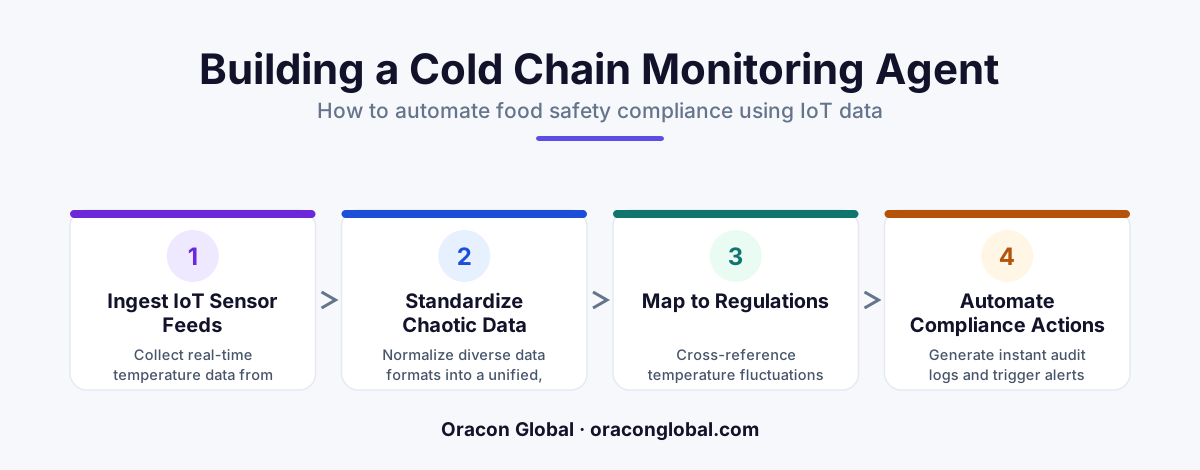
To automate this workflow safely, you need more than a simple API script. You need an event-driven architecture that ingests dirty data, standardizes it, and passes it to an intelligent agent capable of reasoning through compliance rules. The architecture consists of four primary layers.
1. The Multi-Vendor Ingestion and Normalization Layer
Because you cannot force every third-party carrier to use the same IoT hardware, your system must accept diverse telemetry formats. This layer utilizes lightweight schema translators that ingest raw MQTT, HTTP webhooks, or CSV file transfers from various vendors. It converts them into a standardized, unified JSON schema containing the timestamp, location, sensor ID, shipment ID, and temperature reading.
2. The Semantic Event Queue and Buffer
IoT sensors send high-frequency pings. Sending every single normal temperature reading directly to a Large Language Model (LLM) is cost-prohibitive and inefficient. Instead, a deterministic rules engine monitors the incoming stream. If the data remains within safe parameters, it is stored in a standard relational database. The moment a reading breaches a pre-set threshold, the system flags the event and pushes it to a semantic queue, triggering the AI compliance agent.
3. The Compliance Knowledge Retrieval Pipeline (RAG)
The AI agent needs access to your regulatory library. This includes local food safety laws, hazard analysis critical control point (HACCP) plans, and specific customer SLAs. Using Retrieval-Augmented Generation (RAG), the system stores these PDF documents as mathematical representations in a vector database. When a temperature breach is flagged, the agent queries this database to pull the exact compliance clause relevant to that specific food type and transit phase.
4. The Reasoner and Reconciliation Engine
Equipped with the specific temperature telemetry and the relevant regulatory guidelines, the AI agent evaluates the incident. It performs the analysis: "The raw chicken shipment experienced a temperature of 44°F for 12 minutes. Under HACCP Rule 4.2, poultry may exceed 40°F for up to 30 minutes during loading if pre-chilled to 34°F. Checking origin records: shipment was pre-chilled to 33°F. Conclusion: Compliant."
Step-by-Step Guide to Implementing the Agent
Building this agent requires a deliberate approach to ensure data integrity and system reliability. Here is how we design and deploy these systems for production environments.
- Map and Standardize the Data Inputs: Document every IoT vendor API your fleet and partners use. Establish a strict internal schema for what a "temperature event" looks like in your database.
- Construct the Vector Library: Upload your HACCP plans, food safety compliance records, and partner SLAs. Use a hybrid search approach combining vector search (for conceptual matching) and keyword search (for exact rule numbers) to ensure the AI agent retrieves the correct documents.
- Define the Agent's Tooling: Give the AI agent secure, read-only tools to fetch shipment metadata, and write access to a "pending review" ledger in your ERP. Never allow an autonomous agent to overwrite historical sensor logs.
- Establish a Human-in-the-Loop Safeguard: Design a simple interface for your compliance officers. When the agent reconciles an anomaly, it presents its drafted report, the linked compliance source material, and an "Approve/Reject" toggle. Once approved, the agent automatically updates the shipment's compliance certificate in your ERP.
Ensuring System Security and Regulatory Auditability
In highly regulated industries, you must be able to prove how every decision was made. If an auditor asks why a warm shipment was cleared for delivery, pointing to an "AI black box" is not an acceptable answer.
Every time the AI agent performs a reconciliation, it must generate a deterministic audit log. This log must freeze the exact telemetry data points analyzed, the specific compliance PDFs retrieved, and the prompts used by the LLM. By storing these references alongside the human approval signature, you create an immutable paper trail that easily satisfies both internal quality assurance teams and external safety inspectors.
Take Control of Your Supply Chain Compliance
Automating your cold chain monitoring is not about replacing human oversight; it is about freeing your operations team from endless spreadsheet audits so they can focus on resolving real logistical emergencies. A custom-built AI agent transforms raw, chaotic sensor telemetry into structured, regulatory-compliant decisions on autopilot.
At Oracon Global, our senior in-house team specializes in building custom AI agents, workflow automation, and custom web and mobile applications that bridge the gap between physical operations and digital intelligence. We deliver enterprise-grade software built on secure architectures where you retain 100% ownership of the code and intellectual property.
Ready to automate your logistics compliance? Contact Oracon Global today to discuss how we can build a tailored solution for your operations.
Frequently asked questions
Why can standard rules-based software not handle IoT cold chain reconciliation?
Rules-based software triggers alerts on every minor temperature spike, failing to distinguish between a broken sensor, an open trailer door during loading, or a genuine hazard. AI agents understand context and can read unstructured compliance manuals to determine if a deviation violated a specific regulatory threshold.
How do you prevent multi-vendor IoT data formatting issues?
We implement a lightweight translation layer at the ingestion point that standardizes diverse telemetry formats (such as JSON, CSV, or MQTT payloads) into a single unified schema before the AI agent processes the event.
Does the AI agent write compliance reports directly to the ERP without supervision?
The system is designed with a dual-state database. The AI agent drafts the reconciliation reports and flags compliance status, but a human operator approves the final submission inside the ERP to maintain absolute control.
Can this architecture scale to thousands of shipments simultaneously?
Yes. By decoupling telemetry ingestion from the LLM reasoning loop using an event-driven queue, the system processes thousands of sensor pings per second without bottlenecking the AI agent.
Read next
Beyond Chatbots: How to Build AI Agents That Actually Do Work for Your Business
Most businesses use AI to answer questions. Here is how to build custom AI agents that actually take action, connect to your internal tools, and handle complex workflows.
Beyond the Wrapper: How to Build Custom AI Agents for Business That Actually Work
Many businesses invest in basic AI wrappers only to find they lack the security and context needed for real work. Here is how to build custom AI agents that integrate deeply with your workflows and databases.
Enterprise AI Maintenance Costs: Budgeting for Year Two and Beyond
Building an AI system is only half the battle. Discover the practical, ongoing operational costs of enterprise AI, including token management, model drift, and continuous security audits.
Oracon Global builds production-grade AI agents, automation and apps — and you own the code and IP. Tell us what you want to automate.
Book a call →See our work