

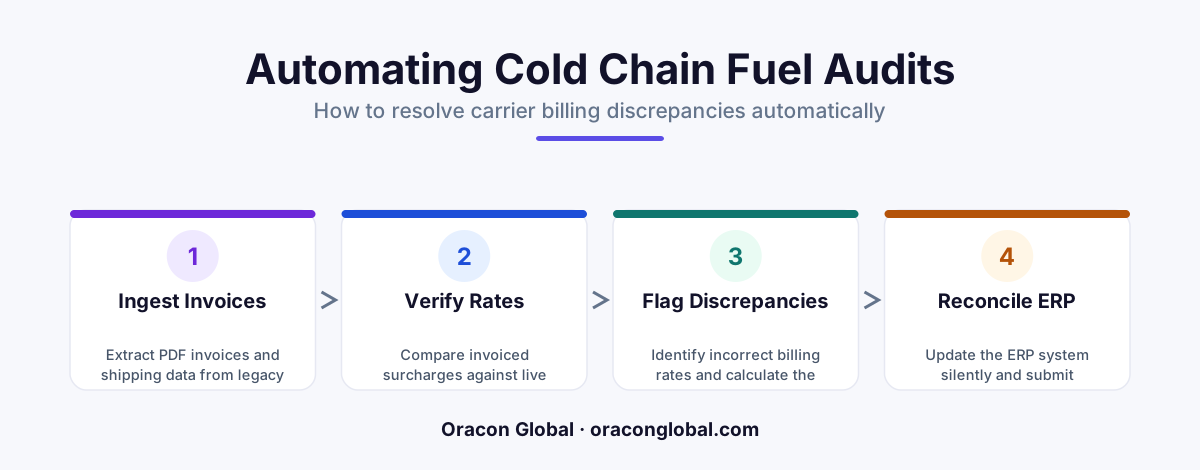
Manually reconciling multi-vendor fuel surcharges against legacy cold chain ERPs is slow and error-prone. By deploying a custom AI auditing agent with a semantic translation layer and automated state machine, businesses can catch, validate, and resolve billing discrepancies automatically without risky database overwrites.
Cold chain logistics operators run on razor-thin margins. When you are moving temperature-sensitive freight across international borders, every minute and every dollar counts. Yet, one of the biggest leaks in shipping profitability happens quietly at the loading dock of your back office: multi-vendor fuel surcharge discrepancies.
Carrier pricing contracts are incredibly complex. Fuel surcharges change weekly based on national or regional indices, varying equipment requirements (such as reefer units requiring separate fuel pools), and customized carrier agreements. Because legacy cold chain ERP systems are notoriously rigid, verifying these bills usually falls on human operators. Staff spend hours manually cross-referencing PDFs, spreadsheets, and EDI files against outdated contract tables. It is slow, expensive, and highly prone to error.
The solution is not to scrap your multi-million dollar legacy ERP. Instead, smart operators are building custom logistics AI agents that act as intelligent middleware, automatically identifying, validating, and reconciling these discrepancies in real time.
The Problem: Why Legacy ERPs Fail at Fuel Auditing
Legacy ERP systems were built for static, predictable data. They excel at managing simple inventory lines, but they struggle with the dynamic, unstructured variables of modern cold chain shipping. Reconciling fuel surcharges presents three unique challenges:
- Unstructured Invoicing: Different carriers submit billing in different formats. One sends an EDI 210, another attaches a messy PDF to an email, and a third drops a CSV into an SFTP folder.
- Dynamic Fuel Indices: Fuel surcharges are tied to fluctuating weekly indices (like the EIA Department of Energy index). Legacy systems cannot dynamically fetch, calculate, and apply these rates based on the exact shipping date and lane.
- Reefer-Specific Complexities: Cold chain shipments often involve dual-temperature runs. Carriers charge separately for propulsion fuel and cooling fuel, creating two distinct surcharge lines on a single invoice.
Without a smart automation layer, these discrepancies are either missed entirely—resulting in severe billing leakage—or they create massive admin bottlenecks that delay carrier payouts and strain vendor relationships.
Step 1: Building the Structured Extraction Pipeline
To audit a fuel surcharge, your system must first understand what the carrier is actually charging. This requires a robust automated freight auditing ingestion pipeline.
A custom AI agent handles this by deploying a specialized extraction model. When an invoice arrives via email or SFTP, the agent strips the file and converts it into a standardized JSON payload. Unlike rigid OCR tools of the past, an LLM-powered extraction pipeline understands context. It knows that "FSC," "Fuel Srg," and "Reefer Fuel" all map to the same conceptual bucket: fuel surcharges.
Once the invoice data is structured, the agent automatically queries the relevant regional fuel index API for the week the shipment occurred. This gives the agent the two baseline numbers it needs: what the carrier billed, and what the market rate dictates.
Designing the JSON Schema
The AI agent formats the extracted data into a clean schema before running any logic checks. This ensures your downstream database receives uniform, readable records. A typical schema mapping includes the carrier ID, shipment date, base freight charge, claimed fuel surcharge, and the fuel index baseline used for that specific route.
Step 2: Designing the Semantic Contract Matching Layer
With the extracted invoice and the live fuel index in hand, the AI agent must check the carrier's math against your active contract terms. This is where legacy ERP reconciliation gets difficult, as carrier contracts are often stored as scanned PDFs or unstructured text in document folders.
To solve this, we build a semantic contract matching layer. The AI agent uses hybrid retrieval (combining vector search with structured SQL metadata) to locate the exact contract for the carrier in question. It extracts the negotiated fuel surcharge matrix, which might look like: "If US On-Highway Diesel is between $3.50 and $3.54, surcharge is 12.5%."
The agent runs a fast, deterministic script to calculate the correct surcharge based on the contract terms. It then compares its calculated number against the carrier’s invoice. If the variance falls within an acceptable margin (for example, under $5.00), the invoice is auto-approved and pushed to the ERP ledger for payment.
Step 3: Creating the Exception Queue and State Machine
What happens when the invoice fails the audit? If a carrier charges a 16% fuel surcharge when the contract dictates 13%, you cannot let an autonomous AI agent blindly reject the bill or overwrite your ERP data. Doing so risks carrier disputes or database corruption.
Instead, the architecture must leverage a deterministic state machine. When a discrepancy is flagged, the agent executes a structured workflow:
- State Update: The shipment status in the ERP is updated to "Pending Audit."
- Discrepancy Logging: The agent logs the exact math behind the failure (e.g., "Expected $342.10, Billed $412.50. Variance of $70.40 due to incorrect fuel index week applied").
- Exception Routing: The discrepancy is pushed to a custom human-in-the-loop dashboard.
By routing exceptions to an active queue, your team does not have to hunt for errors. They simply open their dashboard, review the pre-calculated variance provided by the AI agent, and click "Approve" or "Dispute" with a single click. The agent handles the rest, including auto-drafting a professional dispute email to the carrier with the exact math attached.
Step 4: Safe Cold Chain ERP Integration
Writing data back to a legacy ERP can be risky. Many older systems do not have modern, real-time APIs. To prevent database locks or broken tables, the custom AI agent writes back using an asynchronous queue.
Instead of touching the production database directly, the agent sends its approved reconciliations to a staging buffer. A microservice then processes this queue sequentially, verifying that no human operator is currently editing the target record. This cold chain ERP integration ensures zero downtime, zero data loss, and complete transactional safety.
Owning Your AI Logistics Infrastructure
Off-the-shelf logistics software often forces you into restrictive monthly subscription models and, worse, locks up your business data. When you build a custom auditing agent, you own the underlying intellectual property (IP) entirely. You don’t pay per-transaction fees, and the software adapts to your specific carriers and contracts, not the other way around.
At Oracon Global, our senior in-house team specializes in building custom AI agents, workflow automation systems, and enterprise-grade integrations that bridge modern LLMs with legacy backend databases. We construct reliable, resilient software that helps global logistics operators protect their margins without disrupting their existing workflows.
Want to see how an AI agent can automate your back-office audits? Get in touch with Oracon Global today to discuss your workflow needs.
Frequently asked questions
Why do legacy cold chain ERPs struggle with fuel surcharge audits?
Legacy ERP systems rely on rigid, hardcoded rate tables that cannot easily parse fluctuating, multi-vendor fuel indexing formulas, PDF invoices, or unstructured accessorial charges.
How does the AI agent read unstructured carrier invoices?
The agent uses a structured extraction pipeline to convert PDFs, emails, and EDI documents into standardized JSON payloads before comparing them to ERP contract terms.
Can an AI agent write directly to our legacy ERP safely?
Yes, by using a state machine with a staging queue and human-in-the-loop validation gates, you prevent the AI from making unauthorized or destructive database writes.
Do we need to replace our existing ERP to use this AI agent?
No, the AI agent connects to your legacy system via a lightweight API bridge or database sync layer, meaning you keep your current software while gaining advanced automation.
Read next
Beyond Chatbots: How to Build AI Agents That Actually Do Work for Your Business
Most businesses use AI to answer questions. Here is how to build custom AI agents that actually take action, connect to your internal tools, and handle complex workflows.
Beyond the Wrapper: How to Build Custom AI Agents for Business That Actually Work
Many businesses invest in basic AI wrappers only to find they lack the security and context needed for real work. Here is how to build custom AI agents that integrate deeply with your workflows and databases.
Enterprise AI Maintenance Costs: Budgeting for Year Two and Beyond
Building an AI system is only half the battle. Discover the practical, ongoing operational costs of enterprise AI, including token management, model drift, and continuous security audits.
Oracon Global builds production-grade AI agents, automation and apps — and you own the code and IP. Tell us what you want to automate.
Book a call →See our work