

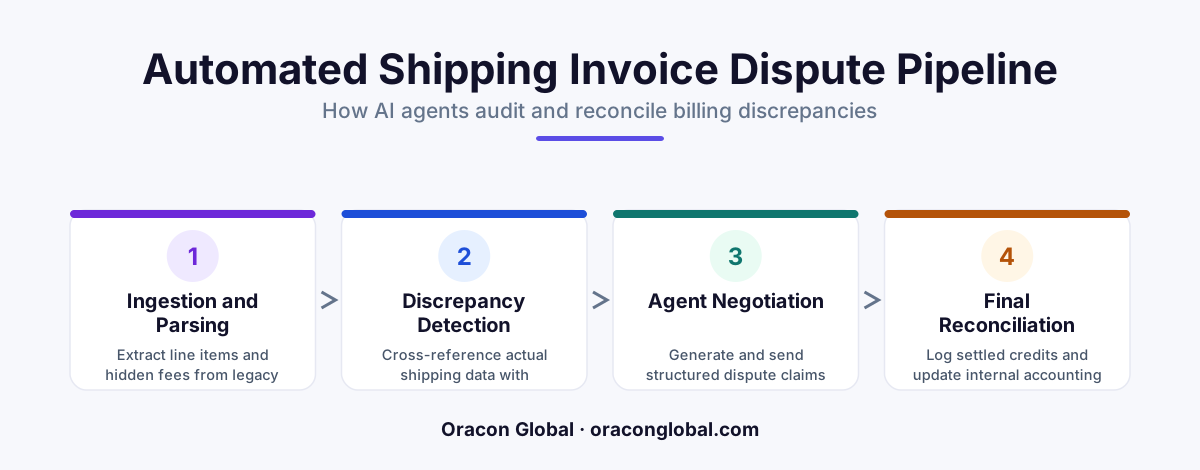
Manually auditing line items on legacy shipping invoices is a major operational bottleneck. By deploying a custom multi-agent AI pipeline, businesses can automatically extract complex invoice data, reconcile it against actual shipping contracts, and negotiate billing disputes directly with carrier systems.
For high-volume shippers, logistics providers, and distributors, auditing freight bills is a constant administrative headache. Shipping invoices from legacy carriers are rarely clean. They arrive as messy PDFs, nested XML files, or unstructured text, packed with complex line items, accessory fees, and fluctuating fuel surcharges that rarely match your original contract rates.
Most operations teams try to solve this with manual spot checks. AP clerks sit with two screens open, comparing PDF invoices against historical rate sheets or Transportation Management System (TMS) data. When they find an error, they have to manually email the carrier to initiate a dispute. Because of the sheer volume, discrepancies under a certain dollar threshold are simply ignored, leading to quiet margin erosion that costs businesses thousands of dollars every month.
At Oracon Global, we build custom AI systems that solve these exact operational leaks. Here is a practical look at how to build a custom multi-agent negotiation pipeline that automatically ingests legacy shipping invoices, reconciles them with your database, and handles the dispute process directly with your vendors.
The Core Challenge: Why Standard RAG and Single LLMs Fail
Many teams assume they can solve invoice auditing by throwing a standard Retrieval-Augmented Generation (RAG) system or a single LLM at the problem. They feed the PDF to a popular model and ask, "Are there any errors here?"
This approach fails in production for three reasons:
- Mathematical Inaccuracy: Large Language Models are language calculators, not financial ledgers. They struggle to consistently calculate compounding fuel surcharges or verify multi-tier tax rates across hundreds of line items.
- Lack of State Management: A single prompt-and-response model cannot manage a long-running dispute process. If a carrier rejects an initial claim, a single LLM has no memory of the historical negotiation context.
- Formatting Fragility: Legacy invoices do not follow a unified standard. Carrier A might call a port fee a "Terminal Handling Charge," while Carrier B calls it an "Origin Service Fee." A generic AI model lacks the domain-specific mapping required to align these with your ERP.
To automate this safely, you need a deterministic multi-agent pipeline. Instead of one AI trying to do everything, you deploy a team of specialized digital employees, each responsible for a single, sandboxed step of the reconciliation lifecycle.
Architecting the Multi-Agent Pipeline
A production-ready multi-agent pipeline breaks the reconciliation process into clear, logical phases. By isolating responsibilities, you can implement hardcoded validation rules between each agent's execution, ensuring absolute financial accuracy.
1. The Extraction Agent (The Data Parser)
The first agent's sole job is to turn messy, unstructured invoices into structured JSON data. Using specialized vision models and layout-aware parsing libraries, this agent extracts every line item, charge code, tracking number, and tax field.
Crucially, this agent does not make business decisions. It simply acts as a highly accurate digitizer, converting visual and textual layouts into clean, predictable database entries. If an invoice scan is too blurry to read with 99% confidence, this agent flags the document for human review rather than guessing.
2. The Reconciliation Agent (The Auditor)
Once the invoice data is structured, the Reconciliation Agent takes over. This agent is connected directly to your internal ERP, TMS, or carrier contract database. It retrieves the original agreed-upon rate sheet and the physical shipment logs for the tracking numbers listed on the invoice.
Using deterministic code blocks rather than creative AI reasoning, this agent performs a side-by-side mathematical audit:
- It cross-references the billed weight against the scale weights recorded in your warehouse.
- It verifies that the fuel surcharges align with the exact index rates specified in the carrier's contract for that date.
- It highlights any unauthorized accessorial charges, such as residential delivery fees on business-to-business shipments.
3. The Negotiation Agent (The Communicator)
When a billing discrepancy is verified, the Negotiation Agent steps in. Its job is to draft the dispute documentation. Because it has access to the output of the Reconciliation Agent, it knows exactly why a line item is wrong.
It doesn't just write a generic email. It drafts a precise, professional dispute letter citing the specific contract clause, the original shipment ID, the scale logs, and the calculated overcharge. It prepares this payload in the exact format required by the carrier—whether that is a formatted email, an API payload, or a structured CSV designed for a legacy upload portal.
Implementing a Hardcoded Human-in-the-Loop Gate
Autonomous AI agents are incredibly powerful, but in financial operations, they must never run completely unsupervised. Letting an AI automatically trigger legal disputes or deduct payments from carrier accounts without human oversight is a major compliance risk.
To mitigate this, the pipeline should write all findings to a custom operational queue. Instead of sending disputes automatically, the Negotiation Agent presents its case to an AP manager on a clean dashboard. The manager sees:
- The original carrier invoice with the disputed line items highlighted in red.
- The exact contract terms pulled from your database.
- The pre-drafted dispute message created by the AI.
With a single click, the human operator can approve the dispute, edit the wording, or dismiss the flag if there was a known operational exception. Once approved, the system automatically dispatches the dispute to the carrier.
Connecting the Pipeline to Legacy Systems
One of the largest hurdles in logistics automation is dealing with legacy software. Many major freight carriers still run on legacy mainframes that do not offer modern REST APIs. They rely on Electronic Data Interchange (EDI) standards like EDI 210, old XML formats, or simple email exchanges.
To bridge this gap, your custom pipeline must use a stateful middleware layer. When the Negotiation Agent approves a dispute, the middleware translates the agent's modern JSON outputs into the specific legacy formats your carriers require. This allows you to deploy cutting-edge AI automation without requiring your vendors to upgrade their technology stack.
Own Your Logistics Automation IP
Building a custom multi-agent pipeline is a strategic investment that directly protects your operating margins. Off-the-shelf SaaS tools often charge per-transaction fees or restrict how you can integrate with your proprietary ERP systems. More importantly, when you use third-party platforms, you do not own the underlying technology.
At Oracon Global, our senior in-house development team builds custom AI agents, workflow automation systems, and enterprise integrations tailored to your exact business rules. We deliver production-grade code, and our clients retain 100% ownership of their custom software and intellectual property.
If you are ready to stop manual invoice audits and build a resilient billing reconciliation engine, contact the Oracon Global team today to discuss your project.
Frequently asked questions
Why do legacy shipping invoices require a multi-agent system instead of a single LLM?
A single LLM lacks the deterministic boundaries needed for financial reconciliation. A multi-agent pipeline splits the workload into specialized tasks—extraction, verification, and negotiation—ensuring high mathematical accuracy and auditability.
How do AI agents communicate with legacy carrier systems that lack APIs?
The pipeline uses a stateful middleware bridge that translates the AI agents' structured JSON outputs into legacy XML, flat files, or automated emails, allowing seamless communication with old carrier portals.
Will the AI agents automatically pay or dispute invoices without human oversight?
No. The system is designed with a strict human-in-the-loop approval gate. The agents prepare the reconciliation report and draft the dispute, but a human operator signs off before any action is finalized.
How does this system prevent margin erosion in shipping operations?
It identifies hidden fuel surcharges, incorrect accessorial fees, and billing errors that usually slip past manual spot checks, recovering lost capital on every carrier run.
Read next
Beyond Chatbots: How to Build AI Agents That Actually Do Work for Your Business
Most businesses use AI to answer questions. Here is how to build custom AI agents that actually take action, connect to your internal tools, and handle complex workflows.
Beyond the Wrapper: How to Build Custom AI Agents for Business That Actually Work
Many businesses invest in basic AI wrappers only to find they lack the security and context needed for real work. Here is how to build custom AI agents that integrate deeply with your workflows and databases.
Enterprise AI Maintenance Costs: Budgeting for Year Two and Beyond
Building an AI system is only half the battle. Discover the practical, ongoing operational costs of enterprise AI, including token management, model drift, and continuous security audits.
Oracon Global builds production-grade AI agents, automation and apps — and you own the code and IP. Tell us what you want to automate.
Book a call →See our work