

Manual store audits miss thousands of shelf pricing errors, leading to margin leakage and compliance fines. By feeding live shelf camera images into an AI vision pipeline and cross-referencing product tags with backend ERP price databases, multi-store retailers can flag and resolve price mismatches automatically in real time.
In multi-store retail operations, maintaining price consistency across physical shelves and central checkout systems is a constant struggle. Store teams regularly update shelf tags for weekly promotions, seasonal markdowns, and vendor price updates. Yet, human error ensures that physical shelf tags frequently lag behind the ground-truth prices stored in your backend enterprise resource planning system.
When a shelf tag displays a lower price than the point-of-sale terminal registers, customers feel cheated at checkout. When the shelf tag displays a higher price, sales drop while stock sits untouched. Performing manual retail price audits across dozens or hundreds of store locations is slow, labor-intensive, and prone to oversight. To fix this, modern retail operators are connecting live shelf camera feeds directly to backend database logic to catch discrepancies before they hurt the bottom line.
The Structural Problem with Manual Shelf Audits
Most retail chains attempt to solve pricing drift by sending associates down store aisles with handheld barcode scanners. Staff scan a physical item, check the handheld screen against the shelf tag, and manually flag discrepancies. While logical on paper, this approach suffers from severe coverage limits.
A typical high-volume retail store carries tens of thousands of active SKUs. In practice, store associates audit only a tiny fraction of those tags during a standard work shift. By the time a full store audit completes, new price updates have already been pushed from corporate headquarters, rendering the audit obsolete.
Relying on manual labor for verification creates several operational friction points:
- Low Audit Coverage: Staff can only physically verify a few hundred tags per week per store, leaving thousands of items unchecked for months.
- Delayed Exception Resolution: Identified tag errors sit on physical paper notes or detached messaging apps before store managers find time to print corrected labels.
- Compliance Hazards: State and local regulations enforce strict accuracy thresholds for shelf pricing, issuing steep fines for persistent tag discrepancies at checkout.
- Margin Leakage: Uncorrected lower shelf tags lead to compliance markdowns at the register, directly eroding store profitability.
Architecting an Automated Camera-to-ERP Verification System
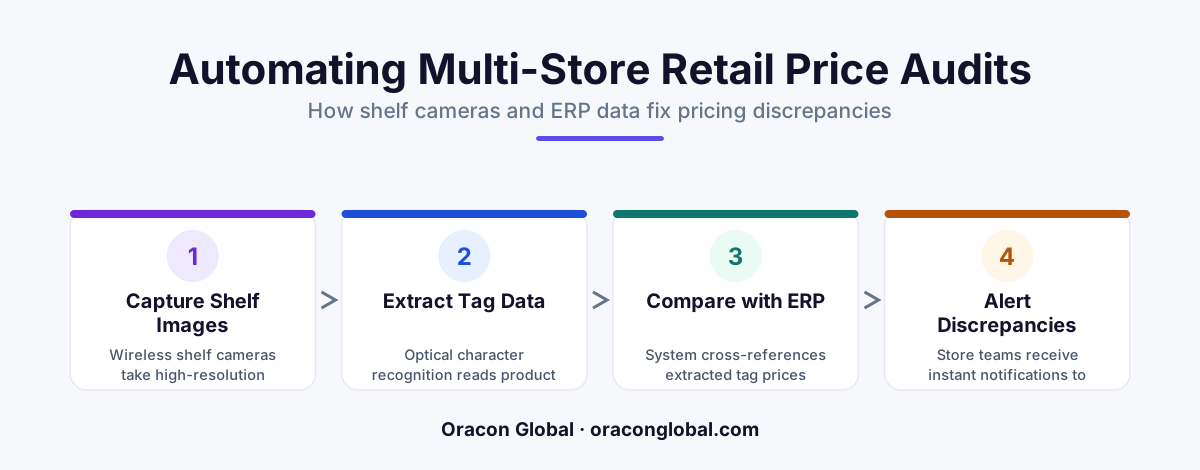
Automating multi-store price verification requires bridging the physical environment of retail aisles with your digital database backend. Instead of relying on periodic human scans, fixed shelf cameras or automated floor rovers take structured imagery of shelf faces continuously throughout the day.
This image data moves through a specialized pipeline designed to compare raw physical pixels against structured ERP records.
1. Image Capture and Region Extraction
High-resolution optical sensors capture images of product shelves under standard store lighting. An edge-processing step segments the raw visual feed, isolating the physical shelf tags from surrounding packaging, shelf rails, and promotional signage.
2. Optical Character and SKU Parsing
Once isolated, an advanced computer vision model processes the shelf tag. It extracts key data points including the visible retail price, unit price, promotion indicators, and identifying markers like the printed barcode, stock keeping unit, or universal product code.
3. Real-Time ERP Inventory Matching
The extracted SKU and physical price are sent to an automated API layer that queries your central ERP or point-of-sale pricing engine. The payload compares the physical price captured by the camera against the active database price for that specific store location.
Handling Edge Cases and Database Safety
Building a reliable system for shelf camera price matching requires planning for real-world environmental noise. Store shelves experience variable lighting, torn paper tags, obscured barcodes, and misplaced merchandise. Passing raw, unverified camera inputs directly into enterprise software risk flooding your system with false alarms.
To keep the workflow accurate and dependable, automated price auditing pipelines rely on strict operational rules:
- Confidence Thresholding: If an optical model cannot parse a shelf tag with high visual confidence—due to glare, physical damage, or low resolution—it flags the image for human review rather than guessing the price.
- Store-Specific Price Matrices: Regional pricing variations mean Store A and Store B may carry different active retail prices for the exact same item. The audit layer evaluates shelf images strictly against the local pricing store ID in the ERP database.
- Time-Window Buffering: When corporate pushes a price update, store staff require a reasonable window to physical update shelf tags. The system suppresses false mismatch alerts for tags scheduled for replacement within the current work shift.
Turning Audit Data into Actionable Store Tasks
Capturing pricing errors is only helpful if store associates can correct them quickly. A mature audit system converts database mismatches directly into targeted workflows for store staff.
When the audit layer identifies a verified price gap, it generates an automatic exception ticket. Rather than sending staff on open-ended store searches, the system routes a precise task to an associate's mobile terminal containing the aisle number, shelf section, target SKU, and a print job for the updated tag.
This closed-loop system ensures that price discrepancies are resolved within hours of detection rather than sitting unaddressed for weeks.
Building Custom Price Audit Infrastructure with Oracon Global
Off-the-shelf retail software often falls short when integrating modern computer vision pipelines with complex, custom ERP installations or multi-vendor legacy backends. At Oracon Global, our senior in-house engineering team designs and builds custom software architectures, AI agents, and custom enterprise tools tailored to your exact operational workflows.
Whether you need to bridge modern camera streams with custom backend databases, automate complex exception queues, or launch robust web and mobile applications for store teams, we deliver tailored software where you retain 100% ownership of the code and intellectual property. Reach out to the senior team at Oracon Global today to discuss your enterprise automation goals.
Frequently asked questions
Why do traditional manual price audits fail in multi-store retail?
Manual audits rely on store staff checking physical tags with handheld scanners, covering only a tiny fraction of total SKUs per week while consuming expensive human labor.
How does a camera-to-ERP price audit work?
Fixed shelf cameras or mobile devices capture shelf tag images, an optical character recognition model extracts product pricing, and an automated pipeline compares those values against the central ERP database.
Do retailers need to replace existing shelf tags to use automated auditing?
No, computer vision models can read standard paper tags, promotional stickers, and digital shelf edge displays without requiring expensive hardware overhauls.
What happens when an automated price audit finds a mismatch?
The system logs the discrepancy, generates a high-priority exception task for store associates to update the tag, and updates audit records across all store locations.
Read next
Beyond Chatbots: How to Build AI Agents That Actually Do Work for Your Business
Most businesses use AI to answer questions. Here is how to build custom AI agents that actually take action, connect to your internal tools, and handle complex workflows.
Beyond the Wrapper: How to Build Custom AI Agents for Business That Actually Work
Many businesses invest in basic AI wrappers only to find they lack the security and context needed for real work. Here is how to build custom AI agents that integrate deeply with your workflows and databases.
Enterprise AI Maintenance Costs: Budgeting for Year Two and Beyond
Building an AI system is only half the battle. Discover the practical, ongoing operational costs of enterprise AI, including token management, model drift, and continuous security audits.
Oracon Global builds production-grade AI agents, automation and apps — and you own the code and IP. Tell us what you want to automate.
Book a call →See our work