

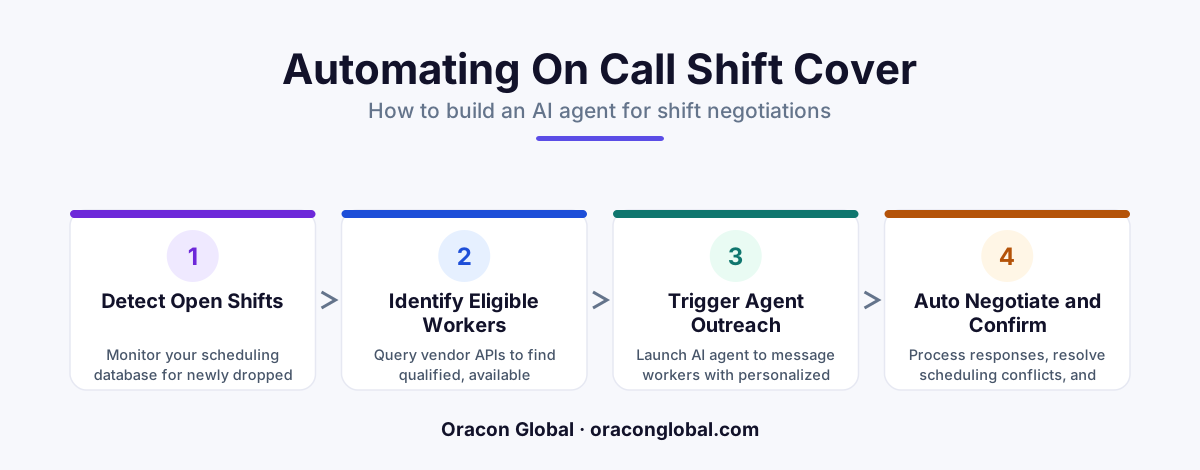
When on-call workers back out of shifts, manual outreach wastes hours. By building a custom AI negotiation agent integrated with your ERP and messaging channels, you can automate outreach, match qualified contractors, and resolve scheduling gaps autonomously while keeping human operators in control.
For operations managers overseeing a contingent workforce, on-call scheduling is a constant game of whack-a-mole. A last-minute cancellation on a Friday night triggers a stressful cycle of phone calls, group texts, and manual spreadsheet updates. By the time a replacement is secured, hours have been lost, and you have likely paid a premium out of sheer desperation.
Traditional scheduling software notifies workers, but it cannot negotiate. It cannot handle the nuance of a worker replying, "I can take the Saturday night shift, but only if I get a 10% premium because it is short notice." To automate this process without losing control of your margins, you need a custom AI shift negotiation agent built specifically for your contingent workforce shift coverage needs.
At Oracon Global, we design and build full-stack AI applications that bridge the gap between legacy operations and autonomous workflows. Here is a practical blueprint showing how to build a custom multi-vendor agentic system to handle on-call scheduling automation for your business.
The Operational Cost of Manual Shift Scrambles
When a scheduled contractor drops a shift, the administrative cost is high. Operations coordinators must log in to the ERP, find qualified workers, and reach out individually via email or messaging apps. This process suffers from three primary issues:
- Extreme Latency: SMS blasts are often ignored, and phone tags can stretch for hours while a critical station remains unstaffed.
- Margin Erosion: Under pressure, coordinators often offer maximum hazard pay immediately rather than negotiating a fair, tiered rate.
- Compliance Risks: In the rush to fill a slot, human operators might overlook expired certifications, union constraints, or weekly hour limits.
An automated shift replacement agent solves these bottlenecks by operating 24/7. It initiates polite, bilateral text conversations, evaluates worker counter-offers against your operational rules, and updates your system of record in real time.
How the AI Shift Cover Agent Architecture Works
A reliable shift cover agent does not run on prompts alone. It requires a resilient, multi-tiered architecture that combines generative AI with strict, hardcoded business logic. The system consists of four key components:
1. The Event Listener (ERP Trigger)
The workflow begins when your shift management app or legacy ERP registers a dropped shift. A webhook triggers the AI agent, passing essential metadata: the shift time, location, required certifications, and the baseline pay rate.
2. The Qualification Matcher
Before contacting anyone, the agent queries your database of active contractors. It filters the pool based on proximity, active compliance certificates, and current weekly hours to prevent overtime violations. Only qualified, eligible personnel are added to the outreach queue.
3. The Deterministic State Machine
This is the safety engine of your agent. The Large Language Model (LLM) handles natural language communication, but the state machine dictates the business rules. For instance, the state machine enforces your maximum pay ceiling. If a worker requests $45 per hour for a shift capped at $40, the state machine overrides the LLM, forcing it to politely counter with your maximum allowed rate.
4. The Multi-Channel Communication Layer
The agent communicates with workers through their preferred channels—whether that is SMS, WhatsApp, Slack, or a custom mobile application. It maintains a clean, human-like conversation thread for each worker, ensuring nobody feels spammed.
A Step-by-Step Guide to the Negotiation Workflow
To understand how this functions in production, let us trace a typical negotiation path when a shift opens up unexpectedly:
- Step 1: Intelligent Initiation. The agent identifies the top five qualified matches. Instead of a generic blast, it sends a personalized message: "Hi Marcus, we have an open field technician shift this Saturday from 2 PM to 10 PM at the West Facility. It matches your profile. Are you available?"
- Step 2: Interactive Negotiation. Marcus replies: "I can do it, but I need an extra $5 an hour to cover travel." The agent checks the state machine. The requested rate is within the approved safety boundary. The agent updates its state and responds: "I can approve that rate for this shift. Would you like me to lock this in for you?"
- Step 3: Safe Escalation. If Marcus had asked for an extra $20 an hour (exceeding the limit), the agent would counter: "I can't go that high, but I can offer an extra $8 an hour for this specific slot. Does that work?" If he declines, the agent moves smoothly to the next candidate in the queue.
- Step 4: Atomic Database Write. Once a worker agrees, the agent reserves the slot, writes the updated contract rate to your ERP database, and sends a calendar invite to Marcus. It then silently closes the pending outreach threads with other candidates, notifying them that the slot has been filled.
Ensuring Security and Preventing API Rate Locks
Building a scheduling agent that interacts with external human workers requires rigorous software engineering. Since your contingent workforce may respond at any time of day, your system must be designed to prevent database collisions.
At Oracon Global, we build these systems using a read-only database replica for fast worker matching, paired with a resilient event queue for safe writes. This architecture ensures that if two workers accept the same shift simultaneously, the system processes the transactions sequentially, avoiding double-bookings. We also build a human-in-the-loop exception dashboard. If a shift remains unfilled after two hours, or if negotiations stall, the agent escalates the issue to a human manager with a single click, providing a full summary of the conversations.
Own Your AI Operations Infrastructure
Many businesses rely on third-party SaaS scheduling platforms that charge high monthly seat licenses and lock away your data. When you build a custom AI scheduling agent with Oracon, your company owns 100% of the code and intellectual property.
A custom solution integrates natively with your existing databases, respects your exact business rules, and scales without adding platform subscription fees. Our senior in-house engineering team works alongside your operators to build robust, production-grade AI systems tailored to your unique workflows.
Ready to automate your scheduling overhead and stabilize your contingent workforce operations? Contact the team at Oracon Global today to discuss how we can build your custom shift coverage agent.
Frequently asked questions
Why can't we just use standard SMS blast software for shift coverage?
SMS blasts are annoying, lack context, and do not negotiate. An AI agent can have bilateral, personalized conversations with workers, verifying qualifications, adjusting rates within set boundaries, and updating systems instantly.
How do we prevent the AI agent from promising rates that are too high?
We build hardcoded, deterministic rate-cap boundaries directly into the database state machine, preventing the LLM from ever suggesting or agreeing to a payout above your pre-approved threshold.
Do we need to replace our existing scheduling software or ERP?
No. A custom AI agent acts as an orchestrator that sits on top of your existing software, reading and writing data via secure APIs without requiring a system rewrite.
How does the AI agent confirm that a worker is qualified for a specific shift?
The agent queries your live workforce database or ERP schema to check active certifications, compliance records, and historical performance before initiating any outreach.
Read next
Beyond Chatbots: How to Build AI Agents That Actually Do Work for Your Business
Most businesses use AI to answer questions. Here is how to build custom AI agents that actually take action, connect to your internal tools, and handle complex workflows.
Beyond the Wrapper: How to Build Custom AI Agents for Business That Actually Work
Many businesses invest in basic AI wrappers only to find they lack the security and context needed for real work. Here is how to build custom AI agents that integrate deeply with your workflows and databases.
Enterprise AI Maintenance Costs: Budgeting for Year Two and Beyond
Building an AI system is only half the battle. Discover the practical, ongoing operational costs of enterprise AI, including token management, model drift, and continuous security audits.
Oracon Global builds production-grade AI agents, automation and apps — and you own the code and IP. Tell us what you want to automate.
Book a call →See our work