

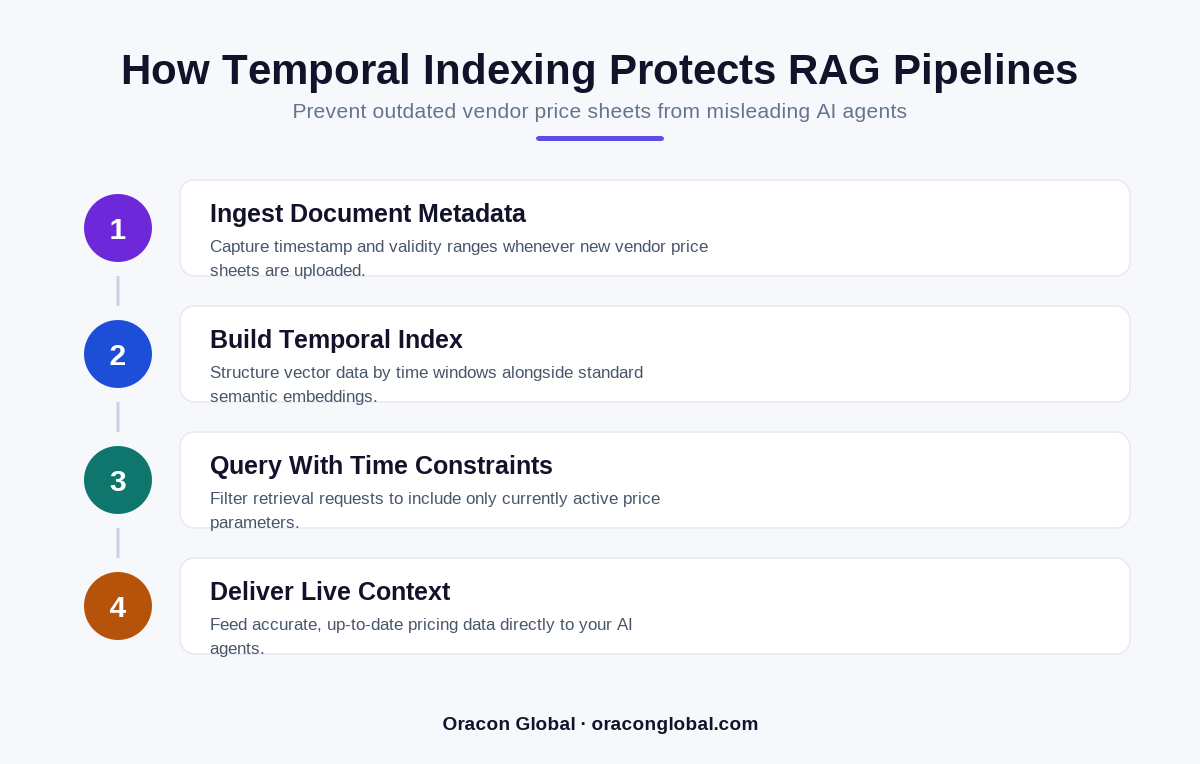
Standard vector search matches text by semantic similarity, ignoring when a document was created or superseded. By implementing a temporal index within your custom RAG pipeline, you force AI agents to evaluate date bounds and version metadata before retrieving vendor price sheets. This prevents your software from quoting legacy prices or executing purchases based on expired catalog data.
When businesses deploy Retrieval-Augmented Generation (RAG) to power internal operations, the primary goal is simple: give an AI agent access to accurate, proprietary company data. In procurement, logistics, and wholesale operations, this usually means feeding the system vendor catalogs, contract terms, and pricing matrices. However, standard vector search has a hidden flaw that quietly wrecks operational accuracy. It does not understand time.
If your team uploads a new vendor pricing PDF every quarter, a naive vector database will treat a price list from two years ago as conceptually identical to the one updated yesterday. Without a temporal index in RAG workflows, your AI models will regularly pull outdated vendor price sheets, leading to incorrect quotes, broken margin calculations, and purchase orders sent at legacy rates.
To build a production-grade custom RAG pipeline that safely automates business decisions, you must engineer time awareness directly into your retrieval layer. Here is why standard vector search fails at handling expiring operational data, and how a temporal index solves the problem permanently.
The Vector Similarity Trap in Pricing Data
Most AI search engines rely on vector embeddings. When a document like a vendor price sheet is ingested, an embedding model converts the text into mathematical coordinates based on its semantic meaning. When an AI agent asks, "What is the unit cost for SKU-8842 from Supplier A?", the database searches for text chunks with the closest mathematical distance to that query.
The problem is that an expired price sheet from 2022 and a valid price sheet from 2026 use virtually identical language. They list the exact same product codes, descriptive terms, and legal disclaimers. Because their semantic structure is almost identical, the vector database often scores the older file higher if the text formatting happens to align slightly better with the search query.
Standard vector search evaluates context, not validity. It cannot tell that a document marked "Effective Jan 2023 - Dec 2023" should be ignored when working on an active 2026 purchase order. Relying on simple prompt instructions like "only use the latest file" fails consistently because the context window is already polluted with the wrong retrieved chunks before the LLM even begins reasoning.
What Is a Temporal Index in a Custom RAG Pipeline?
A temporal index is an architectural layer inside your retrieval pipeline that combines standard vector embeddings with structured, time-aware metadata filters and deterministic dynamic sorting rules. Instead of relying solely on raw semantic score matching, a temporal index forces every query through a two-dimensional verification process: conceptual relevance and time validity.
By enforcing RAG temporal metadata filtering at the database layer, you establish hard boundaries around when a piece of data is allowed to inform an AI agent's actions.
Key Components of Time-Aware Vector Retrieval
- Strict Validity Windows: Document ingestion pipelines capture explicit metadata, including
effective_start_date,effective_end_date, andsuperseded_by_doc_id. - Pre-Retrieval Metadata Filters: Queries execution engines automatically inject time constraints based on the transaction date before calculating vector distances.
- Decaying Relevance Functions: For semi-structured knowledge, mathematical decay scoring gradually lowers the retrieval rank of older documents as newer revisions are indexed.
- Hard Archival Status Flags: Legacy documents are marked as inactive in relational metadata tables, keeping them available for historical audits while blocking them from live operational queues.
How to Structure Temporal Metadata for Price Sheets
Fixing vector decay requires fixing how documents enter your data pipeline. When an operational document like a supplier catalog or price grid is ingested, your system must parse and store explicit metadata alongside the raw text vectors.
A robust metadata payload for a temporal vendor index typically includes the following structured fields:
{

  "vendor_id": "V-99402",

  "catalog_type": "tier_1_pricing",

  "effective_date": "2026-01-01",

  "expiration_date": "2026-12-31",

  "is_active": true,

  "version": "4.2"

}
When an autonomous workflow triggers a query to block outdated vendor price sheets, the backend system does not simply search for matching product terms. It constructs a hybrid database query. First, it applies a hard SQL or metadata filter excluding any record where expiration_date is earlier than the current execution timestamp or where is_active is set to false. Only the remaining valid chunks are passed to the vector similarity engine.
Benefits of Adding Temporal Indexing to Your AI Stack
Implementing proper AI vector database indexing with temporal awareness delivers immediate operational stability across your enterprise workflows:
1. Eliminates Financial Margin Erosion: Prevents automated systems from creating quotes or issuing purchase orders based on obsolete, lower supplier pricing figures.
2. Enables Clean Auditing Without Deleting History: You do not have to purge historic price lists from your database to keep your AI accurate. Old documents remain intact for legal and financial compliance, but remain invisible to live operational agents.
3. Reduces LLM Token Consumption: Filtering out superseded document revisions before vector ranking prevents redundant text chunks from filling up your model's context window, lowering API overhead and speeding up response latency.
4. Supports Mid-Contract Vendor Adjustments: When suppliers issue mid-year price adjustments, setting precise start and end timestamps ensures your agents seamlessly transition to new rates on the exact day they take effect.
Building Production-Ready RAG Architecture with Oracon Global
RAG pipelines used in real-world business operations require far more discipline than simple document search scripts. If your software makes purchasing decisions, handles inventory routing, or generates client-facing quotes, handing unstructured vectors directly to an LLM without deterministic controls introduces massive operational risk.
At Oracon Global, our senior in-house engineering team designs and builds custom AI agents, robust RAG architectures, and enterprise applications engineered for strict operational accuracy. We help companies modernize legacy data flows, build custom software products, and implement zero-leakage data pipelines where every output is backed by deterministic rules and clean code. Best of all, our clients retain 100% ownership of all custom code and intellectual property we build.
Ready to upgrade your enterprise RAG stack or build custom AI agents that perform reliably in production? Explore our live AI demos on our website or contact the senior team at Oracon Global today to discuss your project.
Frequently asked questions
What is a temporal index in a custom RAG pipeline?
A temporal index adds time-aware metadata filter rules and time-decay functions to a vector database, allowing the system to query documents based on both semantic relevance and date validity.
Why do standard vector databases fetch outdated vendor price sheets?
Vector embeddings measure conceptual similarity, not chronological truth. An expired price sheet often looks identical in vector space to a current one, leading the vector database to return the wrong version.
How does temporal indexing differ from just deleting old files?
Hard deleting files destroys historical data needed for financial audits or trend analysis. A temporal index filters out expired documents during runtime retrieval while keeping historical records intact in your primary storage.
Can we add a temporal index to our existing AI architecture?
Yes. Custom RAG pipelines built on platforms like PostgreSQL with pgvector, Qdrant, or Pinecone can be upgraded with temporal metadata schemas and hybrid retrieval logic without rebuilding your entire data stack.
Read next
Beyond Chatbots: How to Build AI Agents That Actually Do Work for Your Business
Most businesses use AI to answer questions. Here is how to build custom AI agents that actually take action, connect to your internal tools, and handle complex workflows.
Beyond the Wrapper: How to Build Custom AI Agents for Business That Actually Work
Many businesses invest in basic AI wrappers only to find they lack the security and context needed for real work. Here is how to build custom AI agents that integrate deeply with your workflows and databases.
Enterprise AI Maintenance Costs: Budgeting for Year Two and Beyond
Building an AI system is only half the battle. Discover the practical, ongoing operational costs of enterprise AI, including token management, model drift, and continuous security audits.
Oracon Global builds production-grade AI agents, automation and apps — and you own the code and IP. Tell us what you want to automate.
Book a call →See our work