

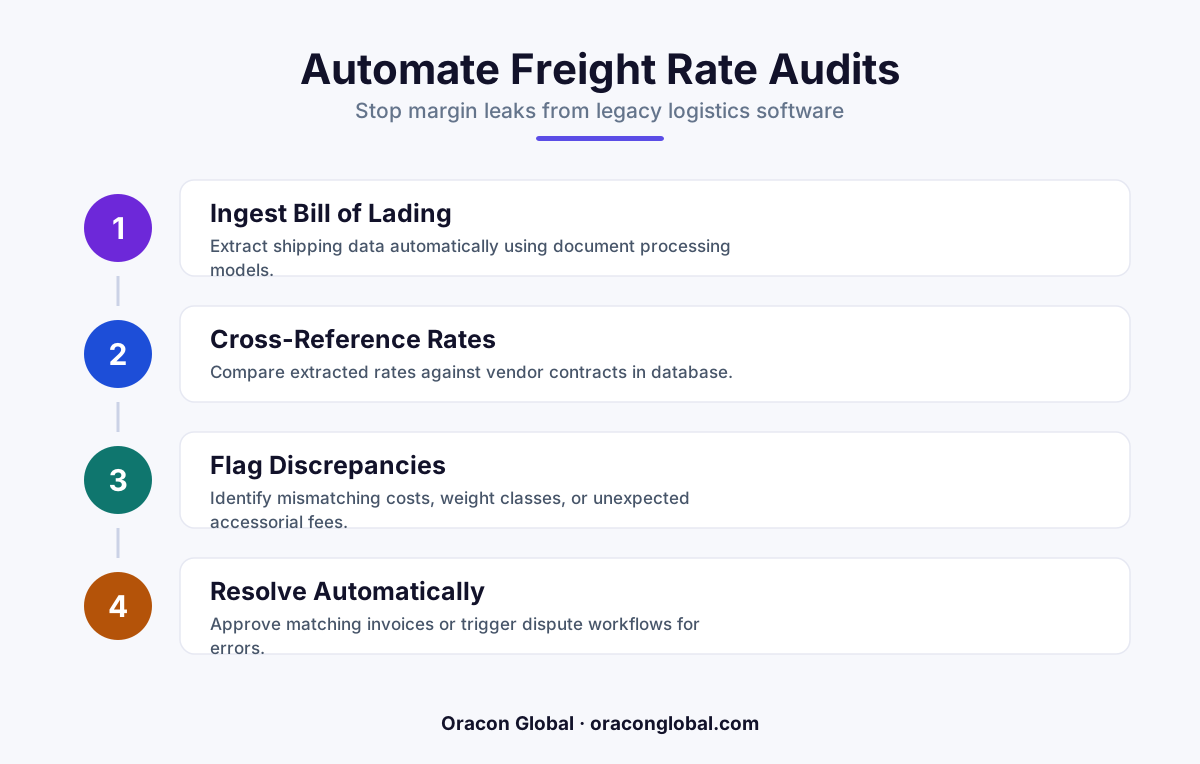
A custom Bill of Lading audit agent acts as an automated mediator between legacy logistics software and dynamic carrier documents. By structuring unstructured paperwork, cross-referencing contracts, and executing API-driven corrections, it stops freight rate discrepancies without requiring system-wide overhauls.
In logistics and supply chain management, thin margins are frequently eroded by tiny, quiet errors. Among the most common culprits are freight rate discrepancies between your agreed carrier contracts and the final Bills of Lading (BoL). When you operate across dozens of shipping vendors, manually auditing every single piece of paperwork against your legacy logistics software is slow, expensive, and prone to human oversight.
Traditional optical character recognition (OCR) tools often fail because they rely on rigid, fragile templates. The moment a shipping vendor updates their invoice layout or introduces a new accessorial fee, the system breaks. To solve this permanently, forward-thinking operators are deploying a dedicated Bill of Lading audit agent. This autonomous digital employee sits between your legacy databases and incoming paperwork, automatically catching and correcting discrepancies before they hit your ledger.
The Cost of Manual Freight Audits
Most enterprise logistics operations rely on legacy logistics software that was built long before modern API ecosystems. These core databases are excellent at tracking inventory and scheduling runs, but they struggle to ingest unstructured data from external vendors. This leaves your operations team to deal with several daily challenges:
- Unnoticed Margin Leaks: Accessorial fees, fuel surcharges, and incorrect lane rates slip through because auditing thousands of line items manually is virtually impossible.
- High Labor Costs: Skilled operators spend hours cross-referencing PDFs against outdated terminal screens instead of managing exceptions.
- Slow Vendor Settlements: Discrepancies delay payments, strain carrier relationships, and cause friction in your billing cycles.
To eliminate these issues, your organization needs an automated freight audit workflow that reads documents like a human but executes reconciliations at machine speed.
How the Bill of Lading Audit Agent Architecture Works
Building an autonomous agent for legacy logistics software requires a clear separation between document ingestion, business logic validation, and database writeback operations. Rather than trying to rebuild your core enterprise software, the agent acts as an intelligent, secure middleware layer.
Step 1: Unstructured Document Ingestion
First, the agent monitors incoming channels, such as a dedicated operations email inbox, an SFTP server, or a cloud storage folder. When a new Bill of Lading arrives as a PDF, the agent uses a document parsing pipeline to convert the visual layout and text tables into structured JSON. This pipeline uses semantic understanding to recognize critical data points like carrier name, origin and destination ZIP codes, weight, and individual line-item charges, regardless of the document format.
Step 2: Cross-Referencing the Source of Truth
Once structured, the agent queries your legacy contract database to pull the active rate sheet for that specific carrier and lane. It checks several variables simultaneously:
- Base freight rates per mile or hundredweight (CWT)
- Agreed fuel surcharge indexes
- Pre-negotiated accessorial fees (such as liftgate or inside delivery charges)
Step 3: Discrepancy Evaluation and Business Rules
If the carrier rate matches your contract, the agent flags the line item as verified. If there is a discrepancy, the agent does not immediately halt. Instead, it runs the variation through your custom business logic rules. For example, if the discrepancy is under $10, the agent might be programmed to automatically approve it to avoid stalling operations. If the mismatch exceeds your defined tolerance, the agent marks it for automated dispute or human escalation.
Safely Interfacing with Legacy Logistics Software
A primary concern for any technology leader is safety. You cannot allow an autonomous AI agent to write directly to production databases without strict boundaries. To prevent corrupted entries or database locks, the agent uses an intermediate staging layer.
The agent writes verified transactions and discrepancy logs to a secure staging table. Your legacy logistics software then pulls from this clean, pre-audited staging table at set intervals. This preserves the integrity of your core system of record while unlocking the speed of modern automation.
"An AI agent should never have free-reign write access to your primary database tables. Instead, direct its output through secure staging views or strict API schemas to ensure your legacy systems remain stable and compliant."
Building vs. Buying Your Logistics Agent
Many off-the-shelf software platforms claim to offer automated freight audit tools, but they often require your business to conform to their rigid workflows. Off-the-shelf software can also tie you to ongoing monthly licensing costs that rise as your volume scales. When you build a custom agent, you gain significant long-term advantages:
- Zero License Fees per Seat: You do not pay more just because your team or your transaction volume grows.
- 100% IP Ownership: Your business owns the entire codebase, the database schemas, and the proprietary business rules.
- Perfect Legacy Compatibility: The agent is custom-fitted to your exact database architecture and legacy software setup, eliminating the need for expensive system overhauls.
Getting Started with Oracon Global
At Oracon Global, our senior in-house engineering team builds production-ready AI agents and enterprise integrations that solve real-world operational challenges. We help logistics providers, manufacturers, and distributors automate manual back-office tasks safely, keeping your operations team focused on handling exceptions rather than data entry.
Ready to stop margin leakage and automate your freight audit workflows? Contact Oracon Global today to discuss how we can build a secure, custom solution for your legacy infrastructure.
Frequently asked questions
Why do traditional optical character recognition (OCR) systems fail at Bill of Lading audits?
Standard OCR merely extracts text without understanding context. When formatting changes across multiple vendors, traditional templates break, leading to missing freight data and manual reconciliation bottlenecks.
How does the AI agent write back to legacy logistics software without an API?
The agent can communicate through secure intermediate staging tables, database views, or lightweight API wrappers that convert modern JSON payloads into the legacy database schemas required by your older systems.
Can this automated freight audit workflow handle unexpected spot rate adjustments?
Yes. By incorporating hardcoded fallback rules, the agent can flag unexpected spot rate fluctuations above a certain threshold and route them directly to a human operator for approval.
Who owns the code and intellectual property of an audit agent built by Oracon?
When you partner with Oracon Global, your business retains 100% ownership of the custom codebase, integrations, and intellectual property from day one.
Read next
Beyond Chatbots: How to Build AI Agents That Actually Do Work for Your Business
Most businesses use AI to answer questions. Here is how to build custom AI agents that actually take action, connect to your internal tools, and handle complex workflows.
Beyond the Wrapper: How to Build Custom AI Agents for Business That Actually Work
Many businesses invest in basic AI wrappers only to find they lack the security and context needed for real work. Here is how to build custom AI agents that integrate deeply with your workflows and databases.
Enterprise AI Maintenance Costs: Budgeting for Year Two and Beyond
Building an AI system is only half the battle. Discover the practical, ongoing operational costs of enterprise AI, including token management, model drift, and continuous security audits.
Oracon Global builds production-grade AI agents, automation and apps — and you own the code and IP. Tell us what you want to automate.
Book a call →See our work