

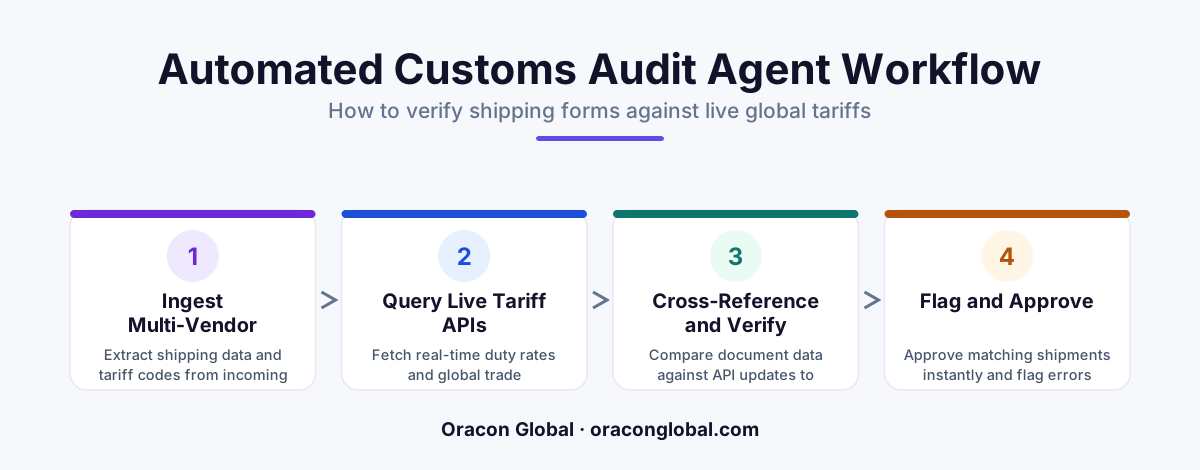
Verify international freight paperwork instantly by deploying a custom AI audit agent. By linking document parsing pipelines with live-updating global tariff APIs, logistics teams can catch classification and pricing discrepancies before shipments reach the border.
International shipping is a constant battle against moving targets. Between varying vendor document formats and daily changes to global trade regulations, manual compliance checks are slow, expensive, and prone to human error. A single incorrect Harmonized System (HS) code on a commercial invoice can stall a container at the border for days, racking up demurrage fees and disrupting supply chains.
To eliminate these bottlenecks, forward-thinking logistics providers and importers are moving away from manual data entry. Instead, they are deploying a custom customs audit agent. This dedicated AI digital employee automatically ingests multi-vendor paperwork, extracts critical shipping data, and verifies it against live global tariff API updates. Here is a practical guide on how to build this system for your operations.
The Real-World Cost of Static Customs Auditing
Most logistics operations rely on templates or static database tables to check customs declarations. While this works for predictable, domestic routes, it fails in international freight automation. There are three primary reasons static systems break:
- Frequent Regulatory Shifts: Tariff rates, trade agreements, and environmental levies change constantly. Static reference databases miss these daily updates.
- Inconsistent Vendor Formats: Every freight forwarder, supplier, and customs broker uses a slightly different layout for invoices, packing lists, and bills of lading. Traditional optical character recognition (OCR) fails when a layout shifts by a few millimeters.
- Complex Classification Hierarchies: Choosing the correct HS code requires matching granular product descriptions with rigid international customs schedules. A human or static system can easily select a close-but-incorrect code, leading to overpayment or audit penalties.
By building an intelligent, agentic workflow, you bridge the gap between messy incoming documents and strict, real-time regulatory APIs.
Step 1: Build a Resilient Document Ingestion Pipeline
An audit agent is only as good as the data it receives. Because you are dealing with multiple vendors, the system must accept structured and unstructured data, including PDFs, scanned images, XML files, and raw emails.
Instead of relying on rigid, template-based extraction, you need an AI-native structured extraction pipeline. This pipeline uses vision-capable language models to read documents like a human customs specialist would. It identifies key fields—such as the exporter of record, importer of record, country of origin, unit price, quantity, and product description—regardless of where they appear on the page.
Once extracted, this data is normalized into a standardized JSON payload. This ensures that whether a form comes from a partner in Germany or a manufacturer in Vietnam, your auditing logic receives the exact same data structure.
Step 2: Connect to Live Global Tariff APIs
With clean, normalized document data in hand, the next step is establishing a live tariff API integration. These APIs serve as the single source of truth for global customs regulations, duty rates, and trade restrictions.
Your agent uses the extracted product descriptions and tentative HS codes to query these external databases. To ensure high performance and reliability, the integration must handle several edge cases:
Handling Latency and API Failures
External government and trade APIs can be notoriously slow or prone to temporary outages. Your custom architecture must include an asynchronous queuing layer. If a tariff API is slow to respond, the agent places the audit task in a pending state, allowing other shipments to process without locking up the entire system.
Fuzzy Matching for Product Descriptions
Vendors rarely write product descriptions that match the legal language of tariff books word-for-word. The agent uses semantic search to compare the vendor's invoice description against the official HS code descriptions, finding the closest legal match and highlighting any significant deviations.
Step 3: Run the Multi-Vendor Audit Engine
Once the agent has both the document data and the live tariff rates, it performs the core audit. The system runs three distinct validation passes:
- The HS Code Alignment Test: Does the HS code provided by the vendor match the live legal description for that product category? If not, the agent suggests the correct code based on the API data.
- The Valuation Audit: The agent recalculates duties and taxes using the live tariff rates and compares them to the vendor’s calculations. This prevents overpaying duties or underpaying and risking border seizures.
- Trade Compliance Checks: The agent cross-references the country of origin and product type with current anti-dumping regulations, trade sanctions, or preferential trade agreements (like USMCA) to ensure all required exemptions are claimed.
Step 4: Designing the Human-in-the-Loop Action Queue
In high-stakes logistics, complete autonomy can be risky. Rather than letting the agent submit customs declarations directly to government portals unchecked, the system should route its findings to an intuitive operational dashboard.
When the agent identifies a discrepancy, it flags the transaction and places it in a human-in-the-loop review queue. The operator sees the original vendor document on one side of the screen and the live tariff API discrepancy on the other, complete with the agent's recommended correction. With a single click, the operator can approve the change, instantly updating your AI-native logistics software and generating the corrected customs paperwork.
"The goal of an audit agent is not to eliminate your compliance team, but to eliminate the manual searching, matching, and calculations that slow them down."
Ownership and Scaling: The Custom Code Advantage
While off-the-shelf logistics software exists, it rarely adapts to the unique vendor networks and legacy ERP systems of growing enterprises. Building automated customs compliance tools with custom code ensures you are not boxed into a vendor's rigid framework.
By partnering with a dedicated engineering team, you build a proprietary asset that integrates directly with your existing warehouse management systems (WMS) and freight forwarding portals. Most importantly, you retain 100% ownership of your codebase and intellectual property, avoiding per-user license fees and maintaining complete control over your operational data.
Streamline Your International Supply Chain
Customs auditing does not have to be a bottleneck. By combining AI-driven document extraction with live, real-time tariff databases, you can secure your supply chain against compliance errors, delays, and unexpected fees.
At Oracon Global, our senior in-house development team builds robust, production-ready AI agents and custom ERP integrations designed for global operations. If you are ready to automate your freight audits and international shipping workflows, reach out to Oracon Global today to discuss your project.
Frequently asked questions
What is a customs audit agent?
It is an intelligent software workflow that automatically extracts data from international shipping documents and verifies it against live global tariff databases to ensure compliance.
How does the agent handle different vendor document layouts?
It uses a structured extraction pipeline that translates unstructured PDFs, emails, and bills of lading from various logistics providers into a single, standardized data format.
Why are live tariff API updates necessary?
Import duties, trade regulations, and harmonized system (HS) codes change frequently, meaning static databases quickly become outdated and lead to compliance penalties.
Do we lose control over customs submissions with an AI agent?
No. The agent acts as an automated auditor that flags discrepancies and presents them in an action queue for human operators to approve or edit before final submission.
Read next
Beyond Chatbots: How to Build AI Agents That Actually Do Work for Your Business
Most businesses use AI to answer questions. Here is how to build custom AI agents that actually take action, connect to your internal tools, and handle complex workflows.
Beyond the Wrapper: How to Build Custom AI Agents for Business That Actually Work
Many businesses invest in basic AI wrappers only to find they lack the security and context needed for real work. Here is how to build custom AI agents that integrate deeply with your workflows and databases.
Enterprise AI Maintenance Costs: Budgeting for Year Two and Beyond
Building an AI system is only half the battle. Discover the practical, ongoing operational costs of enterprise AI, including token management, model drift, and continuous security audits.
Oracon Global builds production-grade AI agents, automation and apps — and you own the code and IP. Tell us what you want to automate.
Book a call →See our work