

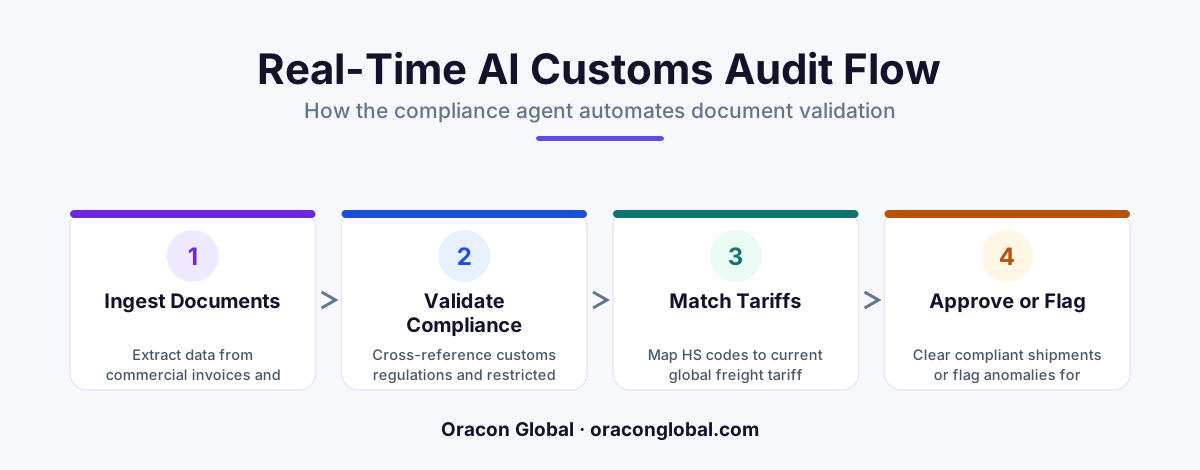
An AI customs compliance agent automates the validation of international shipping documents against dynamic global trade regulations and carrier tariffs. By combining optical character recognition, retrieval-augmented generation, and deterministic validation rules, this architecture catches billing errors and compliance risks before shipments leave the port.
International shipping is a high-stakes paper trail. A single mismatched Harmonized System (HS) code, an incorrect declaration value, or an unauthorized carrier surcharge can stall a container at a port for weeks, racking up severe demurrage fees and compliance penalties. Historically, logistics providers and global trade operators have relied on manual post-audit processes to catch these errors, reviewing freight bills and customs entries weeks after the cargo has cleared.
Waiting for a post-audit is no longer viable in a volatile global market. To protect margins and avoid regulatory friction, forward-looking logistics operators are shifting to real-time verification. Building an AI customs compliance agent allows businesses to execute automated tariff auditing and document verification instantly, catching compliance risks and billing discrepancies before cargo ever leaves the origin port.
The Operational Cost of Manual Customs Auditing
Every international shipment generates a mountain of paperwork: commercial invoices, packing lists, bills of lading, and customs entry forms. Auditing these documents manually introduces three primary points of failure:
- HS Code Mismatching: Global customs rely on the Harmonized System to classify goods. A minor variation in product description can lead to an incorrect HS code classification, resulting in either overpaid duties or heavy underpayment fines.
- Tariff Variance: Ocean and air freight contracts feature complex, dynamic tariff structures with floating fuel surcharges, peak season surcharges, and port-specific fees. Verifying that a carrier invoice matches the pre-negotiated contract tariff is highly labor-intensive.
- Regulatory Drift: Import regulations, sanctions lists, and duty rates change continuously across different jurisdictions, making it difficult for human operators to maintain perfect compliance in real time.
A custom-built logistics AI agent solves this by acting as an automated, real-time gatekeeper. It reads incoming trade documents, cross-references them with live contract tariffs and global trade databases, and flags discrepancies for human review before documents are submitted to customs authorities.
The Architecture of an AI Customs Compliance Agent
To deliver a reliable real-time customs audit, the agent must be built with a dual-engine architecture: a semantic parsing engine to interpret unstructured documents and a deterministic validation engine to enforce strict legal and financial rules.
1. Document Ingestion and Semantic Extraction
Most customs documents arrive as flat PDFs, legacy EDI messages, or scanned images. The first layer of the agent utilizes specialized document-processing vision models to ingest these files. Instead of relying on rigid, template-based OCR that breaks when a layout changes, the agent uses semantic parsing to locate key data fields—such as shipper details, total weight, line-item descriptions, and declared values—regardless of document formatting.
2. The Grounded Retrieval-Augmented Generation (RAG) Pipeline
Once the document data is structured, the agent must verify it against legal regulations and commercial contracts. This requires a highly reliable RAG pipeline. The agent queries a private vector database containing your carrier rate agreements, alongside a relational database containing current HS classification guides and global trade sanctions lists. This grounding step ensures the AI does not hallucinate regulatory requirements or pricing structures.
3. The Deterministic Validation Engine
An AI agent should never have the final, unchecked word on tax calculations or legal declarations. The parsed data and retrieved tariff rules are routed through a hardcoded business logic layer. This layer runs exact mathematical comparisons: checking if the invoiced surcharges match the contract sheet, verifying that the declared value matches the sum of the line items, and confirming that the destination port matches the carrier's service routing.
Step-by-Step: How the Agent Executes a Real-Time Audit
To understand how this system operates in production, let us walk through a typical document verification workflow:
- Intake: A freight forwarder receives a commercial invoice and a draft customs declaration form via email or an API webhook in their ERP.
- Parsing: The AI agent extracts the line items, declared currency, country of origin, and the assigned 6-to-10-digit HS code.
- Validation against Tariff Sheets: The agent matches the line items to your pre-negotiated contract database. If the carrier applied a peak season surcharge of $500, but the contract limits this surcharge to $300, the agent flags the $200 variance.
- Regulatory Compliance Check: The agent verifies the HS code against the destination country's current tariff schedules to ensure the duty calculation is correct. It also checks the shipper and consignee names against global denied-party screening lists.
- Resolution or Approval: If all checks pass, the agent marks the document as compliant in the ERP. If a discrepancy is found, the agent flags the exact line-item error, drafts a correction note, and alerts a human operator.
Ensuring Reliability with Human-in-the-Loop Safeguards
In high-stakes logistics, complete autonomy is a risk. An enterprise-grade AI compliance agent must be designed with human-in-the-loop (HITL) checkpoints. The agent operates as an expert assistant, running the tedious background checks and prep work, but leaves the final submission approval to licensed customs brokers or senior compliance managers.
By establishing clear confidence scoring thresholds, you can control when the agent acts autonomously. For example, if the agent matches an HS code with a confidence level above 98%, it can auto-approve the documentation. If the confidence falls lower due to a vague product description, the agent highlights the specific text and presents three recommended codes to a human specialist for a single-click decision.
Build Your Custom Compliance Infrastructure
Off-the-shelf logistics software often fails to handle the highly customized, multi-layered contracts and unique product catalogs that enterprises use. Building a custom, AI-native compliance agent ensures that your specific business rules, carrier agreements, and operational workflows are hardcoded into the system from day one, giving you a distinct operational advantage.
At Oracon Global, our senior in-house engineering team designs and builds high-performance AI agents, RAG systems, and custom workflow automations tailored to your specific logistics needs. We build robust, production-ready systems that integrate cleanly with your existing ERPs and legacy databases—and we hand over 100% of the custom code and intellectual property to you.
Ready to automate your tariff auditing and eliminate customs compliance errors? Contact the team at Oracon Global today to discuss how we can build your custom compliance architecture.
Frequently asked questions
What is an AI customs compliance agent?
It is an autonomous software system designed to ingest, parse, and verify international shipping documents against global customs regulations and freight tariffs in real time.
How does the agent prevent hallucinations when auditing complex legal codes?
The agent uses a hybrid architecture that pairs large language models with deterministic database lookups and strict validation rules, ensuring all tariff code recommendations are grounded in official regulatory databases.
Can this system handle unstructured documents like scanned bills of lading?
Yes, the architecture integrates advanced vision-based document processing pipelines to convert unstructured scans, PDFs, and invoices into structured data schemas before running compliance checks.
Do we retain ownership of the software if we build it with Oracon?
Yes, Oracon Global operates under a model where you own 100% of the custom code, intellectual property, and system architecture from day one.
Read next
Beyond Chatbots: How to Build AI Agents That Actually Do Work for Your Business
Most businesses use AI to answer questions. Here is how to build custom AI agents that actually take action, connect to your internal tools, and handle complex workflows.
Beyond the Wrapper: How to Build Custom AI Agents for Business That Actually Work
Many businesses invest in basic AI wrappers only to find they lack the security and context needed for real work. Here is how to build custom AI agents that integrate deeply with your workflows and databases.
Enterprise AI Maintenance Costs: Budgeting for Year Two and Beyond
Building an AI system is only half the battle. Discover the practical, ongoing operational costs of enterprise AI, including token management, model drift, and continuous security audits.
Oracon Global builds production-grade AI agents, automation and apps — and you own the code and IP. Tell us what you want to automate.
Book a call →See our work