

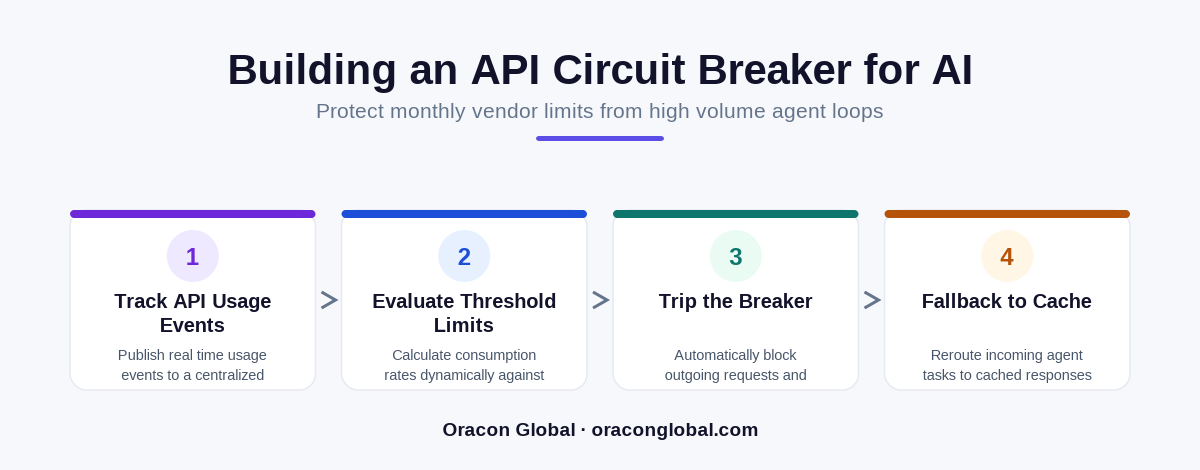
High-volume AI workflows often fail when autonomous agents consume monthly third-party vendor API quotas prematurely. An event-driven API circuit breaker continuously tracks consumption events, enforcing dynamic throttles and routing fallback traffic before quota exhaustion occurs. This architectural pattern keeps enterprise operations running smoothly while protecting your monthly technology budgets.
Deploying autonomous AI agents into high-volume business workflows transforms operational efficiency. Whether processing thousands of incoming logistics documents, enriching sales leads, or auditing complex financial records, AI agents handle repetitive work with incredible speed. However, giving software agents direct access to external tools introduces a significant infrastructure risk: vendor API usage limits. Unlike human employees who operate within predictable working hours, an AI agent encountering a recursive logic loop or processing an unexpected spike in data can exhaust an entire monthly vendor API quota in a single afternoon.
When a third-party vendor API suddenly returns a rate-limit error or quota-exceeded status code, dependent business processes grind to a sudden halt. Relying on basic error retries or waiting for an end-of-month invoice alert is not an enterprise-grade solution. To run reliable high-volume workflows, organizations must implement an API circuit breaker for AI agents—an event-driven protection layer designed to meter usage, enforce dynamic thresholds, and route traffic safely before vendor limits are breached.
The Hidden Risk of Ungoverned Vendor API Limits in Agent Workflows
Modern AI architectures depend heavily on external ecosystems. A single autonomous agent workflow might call an optical character recognition (OCR) engine, query a vector database, pull enrichment data from a commercial provider, and request completions from multiple Large Language Model (LLM) vendors. Each of these service providers enforces distinct rate limits, daily quotas, and monthly credit allocations.
Without centralized state tracking, several issues emerge quickly in production:
- Cascading Outages: If your primary data enrichment vendor locks your account due to quota exhaustion, every downstream workflow relying on that data fails immediately.
- Runaway Token Consumption: Ambiguous document inputs can cause LLM reasoning loops, sending hundreds of redundant calls to costly third-party endpoints within minutes.
- Unpredictable Operating Expenses: Overconsumption often triggers expensive automatic overage tiers or complete service disruptions that halt revenue-generating activities.
Traditional API gateways handle standard rate limits—such as restricting requests to fifty calls per minute—very effectively. However, managing vendor API usage limits across agentic operations requires tracking multi-day and monthly credit consumption metrics across distributed execution threads.
Understanding the Event-Driven Circuit Breaker Pattern
A software circuit breaker monitors operations for failures or threshold breaches. When system metrics cross a dangerous baseline, the circuit breaker "trips," temporarily preventing further requests from hitting the failing or exhausted upstream service. In an event-driven architecture, this state change happens instantly across your entire network via asynchronous messaging.
Rather than checking vendor balances synchronously during every single API call—which introduces unwanted network latency—an event-driven approach publishes every outbound API payload to a lightweight event stream. Dedicated telemetry workers consume these events, update centralized consumption stores, and evaluate spending speeds against monthly limits in real time.
The Three States of an AI API Circuit Breaker
- Closed (Normal Operation): AI agents dispatch third-party API requests normally. Usage events are logged, and real-time quota trackers record cumulative consumption against monthly enterprise allowances.
- Open (Circuit Tripped): Cumulative monthly usage breaches pre-configured safety thresholds (for example, 90% of monthly allocated API credits). The circuit breaker opens immediately. Outbound calls to that specific vendor endpoint are blocked or diverted into fallback queues automatically.
- Half-Open (Gradual Recovery): When billing cycles reset or vendor quotas refresh, the system transitions to a half-open state, allowing a limited subset of queued agent requests to verify vendor availability before returning to normal operations.
Core Architectural Components of the Circuit Breaker
Building a robust event-driven AI architecture for API protection requires four primary software layers working in harmony:
1. The Asynchronous Event Bus
When an AI agent executes a tool call requiring an external vendor, it dispatches an execution metadata payload to a high-throughput event broker. This event contains the target vendor, endpoint identifier, expected token or request cost, and timestamp. Because this process is asynchronous, your primary agent runtime continues executing without waiting for database writes to complete.
2. The Centralized State Engine
A fast, in-memory data store acts as the real-time source of truth for vendor usage metrics. It tracks cumulative monthly volume, sliding-window request speeds, and total expenditures per vendor API key. Because state management is centralized, even if you deploy dozens of parallel agent instances across microservices, every instance adheres to the exact same usage ceilings.
3. Dynamic Threshold Evaluators
Fixed rate limits are rarely sufficient for dynamic workloads. Modern circuit breakers use dynamic rules that adapt based on the operational context. For example, if your system detects that 70% of monthly API credits have been consumed within the first ten days of the month, the evaluator lowers the tripping threshold to protect the remaining quota for critical operations.
4. Automated Fallback Routers
Tripping a circuit breaker should never mean crashing an active user session. When the breaker opens, requests are instantly rerouted according to deterministic business rules:
- Model Degradation: Rerouting non-critical tasks from primary frontier LLMs to lower-cost open-source models hosted on dedicated infrastructure.
- Local Caching: Returning semantic cached responses for duplicate or similar historical queries.
- Queueing for Review: Writing lower-priority background tasks into an exception queue until API limits reset or human operators approve manual credit top-ups.
Implementing LLM Cost Management for Long-Term Scale
Implementing effective LLM cost management and API guardrails is essential when transitioning custom applications from proof-of-concept to enterprise scale. Relying on basic prompt instructions to control agent behavior will eventually fail under unexpected data conditions; robust systems rely on hardcoded architectural controls at the integration layer.
By enforcing clear boundaries between agentic decision-making and external API execution, engineering teams safeguard business continuity. Your operations gain predictable monthly technology costs, high system uptime, and absolute protection against runaway API expenses.
Building Infrastructure That Protects Your Operations
As business applications rely increasingly on autonomous AI workflows and external vendor ecosystems, managing third-party API dependencies becomes a core requirement for enterprise software reliability. Designing resilient event-driven architectures ensures your systems operate smoothly regardless of external traffic spikes or vendor constraints.
At Oracon Global, our senior engineering team designs and ships scalable custom software, high-volume automation pipelines, and resilient AI integration layers tailored to your specific operational needs. If you are scaling custom AI agents or building web and mobile platforms that require production-grade reliability, reach out to the technical team at Oracon Global today.
Frequently asked questions
What is an API circuit breaker for AI agents?
It is an architectural control layer that monitors real-time third-party vendor API calls made by AI agents and automatically pauses, throttles, or reroutes traffic when predefined monthly quota thresholds are reached.
How does this differ from traditional rate limiting?
Traditional rate limiting typically focuses on short-term traffic spikes like requests per minute. An API circuit breaker for AI agents manages long-term consumption metrics, such as monthly token balances, credit pools, and soft caps across asynchronous agentic queues.
What happens to active agent workflows when a circuit breaker trips?
Instead of failing or crashing mid-execution, workflows are gracefully routed to secondary fallback models, local state queues, or human exception queues based on pre-configured fallback rules.
Will implementing a circuit breaker slow down our AI operations?
No. By leveraging an event-driven architecture with lightweight event brokers and caching layers, quota tracking happens asynchronously without adding latency to primary request pipelines.
Read next
Beyond Chatbots: How to Build AI Agents That Actually Do Work for Your Business
Most businesses use AI to answer questions. Here is how to build custom AI agents that actually take action, connect to your internal tools, and handle complex workflows.
Beyond the Wrapper: How to Build Custom AI Agents for Business That Actually Work
Many businesses invest in basic AI wrappers only to find they lack the security and context needed for real work. Here is how to build custom AI agents that integrate deeply with your workflows and databases.
Enterprise AI Maintenance Costs: Budgeting for Year Two and Beyond
Building an AI system is only half the battle. Discover the practical, ongoing operational costs of enterprise AI, including token management, model drift, and continuous security audits.
Oracon Global builds production-grade AI agents, automation and apps — and you own the code and IP. Tell us what you want to automate.
Book a call →See our work