

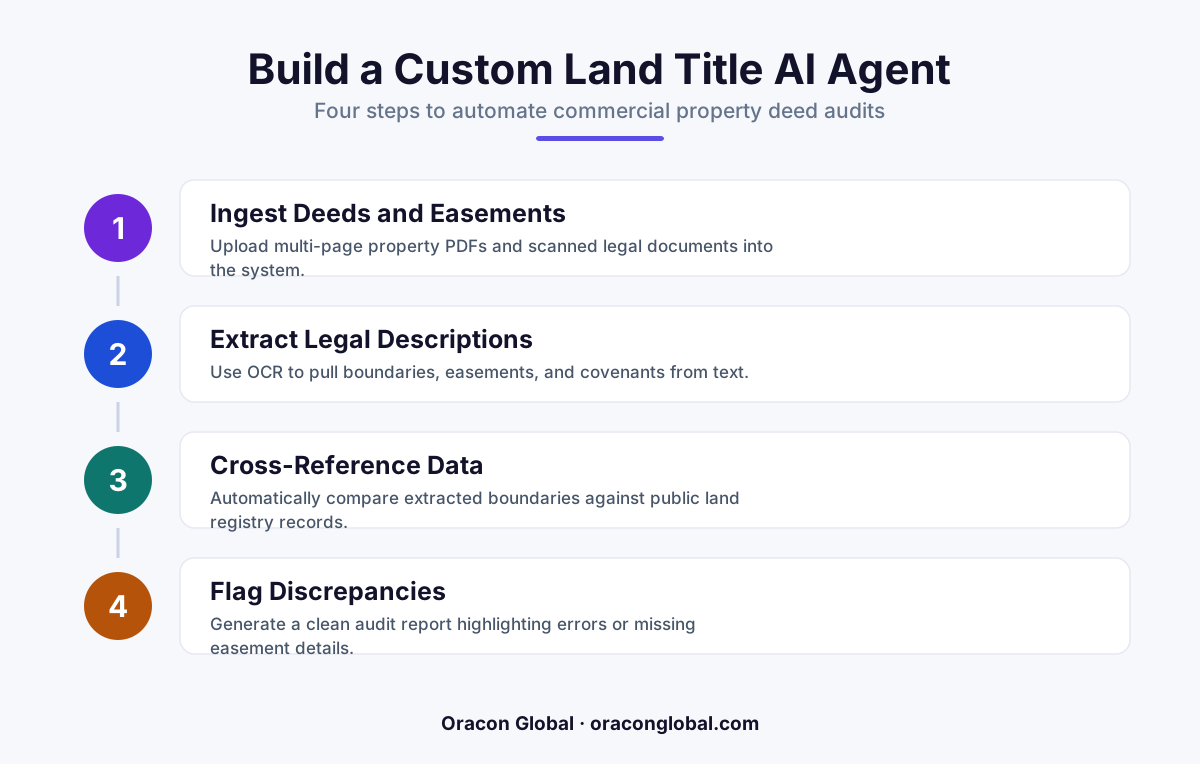
Manually auditing hundred-page land deeds and easement PDFs slows down commercial real estate transactions. By building a custom AI land title agent with structured extraction and deterministic validation rules, investment firms can automate due diligence without risking legal errors.
In commercial real estate due diligence, speed and precision are everything. Before a multi-million dollar transaction closes, acquisition teams must sift through hundreds of pages of historical land records, municipal easements, and deed covenants. A single overlooked restriction on a PDF easement can ruin a development plan or lead to costly litigation.
Manual review of these documents is a massive operational bottleneck. Standard optical character recognition tools fail because they lack the context to understand complex legal language. To solve this, forward-thinking operators are building a custom AI land title agent to automate the extraction, cross-referencing, and verification of complex property documents. Here is how to construct a production-grade system that handles PDF easement auditing and deed analysis safely.
The Problem with Legacy Real Estate Document Review
Commercial real estate documents are rarely clean. A typical due diligence file contains scanned PDFs from the 1970s, hand-signed easement agreements with faded ink, and complex metes-and-bounds legal descriptions. When teams rely on human reviewers to spot conflicting clauses across ten different files, errors slip through.
Common issues in manual commercial real estate due diligence include:
- Inconsistent Terminology: Historical documents use varying legal phrasing to describe the same access rights or utility corridors.
- Multi-Document Mismatches: An easement recorded in 1984 might conflict with a utility deed filed in 2012, but the discrepancy is buried on page forty-seven of an appendix.
- Data Silos: Title commitments, environmental reports, and zoning laws live in separate systems, making cross-referencing a manual chore.
Architecting a Custom Real Estate AI Agent
To build a reliable real estate AI agent, you cannot simply dump legal documents into a generic chat prompt. You need a structured, multi-step pipeline that extracts data deterministically, verifies it against business rules, and flags anomalies for human review.
Step 1: Document Preprocessing and Layout Parsing
Before an AI model can read a property deed, the document must be parsed correctly. Standard text parsers often scramble multi-column easement tables or lose the layout of historical deeds. A custom agent uses advanced layout-aware parsing to segment headers, signature blocks, and legal descriptions into distinct, readable blocks.
Step 2: Structured Entity Extraction
Once the document layout is mapped, the agent extracts critical data points and structures them into a clean schema. For a property deed or easement, this includes:
- Grantor and grantee names
- Parcel identification numbers
- Specific coordinate boundaries (metes and bounds)
- Encroachment terms, maintenance obligations, and expiration dates
Step 3: The Deterministic Validation Layer
AI models are excellent at understanding language, but they should not be trusted to do mathematical or spatial validation alone. A production-grade system passes the extracted coordinate data to a deterministic validation engine. This engine maps the coordinates to ensure the boundaries close mathematically and flags any overlapping spatial claims with neighboring parcels.
Cross-Referencing Multi-Vendor Easement Data
Commercial parcels often involve dozens of historical utility, access, and construction easements. A custom AI agent does not just read these files in isolation; it builds an interactive map of relationships. By comparing the terms of every active easement, the agent automatically highlights potential operational conflicts, such as a water line easement overlapping with a proposed building footprint.
This automated cross-referencing reduces the time required for property deed analysis from days to minutes, allowing your investment team to submit competitive bids faster and with greater confidence.
Building with Security and Ownership in Mind
Commercial real estate transactions rely on highly sensitive proprietary data. Using public, consumer-grade AI tools risks leaking valuable transaction details. A custom-built in-house solution ensures your data remains completely private, secure, and isolated from public training sets.
At Oracon Global, we believe our clients should have complete control over their technology. When we design and deploy custom AI agents, web platforms, or mobile applications for your team, you retain one hundred percent ownership of the code and intellectual property. No licensing traps, no vendor lock-in.
Streamline Your Property Due Diligence
Automating the tedious aspects of land title audits lets your senior underwriters focus on high-value decision-making rather than document hunting. If you are ready to replace manual paperwork with a secure, custom-engineered digital employee designed for your specific real estate workflows, we are here to build it.
Would you like to explore how a custom AI agent can integrate with your existing commercial real estate systems?
Get in touch with the senior development team at Oracon Global today to discuss your project.
Frequently asked questions
Why do traditional optical character recognition tools fail during land title audits?
Traditional OCR only extracts text without understanding context, meaning it struggles with hand-drawn legal descriptions, multi-page easement tables, and historical formatting variations across different county registers.
How does a custom AI agent handle complex legal boundaries like metes and bounds?
The agent uses structured extraction pipelines to parse specific coordinate strings, boundary lines, and acreage data, converting them into clean JSON files that can be verified against county GIS databases.
Who owns the intellectual property of an AI land title agent built by Oracon?
When you build custom business software with Oracon Global, your company retains one hundred percent ownership of the source code and all intellectual property.
Can this AI agent integrate with existing real estate CRM and document systems?
Yes, custom AI agents are built to connect securely via REST or SOAP APIs to your existing database, document storage platform, or custom-built enterprise resource planning system.
Read next
Beyond Chatbots: How to Build AI Agents That Actually Do Work for Your Business
Most businesses use AI to answer questions. Here is how to build custom AI agents that actually take action, connect to your internal tools, and handle complex workflows.
Beyond the Wrapper: How to Build Custom AI Agents for Business That Actually Work
Many businesses invest in basic AI wrappers only to find they lack the security and context needed for real work. Here is how to build custom AI agents that integrate deeply with your workflows and databases.
Enterprise AI Maintenance Costs: Budgeting for Year Two and Beyond
Building an AI system is only half the battle. Discover the practical, ongoing operational costs of enterprise AI, including token management, model drift, and continuous security audits.
Oracon Global builds production-grade AI agents, automation and apps — and you own the code and IP. Tell us what you want to automate.
Book a call →See our work