

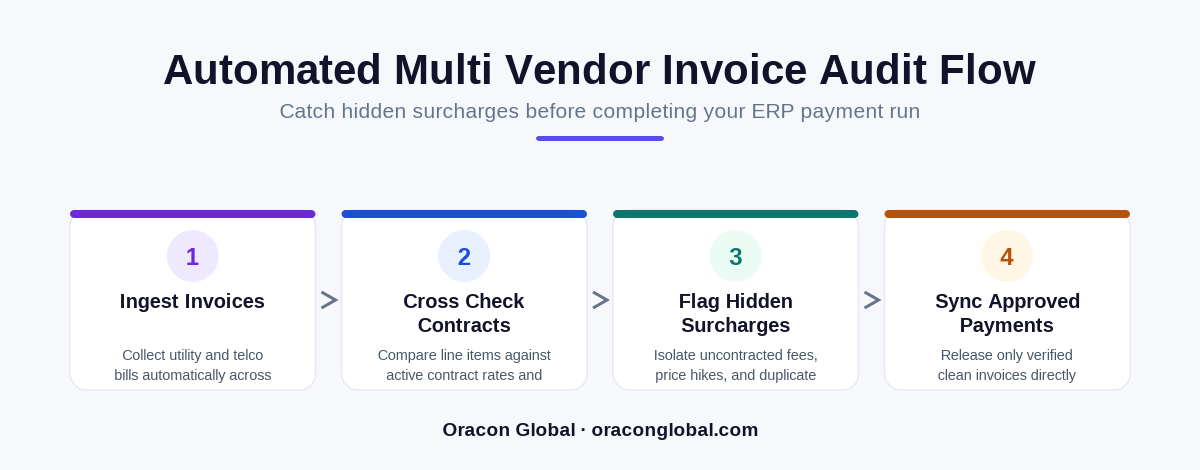
A custom multi-vendor audit agent acts as an automated firewall between incoming utility or telco billing data and your final ERP payment run. By combining dynamic multi-pass document parsing with hardcoded contract validation logic, it catches unannounced rate hikes, regulatory surcharges, and line-item drift before money leaves your account.
If your enterprise operates across multiple physical locations, managing monthly utility and telecommunications bills is a quiet operational nightmare. Gas, power, water, internet, and mobile contracts arrive in dozens of formats every month. Because these services are essential, finance departments often prioritize keeping the lights on over scrutinizing dozens of dense, multi-page PDFs. The result is a steady stream of overpayments driven by unannounced administrative fees, misplaced peak-demand multipliers, and uncontracted line-item additions that slide through standard accounts payable approvals untouched.
Relying on human eyes to manual check thousands of individual utility line items before every weekly payout is impractical. Conversely, trusting basic Optical Character Recognition (OCR) tools often fails because these legacy parsers look for fixed coordinates rather than understanding complex, variable utility billing models. To solve this leak, modern engineering teams build a custom multi-vendor audit agent—an autonomous, intelligent middleware system that sits between incoming invoice feeds and your ERP payment runs to flag every unexpected surcharge in real time.
The Hidden Costs in Multi-Vendor Utility and Telco Billing
Utility and telecommunications billing structures are notoriously opaque. Unlike standard purchase order transactions where fixed quantities match fixed prices, utility and telco invoices are dynamic. A single monthly electric bill might combine base usage, fuel cost adjustments, peak-demand multipliers, state regulatory surcharges, and local taxes. Telecommunications statements often hide recurring equipment rental fees, legacy connection charges, or expired promotional discounts deep inside mid-contract bill cycles.
When you handle dozens or hundreds of vendor accounts across different regions, three core failure modes consistently bypass traditional accounts payable workflows:
- Uncontracted Rate Drift: Vendors gradually raise baseline usage rates or reduce agreed-upon volume discounts mid-term, assuming the small difference will avoid human detection.
- Regulatory and Administrative Surcharge Creep: New fees labeled as regulatory recovery charges or administrative maintenance line items are added to bills without contractual backing.
- Peak-Demand and Penalty Multiplier Errors: Utilities incorrectly calculate billing demand peaks or apply penalty multipliers during non-peak operational windows due to flawed meter readings.
When finance teams run automated payment scripts, these invoices are routinely bundled and settled. Once money leaves your bank account via an automated ERP batch payment, recovering a five percent overcharge requires hours of phone calls, ticket creation, and administrative wrangling. Catching discrepancies before the payment runs execute is the only reliable way to preserve working capital.
Architecting the AI Multi-Vendor Audit Agent Engine
A production-grade audit agent is not a simplistic wrapper around a single chat prompt. It is a structured, multi-pass software pipeline designed to handle messy document extraction, deterministic contract matching, and safe database staging. Building a resilient utility invoice audit architecture requires three primary operational layers working in sequence.
1. Dynamic Multi-Pass Document Extraction
Utility providers update layout formats constantly, rendering template-based parsing obsolete. A custom agent uses dynamic multi-pass document parsing to convert raw PDF, XML, or scanned billing files into clean, typed data structures. During the first pass, a lightweight vision parser identifies structural boundaries, tables, and fine-print disclaimers. In the second pass, a targeted extraction engine maps raw text into a standardized schema—separating baseline consumption charges from secondary fees, taxes, and mysterious line-item adjustments.
2. The Deterministic Contract and Baseline Rules Engine
AI models excel at extracting structure from chaos, but they should never make arbitrary financial judgments alone. Safe software architecture pairs flexible document extraction with strict, hardcoded rule sets. Once the agent parses an incoming bill, it passes the structured JSON payload to a deterministic rule evaluator. This layer compares line items against active contract databases, vendor master agreements, and dynamic historical baseline ranges.
If a telecommunications vendor inserts a $45 administrative fee that does not match any approved clause in your vendor database, or if an electric bill displays a 15% rate jump without a corresponding contractual rate adjustment index, the engine flags the record immediately.
3. Staging and ERP Payment Run Interception
An effective telco surcharge detection system must fit seamlessly into your accounting workflow without interrupting normal operational payments. Instead of writing approved payments straight to your live ledger, the multi-vendor audit agent writes all incoming billing payloads to a dedicated draft buffer or staging table. Validated bills pass directly into the upcoming ERP payment queue. Flagged invoices are isolated into an internal exception queue for human review.
Step-by-Step: The Inspection Pipeline in Action
To see how a custom multi-vendor audit agent operates in production, consider the end-to-end flow of an incoming commercial utility invoice:
- Ingestion and Quarantine: Invoices arrive via direct email intake, vendor API scrapers, or direct file uploads. The system assigns a unique cryptographic hash to the document to prevent duplicate entries and moves it into an isolated processing queue.
- Schema Normalization: The agent extracts line items and normalizes key parameters—converting various units of measurement, billing periods, and site identification codes into standard corporate metadata.
- Historical and Contractual Cross-Checking: The normalized payload is validated against three data sources: active vendor contract terms stored in your database, historical baseline consumption for that specific site, and real-time vendor fee matrices.
- Confidence Scoring and Routing: The engine assigns a composite risk score to the invoice. An invoice with high confidence, zero unexpected line items, and predictable usage rates is automatically marked as approved for the upcoming ERP payment run automation sequence.
- Exception Queue Resolution: If the risk score exceeds established thresholds, the agent pauses the bill, highlights the exact line-item discrepancy on a side-by-side verification interface, and pre-drafts a vendor dispute communication for your finance manager.
Building Human-in-the-Loop Safety into Financial Workflows
When automating enterprise financial systems, safety comes first. Autonomous software should execute repetitive validation tasks, but human operators must retain complete authority over capital movement. Providing your accounts payable team with an intuitive exception dashboard ensures that your operations stay fast, accurate, and under your control.
By shifting your team from manual data entry to exception handling, your staff spends time reviewing high-risk edge cases rather than typing numbers from invoices into spreadsheet cells. When an audit agent flags a hidden $1,200 surcharge on a facility power bill, your finance manager can accept the flag, hold the line-item payout, and issue an inquiry with a single click—protecting company cash before the weekly payment run processes.
Take Control of Your AP Pipeline with Custom AI Solutions
Allowing unverified, variable utility and telco invoices to stream directly into automated financial ledger runs creates an expensive leak in your operational budget. By deploying a targeted multi-vendor audit agent, you create a robust, automated defense that catches uncontracted fees, billing errors, and hidden surcharges before funds leave your account.
At Oracon Global, our senior in-house development team builds enterprise-grade AI agents, intelligent workflow automation engines, and safe custom integrations tailored directly to your technical infrastructure. We design custom software tailored to your workflows, ensuring your business owns 100% of its intellectual property and source code from day one.
Ready to automate your financial validation workflows and eliminate billing leakage? Contact Oracon Global today to discuss your custom automation needs with our engineering experts.
===END===Frequently asked questions
What is a multi-vendor audit agent?
It is an autonomous software worker designed to parse invoices across hundreds of different utility and telecommunications suppliers, validate line items against historical baselines and contracts, and flag discrepancies before financial processing.
How does the agent integrate with our current ERP system?
The agent sits in front of your financial software, operating in a staging environment. It parses incoming digital files or PDFs, converts messy line items into clean structured data, and posts validated batch files directly to your draft ledger via standard APIs.
Why cannot standard OCR software catch hidden utility surcharges?
Basic OCR only converts images into text without context. It does not understand complex utility rate structures, tiered billing brackets, peak-demand formulas, or uncontracted line-item fees hidden within multi-page PDF statements.
What happens when the audit agent finds an overcharge?
The system automatically places the invoice into an human-in-the-loop exception queue, generates a summary detailing the exact discrepancy, and draft an inquiry email to the vendor while holding the ERP payment approval.
Read next
Beyond Chatbots: How to Build AI Agents That Actually Do Work for Your Business
Most businesses use AI to answer questions. Here is how to build custom AI agents that actually take action, connect to your internal tools, and handle complex workflows.
Beyond the Wrapper: How to Build Custom AI Agents for Business That Actually Work
Many businesses invest in basic AI wrappers only to find they lack the security and context needed for real work. Here is how to build custom AI agents that integrate deeply with your workflows and databases.
Enterprise AI Maintenance Costs: Budgeting for Year Two and Beyond
Building an AI system is only half the battle. Discover the practical, ongoing operational costs of enterprise AI, including token management, model drift, and continuous security audits.
Oracon Global builds production-grade AI agents, automation and apps — and you own the code and IP. Tell us what you want to automate.
Book a call →See our work