

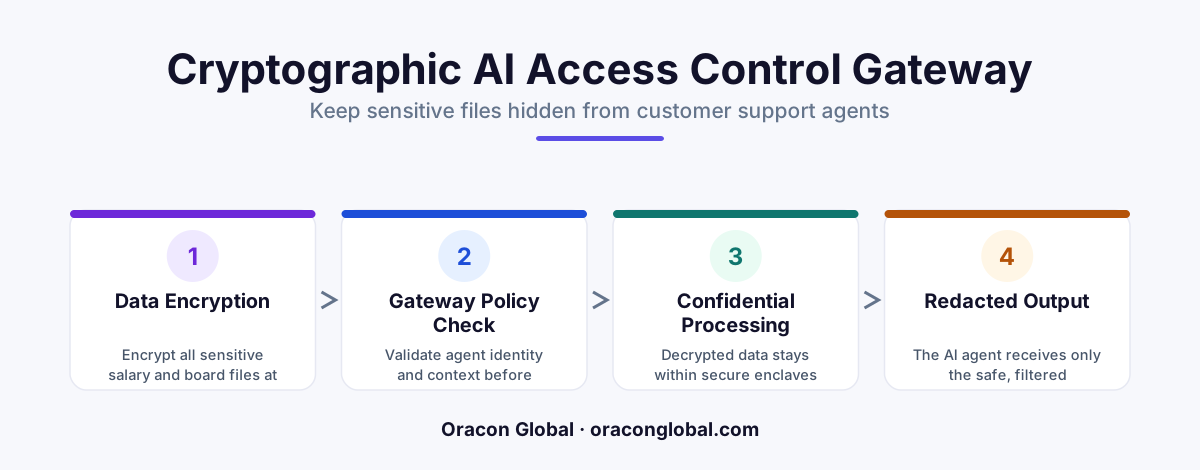
A customer support AI agent must never access sensitive internal data like payroll or board minutes. By building a cryptographic access control gateway, you encrypt sensitive data at rest and in transit, using isolated key management and deterministic query routing to ensure the AI cannot physically read restricted files even if prompted to do so.
When you deploy a customer support AI agent, you give it access to your company's knowledge base so it can resolve client issues quickly. But if your internal systems are interconnected, a major security risk emerges: how do you prevent that public-facing AI from accidentally accessing or being tricked into reading highly sensitive data like employee salaries, board minutes, or corporate financial plans?
Relying on simple system instructions like "do not read salary files" is a recipe for disaster. Prompt injection attacks and unexpected semantic search overlaps can easily bypass written rules. To truly secure your business, you need a deterministic, structural barrier. A custom cryptographic access control gateway ensures that even if your AI agent tries to fetch sensitive records, it physically cannot read the encrypted data.
The Structural Flaw in Standard AI Data Access
Many enterprise teams build Retrieval-Augmented Generation (RAG) systems by dumping all company documents into a single vector database. They rely on the LLM to decide what is safe to share with an external user. This approach exposes your organization to severe vulnerability.
If an external user asks your customer support AI agent a complex, layered question that semantically matches a PDF containing executive board minutes, the database will happily serve that chunk of text to the LLM context window. Once the sensitive data enters the context window, it is only a matter of time before it leaks to the public. To prevent this, data isolation must happen before the AI ever sees the query results.
How a Cryptographic Access Control Gateway Works
A cryptographic gateway acts as an intelligent, zero-trust proxy between your AI database pipelines and your storage layers. Instead of allowing the AI agent to query databases directly, all requests flow through this gateway, which enforces security through three core principles:
- Field-Level Encryption (FLE): Highly sensitive data fields, such as employee salaries or financial projections, are encrypted at rest using keys that the AI agent does not possess.
- Role-Based Key Management: Decryption keys are managed by an isolated key management service (KMS). The customer support AI agent is assigned a cryptographic identity that lacks permission to request the keys required for salary or executive-level data.
- Deterministic Query Routing: The gateway intercepts natural language queries, parses them for intent, and automatically strips out requests for restricted data tables before the query is executed.
The Flow of a Secure Query
When a customer asks your support AI agent about a shipping update, the query follows a highly secure path:
- The user submits the query to the customer support interface.
- The AI agent requests relevant data from the database via the cryptographic gateway.
- The gateway verifies the AI agent's cryptographic signature and token.
- The gateway retrieves the encrypted data blocks from the database.
- Because the AI's token does not have access to the salary decryption keys, the gateway only decrypts the public shipping details, leaving the sensitive data block unreadable.
- The AI receives clean, safe data to formulate its answer.
Building the Gateway Layer Without Sacrificing Performance
A common concern when introducing a cryptographic access control gateway is performance latency. If every database read requires an external call to a key management service, AI response times can slow down dramatically.
To avoid this, the gateway should be built using high-performance, lightweight microservices. By caching decrypted public-facing policy files locally and reserving active cryptographic handshakes only for restricted tables, you keep latency to a minimum. The user gets a near-instantaneous response, and your executive board minutes remain completely safe behind military-grade encryption.
Take Control of Your Enterprise AI Security
Deploying AI digital employees can dramatically improve your operational efficiency, but security must be built into the architecture from day one. At Oracon Global, our senior in-house team specializes in building secure, custom AI agents, robust RAG systems, and enterprise-grade database architectures that keep your proprietary IP and sensitive data completely secure.
Are you ready to build secure, production-ready AI tools for your business? Contact the team at Oracon Global today to discuss your project.
Frequently asked questions
Why can't standard LLM system prompts prevent AI agents from reading sensitive data?
Prompt injection can bypass system instructions. A clever user or an unexpected database search can trick the LLM into ignoring its rules, making hard-coded cryptographic barriers necessary.
What is a cryptographic access control gateway?
It is an independent security layer sitting between your databases and your AI agents. It decrypts data only for authorized users and keeps sensitive keys entirely out of the AI's reach.
Does this cryptographic gateway slow down AI response times?
No. By offloading encryption to optimized hardware or lightweight local decryption microservices, the latency added is virtually imperceptible to the end user.
Do we need to rewrite our entire legacy database to implement this?
No. The gateway acts as a smart proxy. It intercepts queries and decrypts fields on the fly, allowing your legacy databases to remain intact while securing the AI's data access path.
Read next
Beyond Chatbots: How to Build AI Agents That Actually Do Work for Your Business
Most businesses use AI to answer questions. Here is how to build custom AI agents that actually take action, connect to your internal tools, and handle complex workflows.
Beyond the Wrapper: How to Build Custom AI Agents for Business That Actually Work
Many businesses invest in basic AI wrappers only to find they lack the security and context needed for real work. Here is how to build custom AI agents that integrate deeply with your workflows and databases.
Enterprise AI Maintenance Costs: Budgeting for Year Two and Beyond
Building an AI system is only half the battle. Discover the practical, ongoing operational costs of enterprise AI, including token management, model drift, and continuous security audits.
Oracon Global builds production-grade AI agents, automation and apps — and you own the code and IP. Tell us what you want to automate.
Book a call →See our work