

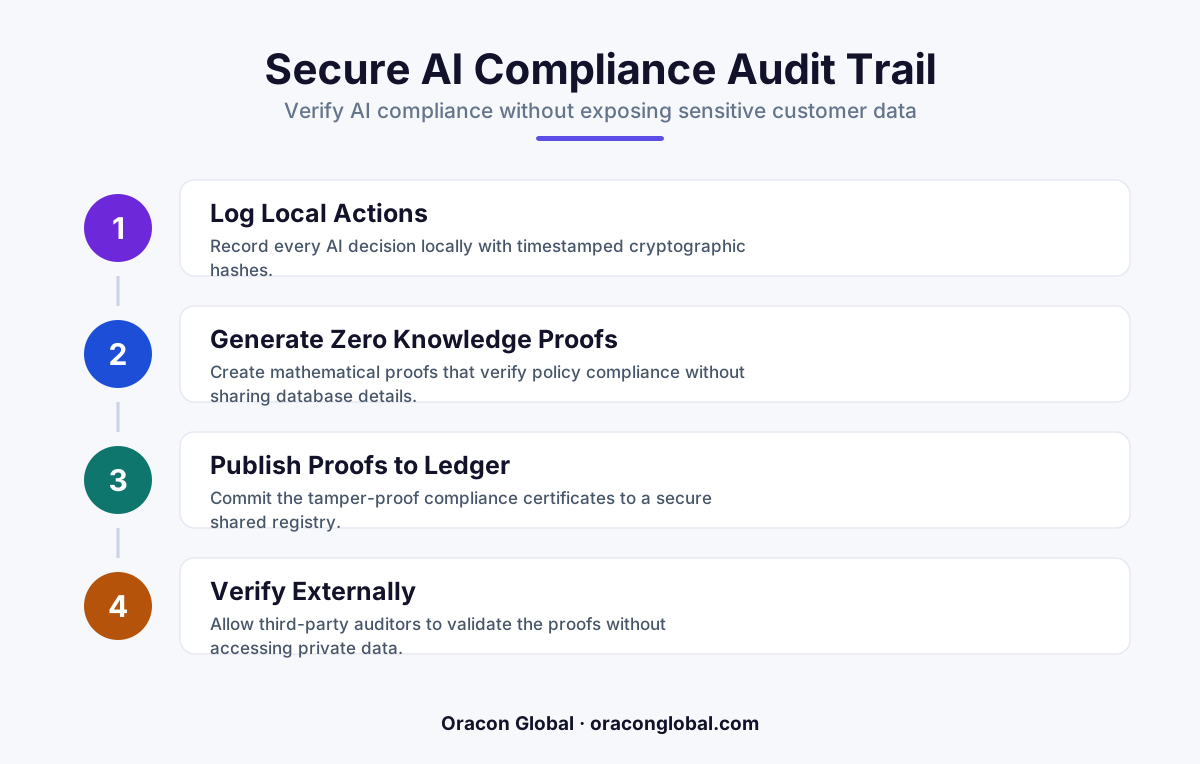
Proving that an AI agent followed regulatory compliance rules traditionally required exposing raw customer data to auditors. By implementing a cryptographic audit trail using hash chains and selective disclosure, you can mathematically prove compliance while keeping proprietary customer data completely secure.
When you deploy an AI digital employee to handle high-value tasks like loan processing, medical billing, or customer contract reviews, you face a difficult architectural paradox. To prove to regulators, internal auditors, and partners that your AI is operating within corporate compliance guidelines, you must show its work. Yet, showing its work usually means exposing the raw, proprietary customer data the AI processed to arrive at its decisions.
In highly regulated sectors, exposing this raw data to a third-party auditor, or even an internal compliance team without specific clearance, creates an immediate data privacy violation. Traditional system logs are no longer enough. They are too easily edited, and they contain too much sensitive information.
To solve this challenge, modern enterprise systems use a cryptographic audit trail. This architecture allows you to mathematically prove that your secure AI digital employee followed every corporate policy, checked every mandatory database, and respected every guardrail, without ever revealing the proprietary customer data itself. Here is how to build one.
The Core Challenge: Auditing a Dynamic AI
Unlike deterministic software that runs on simple "if-this-then-that" logic, an AI digital employee leverages natural language processing and reasoning loops. It makes micro-decisions on how to parse an invoice, match a record, or route a claim. Because of this dynamic behavior, a static system log cannot sufficiently prove compliance.
An auditor needs to verify several key milestones for every transaction:
- The exact system policies and prompt guardrails that were active when the AI ran.
- The specific, unmanipulated corporate databases the AI queried for grounding data.
- The precise mathematical steps the AI took to reach its final output.
- That no sensitive customer data was leaked to external third-party model providers during the process.
To achieve this without exposing personally identifiable information (PII) or proprietary trade secrets, we must decouple the compliance validation from the underlying data payload.
Step 1: Implementing a Cryptographic Hash Chain
The foundation of a secure cryptographic audit trail is the hash chain. Instead of saving raw text files of the AI’s prompts and outputs to a standard SQL database, we pass every state change through a cryptographic hashing algorithm (such as SHA-256).
When the AI digital employee initiates a workflow, the system generates an initial block. This block contains the system prompt hash, the active compliance policy version, and a timestamp. As the AI takes sequential actions, each new step is logged as a new block that includes the hash of the preceding block.
Because each block is cryptographically chained to the last, any retrospective alteration of the logs is mathematically impossible. If an operator attempts to modify an AI's past action to hide a compliance failure, the entire hash chain breaks instantly, alerting security teams.
Step 2: Selective Disclosure via Salted Hashes
To keep customer data completely private while proving compliance, we use salted hashes and a technique called selective disclosure. When the AI processes sensitive data, such as a customer's Social Security number or medical history, we do not store that data in the audit trail.
Instead, we generate a unique, random string of data (a "salt"), combine it with the sensitive value, and hash it. The resulting hash is written to the public-facing audit trail.
When an auditor needs to verify that the AI ran a compliance check against a specific record, they do not need to see the record itself. Instead, the compliance system can provide a mathematical proof. By running the original data through the same hashing function with the salt, the auditor can confirm it matches the hash on the immutable audit trail, validating the transaction occurred without ever storing or viewing the raw customer data.
Step 3: Designing a Zero Trust AI Pipeline
To make the audit trail truly robust, the AI digital employee must operate within a zero trust AI pipeline. In this model, the AI agent is treated as an untrusted third-party service, even if it is hosted internally. Every input and output must pass through strict, deterministic gateway layers.
The Input Gate
Before any user request or database query reaches the AI model, the input gate redacts sensitive PII, replacing it with temporary, secure tokens. It logs the token mapping in a secure, ephemeral memory cache that is inaccessible to the public internet or external LLMs.
The Compliance Validator
Once the AI generates its output, the output gate intercepts the response. Before returning the result to the user or writing it to the core database, the system runs a deterministic compliance script. This script verifies that the AI's action matches active company guidelines, signs the transaction with a cryptographic key, and writes the state hash to the audit ledger.
Step 4: Leveraging Zero-Knowledge Proofs (ZKP) for AI Audits
For highly sensitive environments, such as defense, healthcare, or institutional finance, enterprise teams are turning to zero-knowledge proofs AI architectures. A zero-knowledge proof allows one party (your system) to prove to another party (the compliance auditor) that a statement is true, without revealing any information beyond the statement itself.
In practice, this means your system can generate a mathematical proof that demonstrates:
"The AI digital employee verified that client X meets all necessary underwriting criteria under Compliance Policy v4.2, and did so using verified tax documents, without revealing client X's actual income, name, or tax ID."
Implementing a ZKP layer requires custom backend development to compile the AI's step-by-step reasoning tree into a mathematical circuit. While complex to set up, it represents the gold standard of data privacy, completely neutralizing the risk of regulatory fines or data leaks during external compliance audits.
Ownership of Your Compliance Architecture
Building a secure, tamper-proof compliance framework for your AI operations is not something you can easily purchase off the shelf. Off-the-shelf wrappers and SaaS tools often require you to route your audit logs through their servers, creating yet another third-party data vulnerability.
To maintain complete security and meet strict regulatory standards, you need absolute ownership of your codebase and intellectual property. Building a custom in-house solution ensures your cryptographic keys, database connections, and audit trails remain entirely under your control, with zero platform lock-in.
If you are ready to build production-grade AI applications that respect enterprise security requirements, the senior in-house team at Oracon Global can help. Contact us today to discuss how we can engineer a secure, custom AI digital employee for your organization.
Frequently asked questions
What is a cryptographic audit trail for AI?
It is a tamper-proof digital ledger that uses cryptographic hashing to log every step an AI agent takes, proving compliance without exposing the underlying data.
Why can't we use traditional database logs for AI compliance?
Traditional logs can be edited, deleted, or manipulated. Cryptographic audit trails use mathematical chains that make any post-facto alteration instantly detectable.
Does this process expose sensitive customer PII to external auditors?
No. By leveraging cryptographic hashes and selective disclosure, you can prove the AI followed specific business rules while keeping the actual customer data redacted.
How much latency does a cryptographic trail add to AI operations?
Very little. Hashing data and signing payloads are computationally light operations that run in milliseconds, ensuring your AI digital employees remain highly responsive.
Read next
Beyond Chatbots: How to Build AI Agents That Actually Do Work for Your Business
Most businesses use AI to answer questions. Here is how to build custom AI agents that actually take action, connect to your internal tools, and handle complex workflows.
Beyond the Wrapper: How to Build Custom AI Agents for Business That Actually Work
Many businesses invest in basic AI wrappers only to find they lack the security and context needed for real work. Here is how to build custom AI agents that integrate deeply with your workflows and databases.
Enterprise AI Maintenance Costs: Budgeting for Year Two and Beyond
Building an AI system is only half the battle. Discover the practical, ongoing operational costs of enterprise AI, including token management, model drift, and continuous security audits.
Oracon Global builds production-grade AI agents, automation and apps — and you own the code and IP. Tell us what you want to automate.
Book a call →See our work