

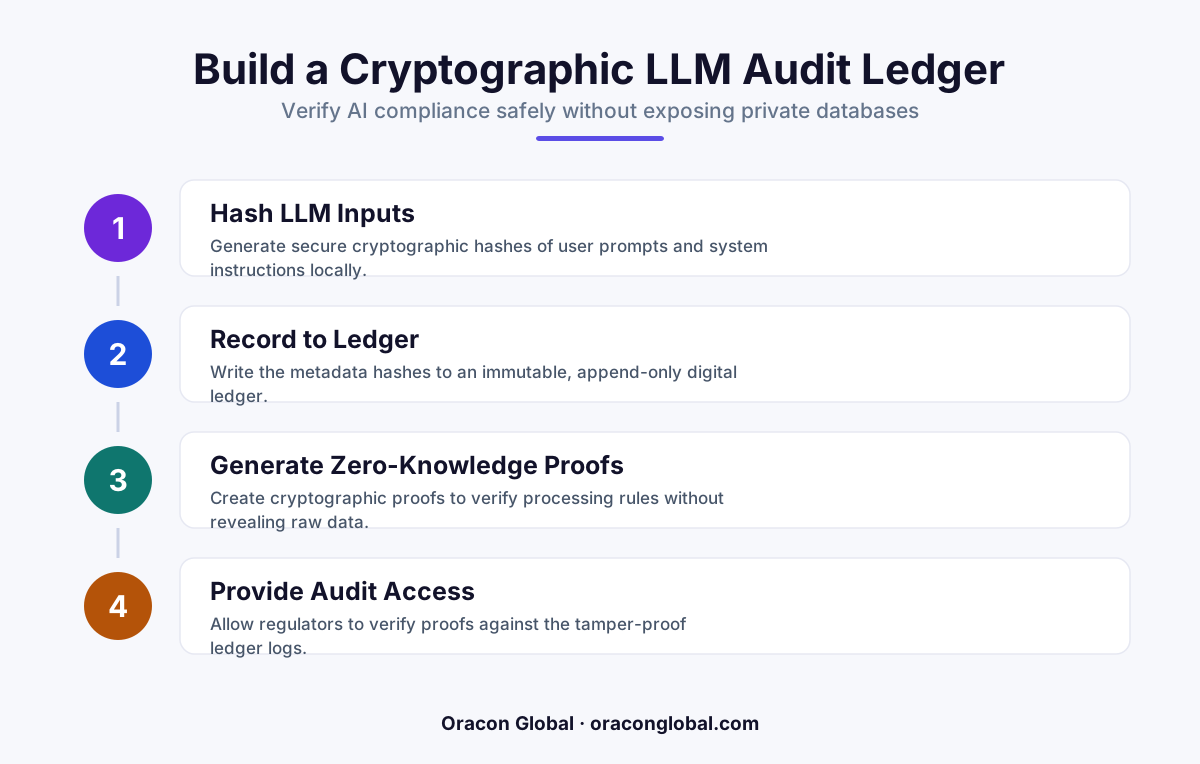
To prove LLM compliance without exposing raw data, you can build a cryptographic ledger that logs hashes of AI inputs, prompts, and outputs on a append-only log. By utilizing zero-knowledge proofs and secure hashing, external compliance auditors can verify that your LLM executed the correct policy framework without ever reading the sensitive customer data stored in your B2B SaaS databases.
In enterprise B2B SaaS, trust is a hard currency. When you deploy autonomous LLM features or AI agents to handle customer workflows, your enterprise clients will inevitably ask a difficult question: How do you prove your AI is adhering to our compliance policies without looking at our private data?
For years, compliance meant granting third-party auditors or client security teams read-only access to database tables, API payloads, and system logs. With large language models, this approach breaks down. LLMs process unstructured, highly sensitive information, from proprietary code to personal healthcare records. Sharing these raw execution logs to prove compliance defeats the very purpose of data privacy.
The solution is not to block audits, but to change how we build them. By implementing a cryptographic audit ledger, you can provide mathematical proof of LLM compliance, safety, and policy adherence while keeping your underlying databases completely private.
The Privacy Dilemma in LLM Auditing
To understand the need for a cryptographic approach, consider a standard automated invoice processing agent built for a logistics company. The agent reads incoming bills of lading, matches them against a private database of supplier contracts, and updates an ERP system.
To prove to compliance officers that the agent did not leak sensitive pricing variables or execute unauthorized modifications, you would traditionally need to show them:
- The raw system prompt used to guide the LLM.
- The exact dynamic context retrieved from your internal SQL database.
- The final raw output of the model.
The problem is that this raw context contains sensitive, proprietary information. If you expose it to an external compliance auditor, you breach your client data isolation agreements. If you redact it manually, the audit loses its integrity because you could have altered the records. You need a way to prove the integrity of the process without revealing the substance of the data.
What is a Cryptographic Audit Ledger?
A cryptographic audit ledger is an append-only data structure that records the state transitions of your AI workflows using one-way cryptographic hashes. Instead of saving raw text, the ledger saves structured mathematical representations of your LLM's actions, prompts, and database queries.
By chaining these hashes together, similar to a Merkle tree, any alteration to a historical record invalidates the entire chain. This provides several key architectural benefits for B2B SaaS platforms:
- Zero-Exposure Verification: You prove that a specific prompt template, model version, and compliance guardrail were used without exposing the customer identifiers or financial data processed during that run.
- Tamper Evidence: Once a log entry is written to the ledger, it cannot be edited, deleted, or backdated by anyone, including database administrators with root access.
- Deterministic Verification: Auditors can run local validation scripts on the hashes to confirm that your production system executed the approved compliant code paths.
The Step-by-Step Architecture
Building a private cryptographic ledger does not require complex blockchain infrastructure. You can build a highly performant, low-latency ledger within your existing cloud infrastructure. Here is how the pipeline works in practice.
Step 1: Isolate and Hash the Static System Prompts
First, separate your system instructions (the rules, guardrails, and compliance boundaries) from the dynamic customer data. Your system prompts are static assets managed in your version control system. When the LLM runs, generate a SHA-256 hash of this static system prompt.
This hash acts as a permanent mathematical signature. If the prompt is modified to bypass a compliance check, the resulting hash will change immediately, signaling an unauthorized change to auditors.
Step 2: Hash the Dynamic Context and Grounding Data
When your RAG (Retrieval-Augmented Generation) pipeline pulls private records from your SaaS database to feed the LLM, do not log the raw records. Instead, normalize the database records into a standard JSON schema, sort the keys alphabetically to ensure consistent hashing, and generate a hash of that specific payload.
This proves exactly what data was sent to the model at that precise millisecond without exposing the actual data values on the ledger.
Step 3: Commit the State Block to the Ledger
For every LLM transaction, create a structured audit block. This block contains metadata alongside the cryptographic signatures of your inputs. A typical audit block schema includes:
- A unique transaction ID.
- A high-precision timestamp.
- The hash of the approved system prompt.
- The hash of the retrieved dynamic context.
- The hash of the model's raw output.
- The hash of the previous ledger entry (creating the cryptographic chain).
This block is then written to an append-only database table configured with strict write-once-read-many (WORM) policies. Even if your primary application database is compromised, the ledger's sequential chain cannot be rewritten without breaking the mathematical continuity of the hashes.
How Auditors Verify Compliance Privately
When it is time for an annual audit or a client safety review, you do not hand over database access keys. Instead, you provide two resources: the cryptographic ledger logs and a verification utility.
The verification process works through mathematical matching. Because cryptographic hashes are deterministic, the same input will always generate the exact same output hash. If an auditor wants to verify that the LLM was grounded in an approved corporate safety policy, they simply hash that policy and compare it to the system prompt hash recorded in your ledger blocks.
If the hashes match, the auditor has mathematical proof that the approved policy was active during that transaction. If they do not match, the system has drifted, or an unauthorized prompt injection bypassed the system. At no point did the auditor need to read the private customer data packaged alongside those instructions.
Building a Culture of Verifiable AI
As enterprise companies adopt AI, the burden of proof is shifting from the developers to the platform builders. Simply promising that your AI is safe, secure, and compliant is no longer enough to close enterprise SaaS deals. Modern security questionnaires demand tangible evidence of technical control.
By decoupling compliance verification from data visibility, a cryptographic audit ledger allows you to scale your LLM features rapidly while maintaining a fortress-like security posture. It is a robust, practical approach that respects both client data isolation and regulatory scrutiny.
Are you looking to implement secure, production-grade AI features in your business software? At Oracon Global, our senior in-house development team designs and builds secure AI agents, enterprise automation pipelines, and custom software systems tailored for high-compliance environments. Reach out to Oracon Global today to discuss how we can help you build secure, verifiable AI architectures.
Frequently asked questions
Why can't we use traditional database logs for LLM compliance audits?
Traditional logs are easily modified, do not offer cryptographic proof of integrity, and typically contain raw, sensitive customer data that violates privacy boundaries when shared with third-party auditors.
What is a cryptographic audit ledger?
It is an append-only, tamper-evident data structure where every entry contains a cryptographic hash of the LLM transaction, creating a verifiable chain of custody without storing raw text.
Does this approach require public blockchain networks?
No, you can implement a highly efficient, private, append-only cryptographic ledger using standard Merkelized structures or managed cloud ledger databases within your own virtual private cloud.
How do auditors verify compliance without seeing the raw inputs?
Auditors verify compliance by running the known, approved LLM prompt templates and system policies through the same hashing algorithm, matching them against the ledger's cryptographic states to prove adherence.
Read next
Beyond Chatbots: How to Build AI Agents That Actually Do Work for Your Business
Most businesses use AI to answer questions. Here is how to build custom AI agents that actually take action, connect to your internal tools, and handle complex workflows.
Beyond the Wrapper: How to Build Custom AI Agents for Business That Actually Work
Many businesses invest in basic AI wrappers only to find they lack the security and context needed for real work. Here is how to build custom AI agents that integrate deeply with your workflows and databases.
Enterprise AI Maintenance Costs: Budgeting for Year Two and Beyond
Building an AI system is only half the battle. Discover the practical, ongoing operational costs of enterprise AI, including token management, model drift, and continuous security audits.
Oracon Global builds production-grade AI agents, automation and apps — and you own the code and IP. Tell us what you want to automate.
Book a call →See our work