

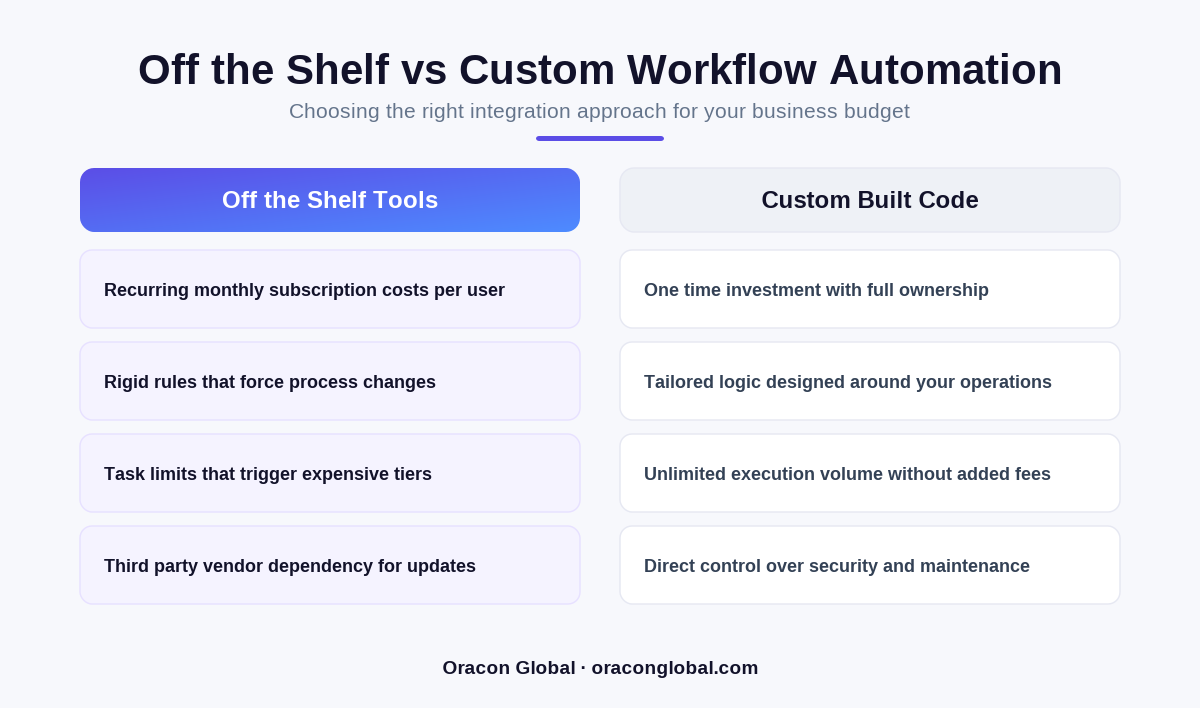
Custom workflow automation connects your software systems using dedicated, tailor-made code rather than pre-built third-party integration platforms. When standard no-code tools become expensive due to task limits or complex data rules, building custom integration pipelines gives you full control, predictable costs, and complete ownership of your IP.
Running a growing business often feels like juggling a dozen different software apps. You might use one app to manage your customer contacts, another to send invoices, and a third to track project updates. Getting these separate apps to speak to each other automatically is known as workflow automation—the process of letting computers handle repetitive, step-by-step business tasks without human manual labor.
Most business owners start by using popular off-the-shelf integration software. These are ready-made web applications where you can drag and drop buttons to link software together. But as your business grows and processes thousands of orders or updates every day, these rental tools often hit a wall. Their subscription bills explode, or their rigid rules prevent you from handling special business scenarios. That is where a custom workflow automation system comes in.
What Is a Custom Workflow Automation System?
A custom workflow automation system is tailor-made software code designed specifically to link your business tools and run your processes on autopilot. Instead of renting a generic intermediary tool, a developer writes custom programs that talk directly to your apps through their API (Application Programming Interface, which is simply a digital gateway that allows two separate software applications to exchange information safely).
To understand how this works in real life, consider a basic everyday analogy:
Imagine hiring a translator to help two people talk. An off-the-shelf tool is like paying a third-party agency a fee every single time the translator opens their mouth to say a word. A custom workflow automation system is like hiring your own in-house, dedicated employee who learns your company's exact dialect, works silently in the background, and never charges you per word spoken.
How Off-the-Shelf Tools Break Your Monthly Budget
Off-the-shelf software tools are great for simple tasks. If you only need to transfer ten emails a day into a spreadsheet, a standard subscription platform works fine. However, these platforms operate on a per-task pricing model. This means every time the system checks for a file, updates a database line, or sends a notification, it counts as a paid event.
As your operations scale, these small fees stack up quickly. Here is why reliance on pre-built platforms often becomes a financial burden for growing operational teams:
- Task Inflation: A single customer order might require updating your CRM, generating an invoice, alerting the warehouse, and sending an SMS. What felt like one business event gets billed as four or five distinct platform tasks.
- High Data Volume Charges: If your company processes thousands of records daily, off-the-shelf pricing tiers can jump from fifty dollars a month to thousands of dollars almost overnight.
- Forced Workarounds: When a pre-made tool cannot handle a complex step in your business process, your team wastes hours building fragile webhooks and multi-step hacks that break frequently.
- Zero Intellectual Property Ownership: You pay expensive subscription fees every month forever, but you never actually own the infrastructure powering your operations.
A Real-World Use Case: Custom Code vs. Renting Platforms
Let us look at a practical scenario involving an online retail company managing fast-moving inventory.
Every time a customer places an order on their website, four things must happen instantly:
- The payment must be verified in the payment gateway.
- The main inventory system must deduct the purchased item so it does not sell twice.
- The shipping department must get a pick-list sent directly to their printing queue.
- The marketing platform must send a personalized confirmation email to the buyer.
Using a standard rental automation service, this single sale requires four connected tasks. If the store handles 50,000 sales a month, that translates to 200,000 automation tasks every single month. Under standard tier pricing, the monthly software bill for just connecting those tools can quickly outpace the cost of renting physical office space.
By switching to a custom app development approach, the company builds a lightweight, direct software integration layer once. The system handles all 200,000 actions directly between systems using clean code hosted on standard server infrastructure. The ongoing usage fees drop to near zero, and the system runs faster with fewer failure points.
The Benefits of Choosing Custom Code for Integration
Building tailored software connections gives your organization full control over its digital architecture. Rather than fitting your business into a vendor's pre-packaged template, the technology adapts to your exact operational requirements.
1. Predictable, Flat Infrastructure Costs
Custom code runs on cloud servers where you pay for raw computing horsepower, not individual data transfers. Whether your automation processes ten orders or ten million, your server costs remain stable and predictable.
2. Unlimited Business Logic Complexity
Off-the-shelf builders use simple "If This, Then That" logic. But real business processes are rarely that simple. Custom software allows for deep rule validation, automated retry mechanisms when servers go down temporarily, and seamless connections to legacy database architectures.
3. Full IP Ownership
When you invest in custom workflow automation, your business owns 100 percent of the source code and software rights. It becomes a permanent core asset on your balance sheet rather than an ongoing operational subscription expense.
4. Future-Ready for Modern AI Capabilities
Custom software systems integrate cleanly with modern AI agents and intelligent document parsers. Because your underlying automation codebase is direct and flexible, adding automated decision-making or voice capabilities later requires zero platform overhaul.
When Should You Make the Switch?
Moving to custom code is a major strategic milestone for growing companies. You do not need to replace every simple connection overnight. However, you should evaluate building a custom workflow system if:
- Your monthly integration tool invoice is growing faster than your headcount.
- Your team frequently complains that pre-built tools are missing features needed for core operations.
- Your software workflows fail routinely because of strict data payload size limits.
- You want absolute control and security over how sensitive customer files move between internal applications.
Build Your Custom Software Architecture with Oracon Global
Connecting your software ecosystem should empower your business to scale effortlessly, not penalize you with expanding subscription fees every time your sales increase. Moving beyond rigid off-the-shelf tools to a custom workflow automation system provides your operations team with speed, reliability, and total cost ownership.
At Oracon Global, our senior in-house engineering team designs and builds robust, high-performance custom software, workflow automation layers, and AI solutions tailored precisely to your operational needs. Every line of code we write belongs entirely to you, giving you full ownership over your technology stack from day one.
Curious how custom code can streamline your business operations and reduce platform overhead? Explore our live interactive software demos on oraconglobal.com or contact our senior engineering team today to discuss your project.
Frequently asked questions
What is a custom workflow automation system?
It is custom software code designed to connect two or more business applications, automatically moving data and triggering actions between them without human effort.
How is custom automation different from no-code integration tools?
No-code tools use subscription platforms with strict usage limits and preset features, whereas custom code is written specifically for your business logic with zero task fees and complete control over ownership.
When should a business move from off-the-shelf tools to custom code?
You should move when your monthly integration subscription bills spike due to high data volumes, or when your business logic becomes too complex for visual drag-and-drop builders to handle reliably.
Who owns the software code when building a custom automation system with Oracon Global?
Your business owns 100 percent of the source code, software architecture, and intellectual property from day one, with zero ongoing platform licensing fees.
Read next
Beyond Chatbots: How to Build AI Agents That Actually Do Work for Your Business
Most businesses use AI to answer questions. Here is how to build custom AI agents that actually take action, connect to your internal tools, and handle complex workflows.
Beyond the Wrapper: How to Build Custom AI Agents for Business That Actually Work
Many businesses invest in basic AI wrappers only to find they lack the security and context needed for real work. Here is how to build custom AI agents that integrate deeply with your workflows and databases.
Enterprise AI Maintenance Costs: Budgeting for Year Two and Beyond
Building an AI system is only half the battle. Discover the practical, ongoing operational costs of enterprise AI, including token management, model drift, and continuous security audits.
Oracon Global builds production-grade AI agents, automation and apps — and you own the code and IP. Tell us what you want to automate.
Book a call →See our work