

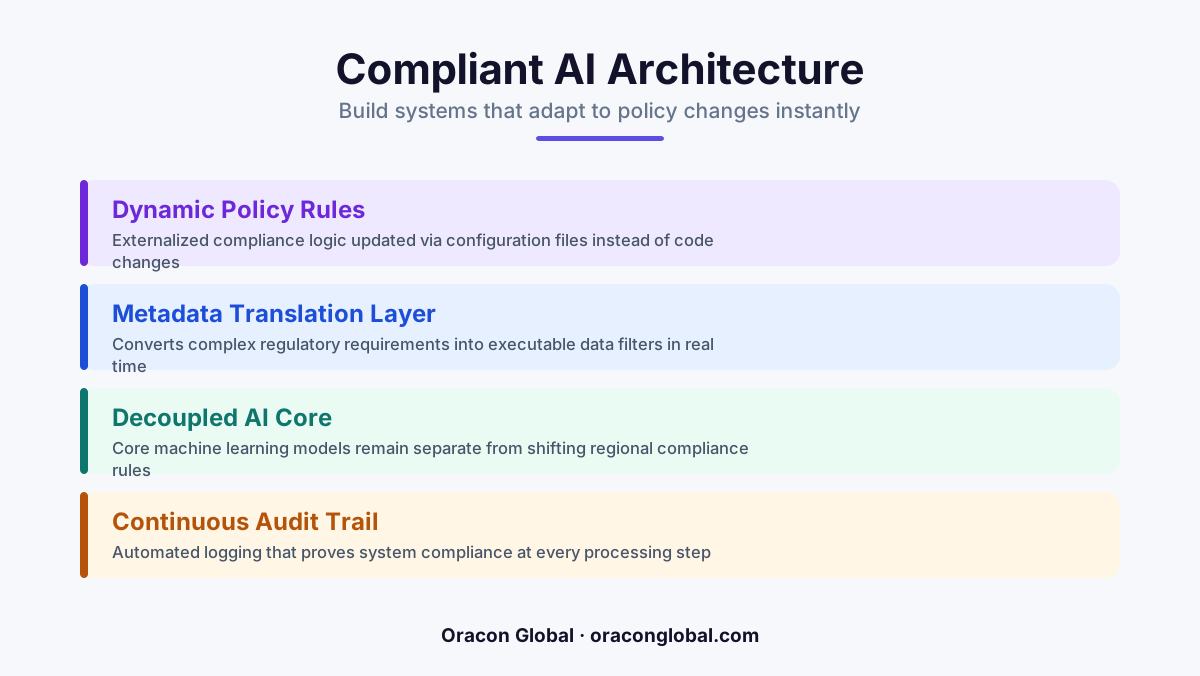
Instead of hardcoding shifting regulatory rules into your application codebase, build an decoupled metadata engine that translates compliance policies into dynamic system constraints. By isolating your business logic from the underlying model prompt structures, your engineering team can update compliance parameters instantly without redeploying the core platform.
If you build enterprise software, you know the feeling. A regulatory body in Europe or California updates a data-handling policy, or an industry-specific compliance framework changes a key threshold. Suddenly, your engineering queue is completely derailed. Instead of shipping your product roadmap, your developers are digging through codebase files to manually update hardcoded limits, database validation scripts, and API payloads.
When you introduce AI digital employees and autonomous agents into B2B SaaS platforms, this fragility scales exponentially. If your AI agents rely on rigid, hardcoded constraints to decide how they process financial files, audit supply chain documents, or interact with legacy systems, a single regulatory shift can quietly break your entire automation pipeline.
Building for long-term reliability requires designing adaptive AI systems that can handle rapid shifts in regulatory compliance in AI without requiring a complete rewrite of your core codebase. Here is how to build a highly adaptable B2B SaaS architecture prepared for the reality of shifting global compliance.
The Danger of Hardcoded Compliance in Agentic Workflows
In traditional enterprise systems, business logic is relatively static. A developer writes an if/else block to check if an invoice exceeds a certain dollar limit or if a user has the correct geographical permissions to view a specific document. This approach is brittle, but predictable.
With autonomous AI systems, the code doesn't just execute static paths; it interprets context and takes action. If your compliance guidelines are baked directly into long, complex prompt templates, you run into three severe operational risks:
- Prompt Drift and Degradation: Attempting to edit a massive system prompt to include a new local compliance rule often triggers unexpected regressions, causing the agent to forget older, equally important business guidelines.
- Auditing Nightmares: If a regulator asks why an AI system made a specific automated decision, you cannot easily query a historical prompt string to prove compliance at a exact millisecond in time.
- High Engineering Overhead: Every minor policy update requires a full software development lifecycle run, including staging tests, integration checks, and production code deployments.
To avoid these bottlenecks, modern systems must treat compliance rules as dynamic, versioned database records rather than static application code or system instructions.
Building a Metadata-Driven Compliance Engine
The most resilient way to solve this challenge is to separate your compliance logic from both your core database schemas and your LLM integration layers. Think of this as a dedicated, decoupled policy registry.
By creating a dynamic database schema specifically for business policies, your application can fetch active rules in real time and inject them directly into your execution environments as structured parameters. Let's look at how this structure works in practice.
1. The Centralized Policy Registry
Instead of scattering rules across different backend microservices, build a centralized database table that stores compliance parameters as structured JSON. Each policy should include clear metadata fields: a unique identifier, an active version number, geographical target codes, and a structured schema containing the precise operational constraints.
2. The Dynamic Rule Compiler
When an AI agent initializes an action, it queries this registry to pull only the policies relevant to the current user's region and transaction type. A lightweight compiler layer translates these database records into a clean, structured JSON object of system constraints. This object is then fed directly into the runtime context of the LLM execution tool.
3. Strict JSON Schema Enforcement
By using structured output techniques, you can force the AI system to evaluate its proposed action against the compiled policy JSON. The model must return an audit log proving how the action satisfies every single constraint in the active policy before the system allows the write to occur on your database layer.
Implementing a Local Caching Layer for Low-Latency Policies
Querying your relational database every single time an AI agent evaluates an API payload or a user interaction introduces unnecessary latency and database locks. This is especially true for high-volume B2B SaaS applications handling thousands of parallel automated tasks.
To protect your platform's responsiveness, implement an active policy cache using an in-memory database like Redis. The workflow is straightforward:
- When a compliance officer or system admin updates a rule in your admin panel, the application writes the change to the persistent database.
- The database triggers an event that immediately invalidates the cache for that specific rule.
- The next time an AI agent triggers a workflow, it pulls the newly updated rule directly from the cache in less than a millisecond, keeping your agentic workflows running at peak speed without database strain.
Designing a Dual-Write Shadow Ledger for Compliance Verification
Even with structured JSON guards, deploying autonomous tools in highly regulated spaces demands a secondary layer of safety. This is where a dual-write shadow ledger comes in.
Before any database write generated by an AI digital employee is permanently committed to your primary ledger, the system writes the proposed transaction to an isolated, append-only staging table. A deterministic, non-AI rule validation engine then parses this staging record against your live policy rules. If the transaction passes, it is instantly promoted to the primary database. If it fails, the transaction is rejected, and an exception alert is routed to your human-in-the-loop dashboard.
"By decoupling policy evaluation from model execution, you gain the absolute predictability of traditional software engineering while preserving the cognitive flexibility of modern artificial intelligence."
How We Build Future-Proof Enterprise Software
At Oracon Global, our senior in-house engineering team designs and delivers robust, production-grade applications that scale seamlessly. Whether we are building custom AI-native ERP systems, intelligent digital employees, or complex SaaS platforms, we build with long-term adaptability in mind. We build clean, highly maintainable systems designed to handle the realities of changing markets, technical standards, and global compliance regulations.
Crucially, our business model is built on transparency and trust: our clients retain 100% ownership of all custom code and intellectual property we develop for them. No licensing traps, no vendor lock-in. You own the software we build, from day one.
Are you ready to build high-performance, compliant software systems that are engineered to grow with your business? Contact our team at Oracon Global today to discuss your development goals.
Frequently asked questions
Why do traditional hardcoded rules fail when compliance laws change?
Hardcoded rules spread regulatory logic across multiple database schemas and application files, making it incredibly difficult to audit, trace, or update without risking breaking changes in production.
How do you decouple compliance policies from an AI agent's prompt?
We use a metadata-driven architecture where rules are stored in a relational database as structured policies and dynamically injected into the runtime context as structured system constraints.
Will an adaptive compliance architecture slow down database queries?
No, by utilizing optimized caching layers such as Redis and indexing your active policy tables, you can retrieve dynamic constraints with sub-millisecond latency.
Who owns the intellectual property of a custom compliance system built by Oracon?
At Oracon Global, our clients retain 100% ownership of the code, system architecture, and intellectual property we build for them.
Read next
Beyond Chatbots: How to Build AI Agents That Actually Do Work for Your Business
Most businesses use AI to answer questions. Here is how to build custom AI agents that actually take action, connect to your internal tools, and handle complex workflows.
Beyond the Wrapper: How to Build Custom AI Agents for Business That Actually Work
Many businesses invest in basic AI wrappers only to find they lack the security and context needed for real work. Here is how to build custom AI agents that integrate deeply with your workflows and databases.
Enterprise AI Maintenance Costs: Budgeting for Year Two and Beyond
Building an AI system is only half the battle. Discover the practical, ongoing operational costs of enterprise AI, including token management, model drift, and continuous security audits.
Oracon Global builds production-grade AI agents, automation and apps — and you own the code and IP. Tell us what you want to automate.
Book a call →See our work