

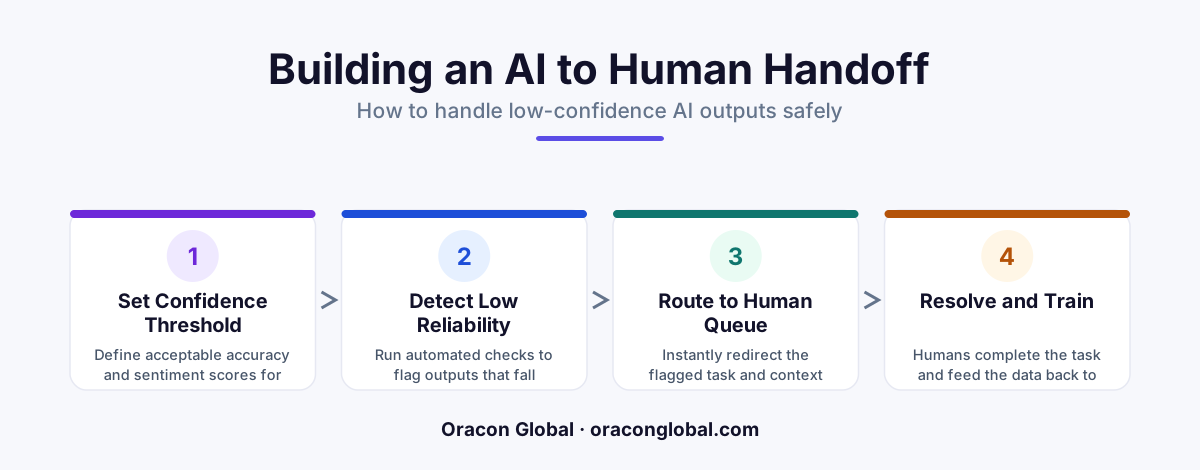
An AI redundancy layer acts as a real-time circuit breaker for your digital employees. By measuring output confidence, formatting validity, and semantic drift, the system can silently reroute complex or failing tasks to a human queue before bad data hits your production systems.
When you transition an AI agent or a digital employee from a simple demo to a core business operations tool, the stakes change. In a demo, a slightly creative or inaccurate response is a minor quirk. In production, an inaccurate response can lead to corrupted database records, broken client agreements, or shipping delays. This is why experienced operators do not rely on raw LLM outputs alone.
To run autonomous systems safely, you need a dedicated AI redundancy layer. This architectural pattern acts as a real-time circuit breaker. It evaluates the quality and reliability of your AI outputs behind the scenes and, if performance falls below a set threshold, gracefully reroutes the task to your human team. Here is how to design and implement this safety net for your business operations.
The Core Concept: Real-Time Quality Gates
An AI redundancy layer sits directly between your generative AI models and your core business databases. Instead of allowing an LLM to write directly to an ERP or email a client, the output must pass through a series of automated quality gates. If the output fails any gate, the system halts the autonomous execution, packages the current state of the workflow, and hands it off to a human workspace.
This approach protects your operational integrity while keeping processes moving. Your human staff do not have to monitor every single transaction; instead, they act as an escalation path, stepping in only when the AI encounters an edge case it is not equipped to handle.
Key Metrics for Your LLM Reliability Threshold
To build a reliable fallback system, you must define exactly what constitutes a failure. Reliability is not a subjective feeling; it must be represented by concrete, measurable metrics within your software pipeline. Here are the primary signals used to trigger a human handoff:
- Deterministic Schema Validation: Did the LLM return the exact JSON structure required by your database? If a field is missing, improperly typed, or contains invalid dates, the transaction is instantly paused.
- Confidence and Log-Probabilities: Most enterprise LLM APIs expose token-level log-probabilities. By analyzing these scores, your application can determine if the model was highly confident in its decision or simply guessing the next word.
- Semantic Boundary Auditing: By running the AI output through a lightweight semantic classifier, you can detect if the response contains restricted phrases, off-topic subjects, or logic that contradicts your stored business rules.
- Execution Step Timeouts: If a multi-step AI agent gets stuck in an infinite loop or takes too long to call a necessary API tool, the redundancy layer steps in to terminate the run and notify an administrator.
Establishing Your Threshold Matrix
Different tasks require different levels of tolerance. A support response answering a generic shipping policy question can have a lower confidence threshold. On the other hand, an AI agent updating an inventory ledger or adjusting a pricing table requires a strict, near-zero-tolerance threshold. Designing your redundancy layer with task-specific thresholds ensures you do not overwhelm your human team with unnecessary alerts while still protecting high-risk workflows.
Designing the Human Handoff State Machine
When an LLM reliability threshold is breached, you cannot simply drop the request. The transition must be seamless for both the end-user and your internal team. This requires a robust state machine to manage the lifecycle of the handoff.
First, the redundancy layer saves the exact state of the workflow, including the user's original input, the prompt template, the raw LLM attempt, and the specific validation error. This prevents data loss and gives the human reviewer immediate context.
Next, the system updates the transaction state to "Pending Human Review" and routes the package to an internal queue. For your operations team, this should look like a simple, action-oriented dashboard. Instead of hunting for what went wrong, the human reviewer is presented with a clear side-by-side comparison: what the system expected, what the AI generated, and a simple interface to edit, approve, or reject the action.
Best Practices for Asynchronous Fallbacks
Implementing human-in-the-loop AI workflows requires careful attention to system performance and user experience. To keep your applications running smoothly, consider these structural best practices:
- Use Event-Driven Queues: Never hold an HTTP request open while waiting for human intervention. Put the task into an asynchronous queue and update the user interface with an appropriate pending status.
- Provide Contextual UI for Human Operators: Minimize the time it takes for a human to resolve a handoff. Highlight the exact line of text or database field that triggered the validation failure.
- Feed Handed-off Tasks Back into Evaluation: Use every human-corrected task as training data. By saving these edge cases, your development team can continuously update prompt strategies, fine-tune models, and improve deterministic guardrails.
- Establish Escalation SLA Alerts: Set up automated alerts for your human queues. If a high-priority customer request is handed off and sits unresolved for more than ten minutes, escalate it to an on-duty team leader.
Building vs. Buying Your Redundancy Architecture
While basic retry logic can be written quickly, a production-grade AI redundancy layer requires custom middleware tailored to your specific database architecture and business rules. Off-the-shelf wrappers often lack the fine-grained state management needed to cleanly pause a transaction mid-execution, and they rarely integrate natively with your team’s existing ticketing tools or custom admin portals.
At Oracon Global, our senior in-house development team focuses on building durable, enterprise-grade AI applications and custom ERP systems. We write clean, custom state machines and validation layers from scratch, ensuring that your business owns 100% of the code and intellectual property. Whether you are launching autonomous digital employees or automating complex backend workflows, we design our systems to fail safely, protecting your operations and your brand.
If you are planning an AI integration and want to ensure it is resilient enough for production, contact Oracon Global today to discuss how we can build a secure redundancy architecture for your team.
Frequently asked questions
What is an AI redundancy layer?
It is an architectural safety net that monitors the quality, confidence, and accuracy of LLM outputs in real time, routing tasks to human operators if the AI performance drops below a specific threshold.
How do you measure LLM reliability in production?
Reliability is tracked using deterministic validation checks, output schema parsing success, log-probability scores from the model, and semantic distance comparisons against known safe responses.
Where does the handed-off task go when the AI fails?
Failed or low-confidence runs are packaged with their full execution history and placed into a structured human review queue, such as a custom operations dashboard or an existing ticketing system.
Does a redundancy layer slow down the user experience?
When designed correctly using asynchronous event queues, the validation and routing happen in milliseconds, ensuring that either a verified AI response or a gracefully managed human fallback occurs without system lag.
Read next
Beyond Chatbots: How to Build AI Agents That Actually Do Work for Your Business
Most businesses use AI to answer questions. Here is how to build custom AI agents that actually take action, connect to your internal tools, and handle complex workflows.
Beyond the Wrapper: How to Build Custom AI Agents for Business That Actually Work
Many businesses invest in basic AI wrappers only to find they lack the security and context needed for real work. Here is how to build custom AI agents that integrate deeply with your workflows and databases.
Enterprise AI Maintenance Costs: Budgeting for Year Two and Beyond
Building an AI system is only half the battle. Discover the practical, ongoing operational costs of enterprise AI, including token management, model drift, and continuous security audits.
Oracon Global builds production-grade AI agents, automation and apps — and you own the code and IP. Tell us what you want to automate.
Book a call →See our work