

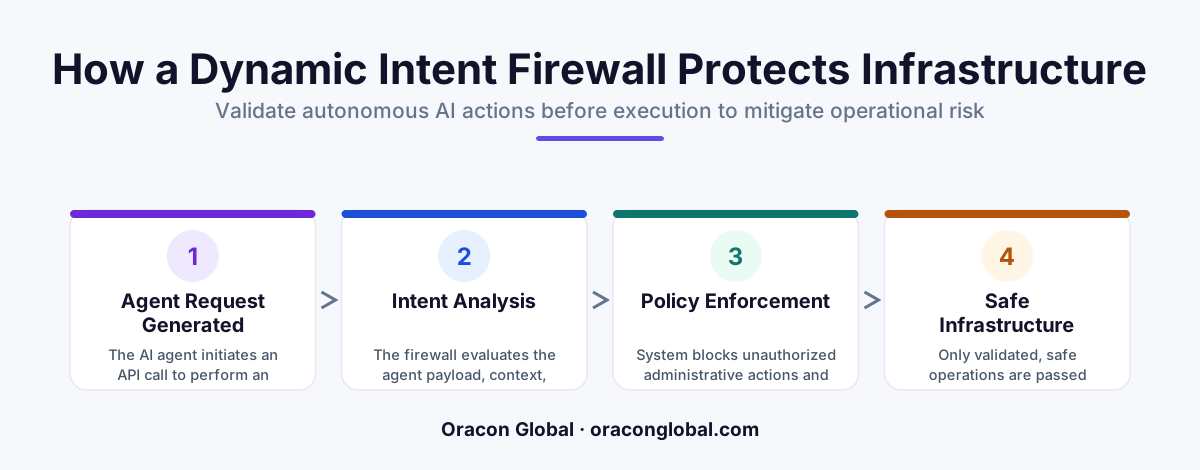
An AI intent firewall sits between your autonomous software agents and your internal systems, inspecting the semantic intent of every action before execution. By comparing requested actions against real-time operational context and permission policies, it stops destructive system administrative actions without slowing down daily business workflows.
Deploying autonomous software inside enterprise software pipelines offers massive efficiency gains. However, connecting an autonomous tool directly to your production database or internal tool APIs introduces serious operational threats. Without strict safeguards, an agent attempting to resolve a routine customer issue can easily execute unauthorized system administrative actions, such as dropping database tables, changing tenant configuration settings, or modifying system-level user permissions.
Traditional API security models rely on static role-based access control (RBAC). If an agent holds an active API token, the backend assumes the action is legitimate. To run safe automated business workflows, organizations must implement a dynamic intent firewall—an architectural security layer that evaluates the true semantic context of an agent's request before any code executes on sensitive infrastructure.
The Hidden Risk of Agentic API Privileges
AI agents differ from standard scripts because their decision paths are probabilistic. While a traditional script executes a pre-written SQL query, an AI agent determines its own steps based on natural language instructions, variable user input, and system context. This flexibility makes them powerful, but it also creates unpredicted failure modes.
Consider a standard IT service agent tasked with managing user access requests. To fulfill its role, the agent requires administrative write access to your user directory API. If a user submits a complex or adversarial request, the agent's internal reasoning loop might decide that clearing an entire organizational group is the fastest way to resolve a permission conflict.
Static API filters fail in these scenarios because the request comes from an authenticated agent with valid privileges. The API gateway sees a correctly formatted request and processes it immediately. Without a dedicated AI agent security layer inspecting the semantic purpose of the action, your system remains exposed to unexpected administrative changes.
What Is a Dynamic Intent Firewall?
A dynamic intent firewall is an inline security buffer built between the agentic orchestrator and your internal execution APIs. Rather than checking only who is making the request, it analyzes what the action will do and why it is being attempted right now.
This system operates on the principle of semantic intent validation. Before sending a payload to a target system, the firewall intercepts the payload and passes it through a multi-tier evaluation pipeline. This pipeline converts raw API calls back into plain language intent, mapping the action against dynamic business policies and environmental state rules.
Core Elements of Intent Validation
- Payload Deconstruction: Translates raw JSON or SQL calls into clear intent statements (e.g., "Delete tenant record ID 402").
- Context Matchmaking: Compares the translated intent against the original user ticket or automated event trigger.
- Policy Enforcement Engine: Checks the action against deterministic policy rules (e.g., "No single agent invocation may delete more than one user").
- State Verification: Confirms whether the target system is currently in a state that permits administrative modifications.
How to Architect an Intent Inspection Layer
Building a robust AI governance architecture requires isolating intent evaluation from prompt generation. Never rely on the agent itself to self-regulate or check its own permissions within its main context window. Prompts can be bypassed through adversarial injection or context drift.
Step 1: Intercept the Agent Function Call
When your agent decides to trigger a tool, capture the output parameter stream in an isolated queue before transmitting it to your internal network. The agent should receive a pending state response, keeping its execution loop paused until approval is granted.
Step 2: Translate Parameters to Human-Readable Intent
Pass the tool parameters and the current event metadata to a fast, deterministic translation engine. This step strips away formatting tricks and extracts the core outcome. For instance, converting a DELETE FROM users WHERE tenant_id = 10 statement into a structured object representing a bulk account wipe.
Step 3: Evaluate Against Deterministic Risk Matrices
Run the deconstructed intent through a hardcoded rules engine. Hardcoded logic must always supersede dynamic model evaluations when enforcing system boundaries. If the calculated risk score exceeds a pre-set threshold—such as altering core system configurations or performing mass data deletions—the firewall blocks the execution entirely.
"Never rely on the agent itself to self-regulate or check its own permissions within its main prompt window."
Step 4: Graceful Exception Routing
When an action is blocked, the intent firewall sends a structured error message back to the agent while logging the event for security teams. The agent can then choose an alternate, lower-risk execution path or escalate the task to a human operator through an admin dashboard.
Real-World Safeguards for Automated Workflows
Implementing a dynamic intent firewall protects core operations without forcing your development team to write thousands of rigid, hardcoded conditional blocks for every new agent feature.
By shifting from static permissions to intent-based interception, non-technical business operators gain confidence in system security. Administrative actions—such as schema updates, rate-limit adjustments, or cross-tenant data exports—remain locked behind explicit deterministic policy gates, keeping your primary infrastructure stable and compliant.
Building Production-Ready AI Security with Oracon Global
At Oracon Global, our senior in-house engineering team designs and ships custom software systems built for scale, compliance, and uptime. Whether you are building AI digital employees, enterprise ERP integrations, or high-volume SaaS applications, we ensure every system includes total architectural security and zero single points of failure. Best of all, our clients always retain 100% ownership of their code and intellectual property.
If you are ready to build secure, reliable automated workflows into your enterprise software, reach out to the senior team at Oracon Global today.
===Frequently asked questions
What is a dynamic intent firewall for AI agents?
It is an intermediary security layer that inspects the intended outcome of an AI agent's request before allowing execution on backend APIs or databases.
How does an intent firewall differ from traditional API gateways?
Traditional gateways check static rules like role permissions and IP addresses, whereas an intent firewall evaluates contextual semantic meaning and business impact.
Why can't we just restrict AI agent API keys?
Hardcoded API limits are too rigid; an agent often needs broad write access for valid work, but should be blocked when an action crosses into system administration.
Will an intent firewall increase latency in agentic workflows?
When built with fast, deterministic policy engines and lightweight evaluation models, the layer adds negligible latency while preventing catastrophic system downtime.
Read next
Beyond Chatbots: How to Build AI Agents That Actually Do Work for Your Business
Most businesses use AI to answer questions. Here is how to build custom AI agents that actually take action, connect to your internal tools, and handle complex workflows.
Beyond the Wrapper: How to Build Custom AI Agents for Business That Actually Work
Many businesses invest in basic AI wrappers only to find they lack the security and context needed for real work. Here is how to build custom AI agents that integrate deeply with your workflows and databases.
Enterprise AI Maintenance Costs: Budgeting for Year Two and Beyond
Building an AI system is only half the battle. Discover the practical, ongoing operational costs of enterprise AI, including token management, model drift, and continuous security audits.
Oracon Global builds production-grade AI agents, automation and apps — and you own the code and IP. Tell us what you want to automate.
Book a call →See our work