

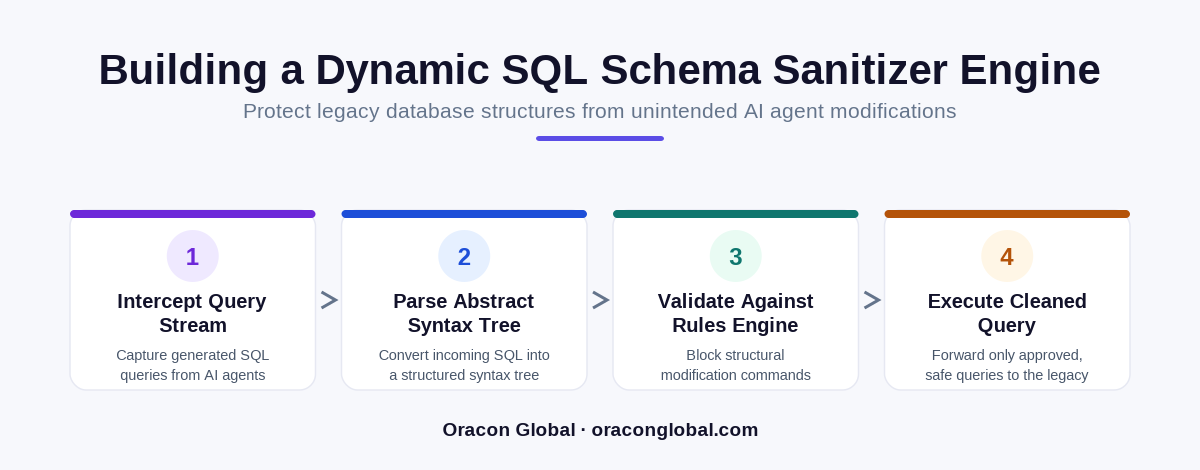
When autonomous AI agents write directly to legacy SQL databases, raw dynamic SQL generation risks accidental schema modifications, dropped tables, or altered constraints. A dynamic schema sanitizer engine sits between your AI execution layer and database driver, parsing SQL queries into Abstract Syntax Trees to strip out Data Definition Language commands. This allows safe, read-write operations without risking structural corruption.
Connecting autonomous AI agents to legacy enterprise databases is one of the fastest ways to eliminate manual data entry, streamline operations, and automate complex workflows. However, granting an AI model execution rights over a legacy SQL database introduces an immediate architectural risk: dynamic schema mutation.
Large Language Models operate non-deterministically. Even when instructed to only query or insert record data, an agent attempting to resolve a database constraint, format mismatch, or missing column may dynamically attempt to execute Data Definition Language (DDL) statements like ALTER TABLE, DROP INDEX, or CREATE TABLE. In legacy SQL environments, where downstream applications and reporting tools rely on rigid, decades-old database schemas, a single unauthorized structural change can crash critical line-of-business systems.
Relying on system prompts to enforce database guardrails is a recipe for silent failure. To guarantee system stability, software teams must implement a dynamic schema sanitizer engine—a deterministic middleware layer that validates and cleans generated SQL before it touches production tables.
The Hidden Risk of AI Agents in Legacy Databases
When engineering custom AI agents or AI digital employees for enterprise environments, developers usually grant the agent access to SQL execution tools. The agent uses LLM reasoning to translate user requests into standard SQL statements like SELECT, INSERT, and UPDATE.
The problem arises when an agent encounters unexpected data anomalies, such as an oversized string payload or a foreign key conflict. Rather than failing gracefully, advanced LLMs often attempt to "fix" the underlying issue by altering the database structure to accommodate the bad payload. Common unauthorized modifications include:
- Broadening column types: Converting fixed
VARCHAR(20)fields toTEXTto force fitting long data. - Dropping safety constraints: Removing
NOT NULLorUNIQUEconstraints when payload validation fails. - Truncating temporary tables: Running destructive cleanups on shared staging environments.
- Creating arbitrary index locks: Generating non-standard indexes that degrade database performance under heavy read loads.
To preserve database integrity, your backend architecture must treat every AI-generated query as unverified user input.
What Is a Dynamic Schema Sanitizer Engine?
A dynamic schema sanitizer engine acts as an intelligent firewall positioned directly between your AI agent's tool-execution layer and your SQL database driver. Unlike standard static permissions that broadly permit or block connections, a schema sanitizer dynamically evaluates the AST (Abstract Syntax Tree) of incoming queries at runtime.
Rather than relying on simple regex pattern matching—which can easily be bypassed by complex SQL formatting or subqueries—the sanitizer parses the query into a structured tree, checks the node intent against strict security rules, and strips out or rejects any attempt to modify database structures.
Key Functions of the Sanitizer Engine
- AST Query Decomposition: Breaks SQL commands down into tokens, statement types, targets, and conditions.
- DDL Blacklisting & Command Isolation: Immediately aborts queries containing structural modification operations like
ALTER,DROP,RENAME, orTRUNCATE. - Schema Mapping Enforcement: Verifies that target tables and columns match an approved static schema blueprint.
- Dynamic Exception Generation: Converts unsafe SQL attempts into safe, structured operational feedback that gets routed back to the AI agent for retry.
Building a Schema Sanitizer Engine: Architectural Overview
Building an effective database firewall for AI agents requires a clean, three-phase execution pipeline within your backend middleware.
1. Tokenization and Parsing Layer
The engine receives the raw string payload generated by the LLM. Instead of executing the query immediately, it passes the string to a fast, local SQL parser library. The parser converts the text string into a syntax tree representing the query's structural intent.
If the query fails parsing due to malformed syntax, the execution is immediately halted, returning a formatted syntax error to the agent to attempt a clean re-generation.
2. Policy & Structural Intent Inspection
Once transformed into an AST, the engine checks the top-level command type. Safe operational intent is isolated into strict classifications:
- Allowed Data Manipulation (DML):
SELECT,INSERT,UPDATE(with strictWHEREclause enforcement). - Forbidden Schema Alteration (DDL):
ALTER,DROP,CREATE,TRUNCATE,GRANT,REVOKE.
If a forbidden node type is detected anywhere within the syntax tree—including nested subqueries or CTEs (Common Table Expressions)—the query is dropped before hitting the database connection pool.
3. Graceful Exception Feedback Loop
Simply throwing a generic database error when an agent attempts a schema change causes the workflow to stall. The schema sanitizer translates blocked DDL attempts into deterministic context messages for the LLM.
For example, if an agent generates ALTER TABLE orders ALTER COLUMN notes TYPE TEXT;, the engine intercepts the command and returns: "Security Exception: Schema modifications are strictly prohibited. Adjust payload values to match existing table column boundaries instead." This allows the agent to self-correct its payload without human intervention or system downtime.
Complementing Database Roles with Application Safety Layers
A common question from technical leaders is why database-level user permissions (such as assigning a read-write SQL role without DDL privileges) are not sufficient on their own.
While database role separation is a vital baseline security measure, relying solely on SQL server exceptions leads to brittle AI workflows. When a legacy database rejects a query via a permission denial driver error, it frequently terminates the active database transaction, creates unhandled execution state timeouts, or leaves high-level agent state loops hanging.
A dedicated dynamic schema sanitizer engine handles security checks application-side. It prevents unnecessary database connections, keeps transaction pools healthy, structures error handling cleanly, and ensures your legacy SQL databases remain fast, predictable, and fully protected.
Safe AI Integrations Built for Production
Integrating autonomous AI agents into mission-critical business systems requires strict safety boundaries, custom architectural controls, and robust error management. At Oracon Global, our senior in-house engineering team designs and ships custom enterprise software, AI agents, and AI-native ERP architectures designed to scale safely alongside your existing database infrastructure.
Whether you need to connect intelligent automation to legacy SQL environments or build custom workflow applications with dedicated guardrails, we build robust solutions tailored specifically to your business operations—with 100% IP ownership maintained by you.
Ready to automate your operations safely? Explore live AI demos on Oracon Global or talk with our team to discuss your engineering roadmap today.
Frequently asked questions
What is a dynamic schema sanitizer engine?
It is an architectural safety layer that sits between an AI agent and a legacy SQL database to inspect, parse, and block unauthorized schema modification commands like ALTER, DROP, or TRUNCATE before execution.
Why cannot we just rely on system prompts to stop AI agents from altering SQL schemas?
System prompts are non-deterministic recommendations, not hard security controls. Under complex context windows or prompt injection attacks, an LLM can still generate raw DDL queries that alter database structures.
Will a dynamic schema sanitizer slow down my database query performance?
No, when built as a lightweight AST (Abstract Syntax Tree) parsing layer, schema sanitization adds negligible microsecond-level overhead, which is far faster than the LLM's own network response time.
Do we need to refactor our legacy database to install a dynamic schema sanitizer engine?
No, a schema sanitizer functions as middleware or an API gateway layer between the AI agent's tool execution framework and your existing database connection strings, requiring zero changes to your underlying legacy schema.
Read next
Beyond Chatbots: How to Build AI Agents That Actually Do Work for Your Business
Most businesses use AI to answer questions. Here is how to build custom AI agents that actually take action, connect to your internal tools, and handle complex workflows.
Beyond the Wrapper: How to Build Custom AI Agents for Business That Actually Work
Many businesses invest in basic AI wrappers only to find they lack the security and context needed for real work. Here is how to build custom AI agents that integrate deeply with your workflows and databases.
Enterprise AI Maintenance Costs: Budgeting for Year Two and Beyond
Building an AI system is only half the battle. Discover the practical, ongoing operational costs of enterprise AI, including token management, model drift, and continuous security audits.
Oracon Global builds production-grade AI agents, automation and apps — and you own the code and IP. Tell us what you want to automate.
Book a call →See our work