

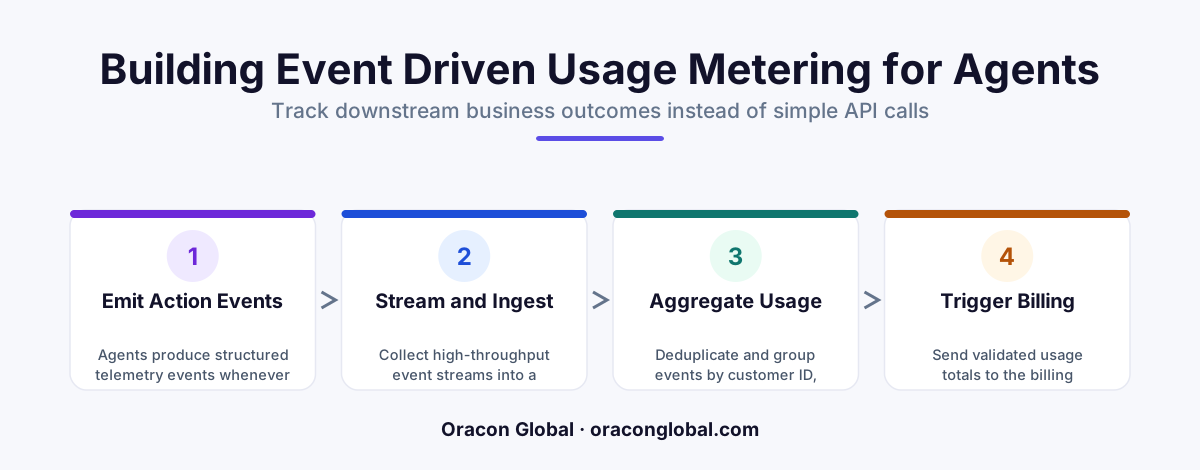
Charging agentic SaaS users per API call penalizes your margins when agents loop to solve complex problems, while per-seat pricing fails when AI replaces human users. An event-driven usage metering pipeline decouples execution work from client billing by catching downstream agent events, validating their completion, and converting completed business outcomes into accurate billable units.
Traditional B2B SaaS pricing was built around human seats and static API calls. If a user logged into a dashboard, you charged them monthly for the seat. If they connected an integration, you billed them per request. However, when software evolves into autonomous AI agents that run multi-step workflows without human intervention, those legacy billing models fall apart.
If you build an autonomous agent that takes 15 internal LLM loops, three vector search retrievals, and two database lookups to reconcile a single invoice, charging the customer per API call leads to chaotic, unpredictable invoices. Conversely, charging per seat makes no sense when the agent is replacing the human seat entirely. To capture value fairly and protect your margins, you need an event-driven usage metering architecture designed specifically for agentic SaaS billing. By capturing verified downstream agent actions, you can charge clients for completed business outcomes instead of low-level infrastructure calls.
Why API-Based Billing Fails Autonomous AI Workflows
When building custom SaaS products, founders often start by passing LLM token costs directly to the end user with a mark-up. While simple to implement, this approach creates major operational problems for agentic software:
- Unpredictable Customer Invoices: An AI agent attempting to solve an edge case might execute seven reasoning loops today and two tomorrow for the exact same end result. Customers dislike variable pricing tied to model reasoning variations.
- Margin Compression: If an agent gets stuck in a retry loop or requires a larger model context window to fix an error, your backend infrastructure costs spike while the customer receives no additional business value.
- Misaligned Value: Customers do not care how many tokens an agent consumed. They care that a support ticket was resolved, a document was parsed, or an inventory record was updated.
To implement true value-based pricing, your system needs to decouple internal model execution from outward usage metering. You achieve this by introducing an event-driven pipeline that Listens for completed downstream actions.
Architecting the Event-Driven Usage Metering Pipeline
An effective usage-based billing pipeline must handle high throughput, guarantee event deliverability, and enforce strict idempotency so clients are never billed twice for the same background task. The architecture relies on four fundamental layers.
1. The Downstream Action Broker
Instead of placing metering code directly inside your prompt execution functions, your agents emit semantic domain events whenever they complete a meaningful unit of work. For example, when an agent successfully posts a verified payment entry into a downstream accounting system, it emits an event such as invoice.reconciled.
This event is pushed to an asynchronous event broker like Apache Kafka or AWS EventBridge. The event payload carries metadata about the tenant, the session ID, the target system, and the specific outcome achieved, completely isolated from the raw token count used behind the scenes.
2. The Idempotency and Validation Engine
In distributed agent architectures, network blips and API retries are common. If an agent retries a failed step, the event broker might receive duplicate progress signals. A specialized validation worker processes the incoming stream, checking transaction IDs against a real-time state database like Redis.
If the action has already been metered for that specific workflow execution, the duplicate signal is silently dropped. This step guarantees that your agent action metering layer only counts confirmed, unique business actions.
3. The Dynamic Value Mapping Layer
Not all agent actions carry equal weight. Creating a draft document might be worth one credit, while executing a multi-system database migration might be worth fifty credits. The mapping layer ingests the validated domain event and evaluates it against the tenant's current pricing plan.
By keeping this business logic separate from your core AI reasoning code, your product team can adjust pricing tiers, grant usage allowances, or modify credit weights without redeploying your agent orchestration code.
4. The Immutable Usage Ledger
Once transformed into billable units, the usage record is written to an append-only, immutable database table. This ledger serves as the single source of truth for both monthly invoicing and customer-facing usage dashboards. Because the ledger references the unique event ID and the downstream system acknowledgment, your customer success team can answer billing inquiries with complete operational auditability.
Key Technical Requirements for Reliable Billing
When engineering an event-driven metering engine for production SaaS platforms, several non-negotiable guardrails must be established:
- Out-of-Band Processing: Metering logic must never execute on the critical path of the agent's reasoning loop. If the billing database slows down, your AI agent should continue serving users without latency spikes.
- Dead-Letter Queues (DLQs): Any unparseable or unverified action events must route immediately to a dead-letter queue for manual review rather than failing silently or blocking the event pipeline.
- Real-Time Credit Checking: If a client operates on a prepaid credit model, the gateway must evaluate their remaining balance before launching high-cost agent workflows, while leaving final ledger writes to the downstream event worker.
Building Agentic SaaS Platforms That Scale Safely
Transitioning your SaaS product from legacy seat-based pricing to outcome-based pricing is essential for staying competitive as AI agents take over modern workflows. Capturing value at the action level aligns your software's revenue directly with the ROI you deliver to your customers, while protecting your operating margins against fluctuating API costs.
Building resilient, event-driven infrastructure requires senior engineering expertise across asynchronous architecture, distributed data systems, and custom AI orchestration. At Oracon Global, our senior in-house engineering team designs and builds custom AI agents, AI-native ERPs, and complete SaaS platforms. Every line of code and piece of intellectual property we write belongs entirely to you.
If you are ready to modernize your SaaS infrastructure or build an autonomous agent platform built for scale, explore our live AI demos at Oracon Global or reach out to our team to start the conversation.
Frequently asked questions
What is event-driven usage metering for agentic SaaS?
It is an architecture that captures downstream events generated when an AI agent completes a real task, allowing you to bill clients based on outcomes rather than raw API calls or tokens.
Why shouldn't I bill agentic SaaS by LLM API calls or tokens?
API call volume varies widely depending on prompt complexity, retry loops, and model routing. Billing per API call makes customer costs unpredictable and punishes software efficiency.
How does an event-driven metering pipeline prevent duplicate billing?
The pipeline uses idempotent event ingestion and transaction ledgers that verify an action was successfully executed and acknowledged by downstream systems before generating a billing record.
Do clients own the intellectual property when Oracon Global builds custom software?
Yes, clients retain 100 percent ownership of the source code, architecture, and intellectual property for all custom solutions built by Oracon Global.
Read next
Beyond Chatbots: How to Build AI Agents That Actually Do Work for Your Business
Most businesses use AI to answer questions. Here is how to build custom AI agents that actually take action, connect to your internal tools, and handle complex workflows.
Beyond the Wrapper: How to Build Custom AI Agents for Business That Actually Work
Many businesses invest in basic AI wrappers only to find they lack the security and context needed for real work. Here is how to build custom AI agents that integrate deeply with your workflows and databases.
Enterprise AI Maintenance Costs: Budgeting for Year Two and Beyond
Building an AI system is only half the battle. Discover the practical, ongoing operational costs of enterprise AI, including token management, model drift, and continuous security audits.
Oracon Global builds production-grade AI agents, automation and apps — and you own the code and IP. Tell us what you want to automate.
Book a call →See our work