

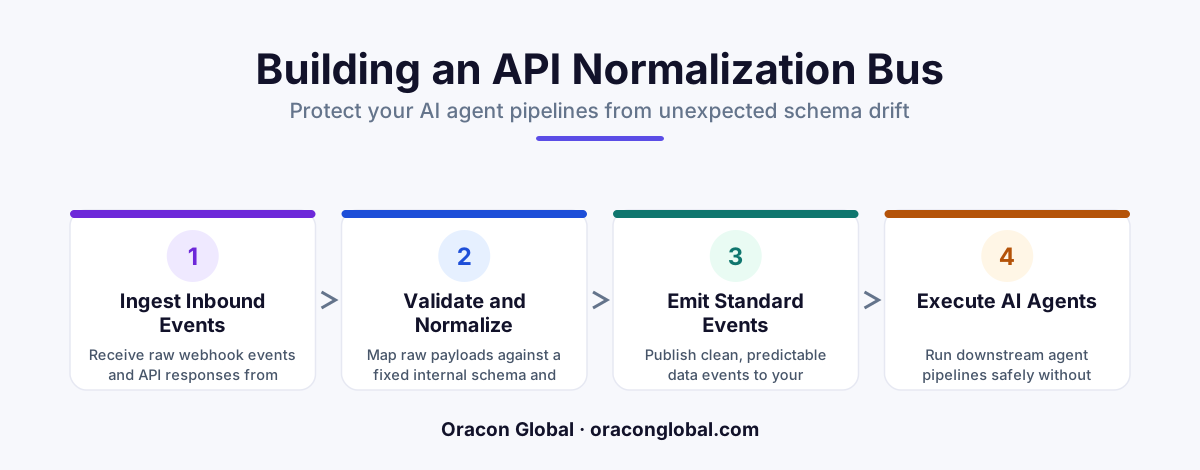
Unannounced API updates from third-party platforms cause silent failures and crashes in custom AI agent workflows. An event-driven API normalization bus acts as a protective buffer between incoming payloads and your agent’s execution core. By decoupling ingestion, validating payload structures, and translating incoming fields into a standardized internal schema before execution, your business software remains immune to external developer updates.
Building an autonomous digital employee or custom software workflow to handle daily operational tasks is one of the most effective investments a business can make. However, once your system transitions from a quick prototype into a live environment, it meets an unpredictable real-world hazard: external software changes. When third-party vendors update their payload structures, shift parameter names, or deprecate data fields without warning, your system encounters schema drift in AI pipelines. If your software architecture pipes external data straight into an operational agent, these subtle structural shifts can instantly cause execution failures, bad database updates, or severe downtime.
To keep custom software robust and reliable, engineering teams must decouple third-party data collection from internal business logic. Building an event-driven API normalization bus ensures that unexpected API alterations never compromise your underlying systems, keeping your digital workflows running smoothly regardless of outside updates.
Understanding Schema Drift and Its Impact on Software Agents
Schema drift happens whenever the structural format of incoming data changes upstream. In classic web applications, a missing JSON key might trigger a readable error log or a simple UI glitch. But when autonomous tools process real-world workflows, a structural change can cascade into much larger issues across your technical infrastructure.
Consider an automated system built to handle inventory restocks, shipping verification, or client onboarding. If a logistics partner alters their webhook response by changing an operational field from shipment_id to tracking_number, an unbuffered system will encounter immediate friction:
- Silent Execution Drops: The pipeline fails to find expected fields, causing execution loops to fail quietly while task queues back up.
- Resource Waste and High Costs: The underlying processing engine repeatedly retries complex tasks with malformed data, consuming platform budgets without completing work.
- Corrupted Internal Records: If the model attempts to guess missing fields, it may write inaccurate information directly into your primary operational database.
- Uncontrolled System Errors: Malformed payloads pass through validation checks, causing downstream microservices to throw unhandled exceptions.
Relying on model intelligence or longer context prompts to continuously guess and interpret fluctuating payload structures is slow, expensive, and fragile. Deterministic logic belongs in your architecture, not in flexible prompt instructions.
What Is an Event-Driven API Normalization Bus?
An API normalization bus is a dedicated architectural layer that sits between incoming raw external webhooks and your internal digital workers. Instead of allowing external systems to hand payload data directly to your processing queues, every incoming event is captured, held safely, and translated into a unified internal format.
By making this layer event-driven, incoming requests are accepted instantly and buffered in a queue. This decouples payload reception from payload execution. If a vendor payload breaks, your system isolates the specific event in a safe staging buffer without stalling the rest of your company's operational software.
The Architecture: How Data Flows Through the Bus
A resilient normalization pipeline processes data through four defined stages before handing instructions off to an operational agent:
- Ingestion and Event Buffering: Incoming HTTP webhooks or API responses are stored raw inside an asynchronous messaging queue (such as Redis Streams or RabbitMQ). The external system receives an immediate success response, preventing connection timeouts.
- Schema Validation: The bus evaluates the raw payload against a predefined data contract. If expected fields match internal rules, the payload moves instantly to translation.
- Payload Normalization: A light parsing microservice converts external key names, timestamp structures, and data types into your company's standardized internal schema.
- Safe Dispatch: The clean, validated payload is published to the internal execution topic, where your digital workforce picks it up with absolute operational certainty.
Key Steps to Constructing a Resilient Normalization Layer
Designing a system that handles structural API changes requires strict boundaries between external communication interfaces and core application state machines. Here is how senior engineering teams construct these protections.
1. Establish a Immutable Canonical Data Schema
Your internal systems should never adapt to vendor-specific naming conventions. Define an immutable standard format for core operational records within your application domain. Whether a data source calls a customer ID client_ref, user_id, or account_num, the normalization layer must convert that key into your internal variable name before it reaches your business logic.
2. Implement Strict Edge Validation Guards
Use fast, lightweight validation schemas (like Zod or Pydantic) at the ingestion point. If a third-party vendor updates an API and drops a required field, the validation guard immediately flags the incoming payload as non-compliant before any heavy processing begins. This prevents structural errors from polluting downstream execution contexts.
3. Build an Automated Exception Quarantine Queue
When an incoming event fails schema validation due to upstream changes, it should not disappear or crash your service. The normalization bus automatically routes malformed payloads to a quarantine queue. The pipeline flags the structural drift for developers while retaining the original event. Once a quick mapping update is applied to the bus, queued payloads can be replayed safely without losing business data.
Architecture rule: Software logic should only interact with data that matches your internal schema contracts. Never allow raw third-party payloads to reach core application state machines directly.
The Strategic Advantages of Ownable Data Infrastructure
Relying on hasty third-party integrations or fragile no-code automation wrappers leaves your operations vulnerable to unexpected upstream changes. When you build dedicated, event-driven infrastructure, your business gains long-term operational resilience:
- Complete IP Ownership: Your core business workflows, mapping logic, and system architectures remain custom assets fully owned by your business.
- Predictable System Performance: Pre-validating data eliminates unexpected processing loops and keeps platform usage fees completely predictable.
- Multi-Vendor Flexibility: Swap external vendors, APIs, or software providers anytime without needing to rewrite your core operational software.
- High Reliability at Scale: Decoupled message queues mean system maintenance or third-party outages never cause lost requests or dropped customer records.
Future-Proof Your Custom Software and Workflows
As businesses deploy software workers to manage increasingly complex data pipelines, system reliability depends entirely on structural stability. Unannounced external platform updates and breaking API changes are inevitable, but software failures are entirely preventable.
Building an event-driven normalization bus provides your platforms with a permanent buffer against the noisy, unpredictable broader software ecosystem. By enforcing strict data contracts at the system boundary, your custom tools remain focused, fast, and entirely immune to external schema drift.
If you are building custom AI agents, web applications, or scalable backend pipelines and need an experienced engineering partner to ensure your infrastructure holds up under load, reach out to the senior engineering team at Oracon Global today.
Frequently asked questions
What is schema drift in AI agent pipelines?
Schema drift occurs when an external vendor or partner changes their API payload structure—such as renaming a field, altering a data format, or dropping a key—without notifying your system. When custom AI agents attempt to read the altered data, they often crash, hallucinate, or fail to complete tasks.
How does an API normalization bus prevent AI agent crashes?
An API normalization bus acts as an intermediate ingestion and translation layer. Instead of piping external webhook or API data directly into an AI agent, the bus captures the event, validates it against a strict internal contract, normalizes the data into a standard schema, and routes it safely to your agent core.
Why can't I just use strict prompt instructions to handle API schema changes?
Relying on Large Language Models to dynamically parse changing JSON schemas is expensive, slow, and non-deterministic. If an external API field vanishes or shifts type, the AI agent may hallucinate missing information or execute invalid database updates. Schema stability belongs in software architecture, not prompt engineering.
Does implementing an event-driven bus add latency to my AI workflows?
When engineered correctly, an asynchronous event bus adds negligible latency (often under 20 milliseconds) while providing immense operational security. By offloading parsing and translation to a dedicated event queue, your AI agents run faster because they consume pre-validated, clean payloads every single time.
Read next
Beyond Chatbots: How to Build AI Agents That Actually Do Work for Your Business
Most businesses use AI to answer questions. Here is how to build custom AI agents that actually take action, connect to your internal tools, and handle complex workflows.
Beyond the Wrapper: How to Build Custom AI Agents for Business That Actually Work
Many businesses invest in basic AI wrappers only to find they lack the security and context needed for real work. Here is how to build custom AI agents that integrate deeply with your workflows and databases.
Enterprise AI Maintenance Costs: Budgeting for Year Two and Beyond
Building an AI system is only half the battle. Discover the practical, ongoing operational costs of enterprise AI, including token management, model drift, and continuous security audits.
Oracon Global builds production-grade AI agents, automation and apps — and you own the code and IP. Tell us what you want to automate.
Book a call →See our work