

AI-native e-commerce platforms fail when autonomous agents misinterpret raw, unstandardized vendor SKU formats across international borders. Building a custom middleware mapping layer forces deterministic validation before data reaches your AI models, eliminating shipping errors and inventory mismatches.
AI-native e-commerce platforms promise something incredible: autonomous operations that can source products, manage listings, adjust pricing, and route orders without constant human intervention. But when you scale these platforms to handle multi-vendor marketplaces across international borders, a silent point of failure emerges at the database level.
That failure is the product SKU. When multiple global vendors supply similar products, their Stock Keeping Unit (SKU) schemas rarely align. One supplier might use a simple alphanumeric string, another might rely on serialized barcode formats, and a third might include regional language prefixes. If you feed these mismatched, raw identifiers directly into an AI agent, the model will eventually misinterpret the data, group unrelated items together, and ship the wrong products to your customers.
To prevent these costly errors, you need a deterministic multi-vendor inventory mapping layer. Here is how to design a system that keeps your cross-border SKU schemas perfectly aligned on modern AI e-commerce platforms.
The Danger of Relying on AI for Exact Matches
Large language models (LLMs) are excellent at understanding context, sentiment, and unstructured text. They are notoriously bad, however, at matching exact database keys when those keys do not follow a strict, standardized pattern.
If a vendor in Germany lists a product as BLK-SHRT-L-01 and a vendor in Japan lists the exact same item as KURO-T-LGE, a human operator or a highly trained AI agent might intuitively guess they are the same thing. However, letting an AI make autonomous decisions on raw inventory strings introduces structural risk. The AI might confidently assume two different black shirts are identical, causing your platform to draw from the wrong supplier's stock, mess up regional tax calculations, or miscalculate shipping weights.
To build a resilient platform, you must decouple semantic search (what the AI uses to help customers find products) from the underlying transactional logic (how your database tracks physical boxes). This is where a custom inventory layer becomes essential.
Architecting the Custom Inventory Mapping Layer
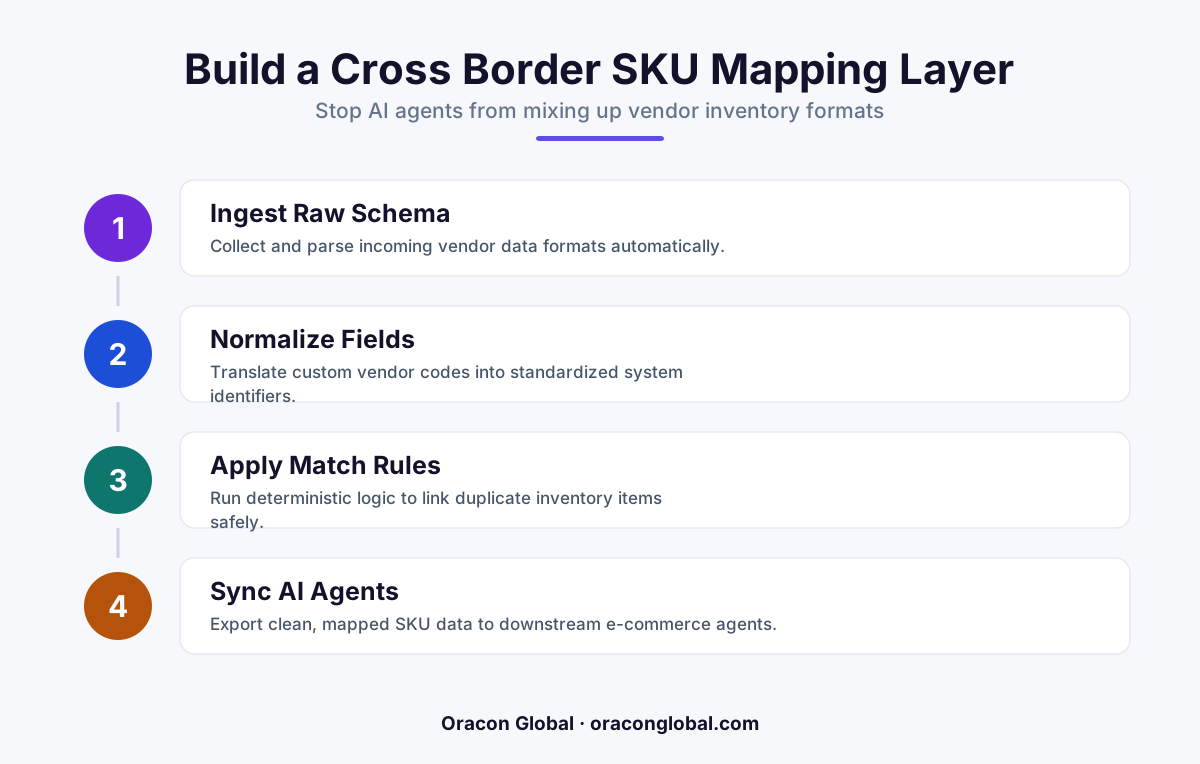
A reliable mapping layer acts as an airlock between your external vendors and your internal database. Instead of letting your AI agents query raw vendor spreadsheets or API endpoints directly, all incoming product data must pass through a structured pipeline that enforces product data harmonization.
The golden rule of AI-native architecture: Never let an AI make an assumption about a primary key. Translate the key first, then let the AI work with the standardized output.
A typical production architecture for this pipeline relies on three distinct steps:
- The Ingestion Gateway: A set of lightweight, vendor-specific API connectors or file parsers that pull raw inventory updates from your suppliers.
- The Translation Engine: A rule-based microservice that matches incoming vendor identifiers against your internal, master SKU format (often using standardized Global Trade Item Numbers, or GTINs, as an anchor).
- The Semantic Metadata Enricher: This is where AI actually belongs. Once the SKU is mapped safely in the database, your AI can parse the unstructured product description, tag attributes (color, material, size), and prepare the listing for the front-end marketplace.
Designing the Master Schema
Your internal database should use a single, immutable Master SKU format. Every external vendor SKU is then mapped to this Master SKU in a relational table. The schema for this mapping table should look something like this:
- Master_SKU_ID: Your internal, globally unique identifier (e.g., US-APP-0982-L).
- Vendor_ID: The unique identifier of the supplier.
- Vendor_Raw_SKU: The messy, original string provided by the vendor.
- Region_Code: The originating country or tax jurisdiction.
- Last_Sync_Timestamp: When the inventory count was last verified.
Handling Regional Deviations and Edge Cases
Cross-border e-commerce introduces complexities beyond simple translation. You must also account for localized pack sizes, bundled offers, and varying measurement systems. For example, a "pack of 12" in one country might be sold individually in another under a slightly altered SKU suffix.
Your custom mapping layer must include programmatic validation steps that check for these discrepancies. If a vendor's inventory update shows a massive price drop or a sudden spike in available units, the mapping layer should flag this transition as an anomaly. Rather than allowing the AI to process the change blindly, the system drops the update into a human-in-the-loop review queue.
This deterministic approach ensures that your platform maintains absolute pricing and inventory integrity, even when foreign suppliers update their backend catalogs unexpectedly.
Why Building Custom In-House Software Wins
Many founders are tempted to patch these issues using generic, off-the-shelf integration tools. While these tools can connect API endpoints, they rarely have the flexibility required to handle complex, cross-border business logic and custom AI pipelines. They also lock you into ongoing monthly subscription fees that scale alongside your transaction volume.
When you build a custom mapping layer with a dedicated development partner, you gain complete control over your technical destiny. You own 100% of the code and intellectual property. More importantly, your software can be tailored specifically to your operational workflows, ensuring that your AI agents operate on perfectly clean data every single second of the day.
Taking the Next Step with Oracon Global
Building custom, production-grade systems that bridge complex databases and AI agents is exactly what we do. At Oracon Global, our senior in-house engineering team designs and builds high-performance AI engines, custom web and mobile applications, and enterprise-grade workflow automation tools for businesses worldwide.
If you are ready to eliminate inventory errors and scale your e-commerce operations with software built to last, we should talk. Reach out to our team at Oracon Global today to schedule a practical, non-technical consultation about your next build.
Frequently asked questions
Why do AI e-commerce platforms struggle with cross-border SKUs?
AI models are highly capable at semantic reasoning, but they lack the rigid constraints needed to map highly variable, non-standardized SKU schemas across global vendors without occasionally making false assumptions.
What is a custom multi-vendor inventory mapping layer?
It is a dedicated software middleware service that ingests, cleans, and translates disparate supplier product data into a single, standardized schema before it is processed by your database or AI tools.
Can we rely on LLMs to translate product codes directly?
Relying solely on LLMs for direct identifier mapping leads to hallucinated product codes, mismatched orders, and expensive shipping errors. LLMs should assist in categorization, not the core identification lookup.
How does this architecture protect our system IP?
By building a custom mapping layer internally rather than renting third-party middleware, you retain 100% ownership of your core data pipeline, business logic, and proprietary code.===
Read next
Beyond Chatbots: How to Build AI Agents That Actually Do Work for Your Business
Most businesses use AI to answer questions. Here is how to build custom AI agents that actually take action, connect to your internal tools, and handle complex workflows.
Beyond the Wrapper: How to Build Custom AI Agents for Business That Actually Work
Many businesses invest in basic AI wrappers only to find they lack the security and context needed for real work. Here is how to build custom AI agents that integrate deeply with your workflows and databases.
Enterprise AI Maintenance Costs: Budgeting for Year Two and Beyond
Building an AI system is only half the battle. Discover the practical, ongoing operational costs of enterprise AI, including token management, model drift, and continuous security audits.
Oracon Global builds production-grade AI agents, automation and apps — and you own the code and IP. Tell us what you want to automate.
Book a call →See our work