

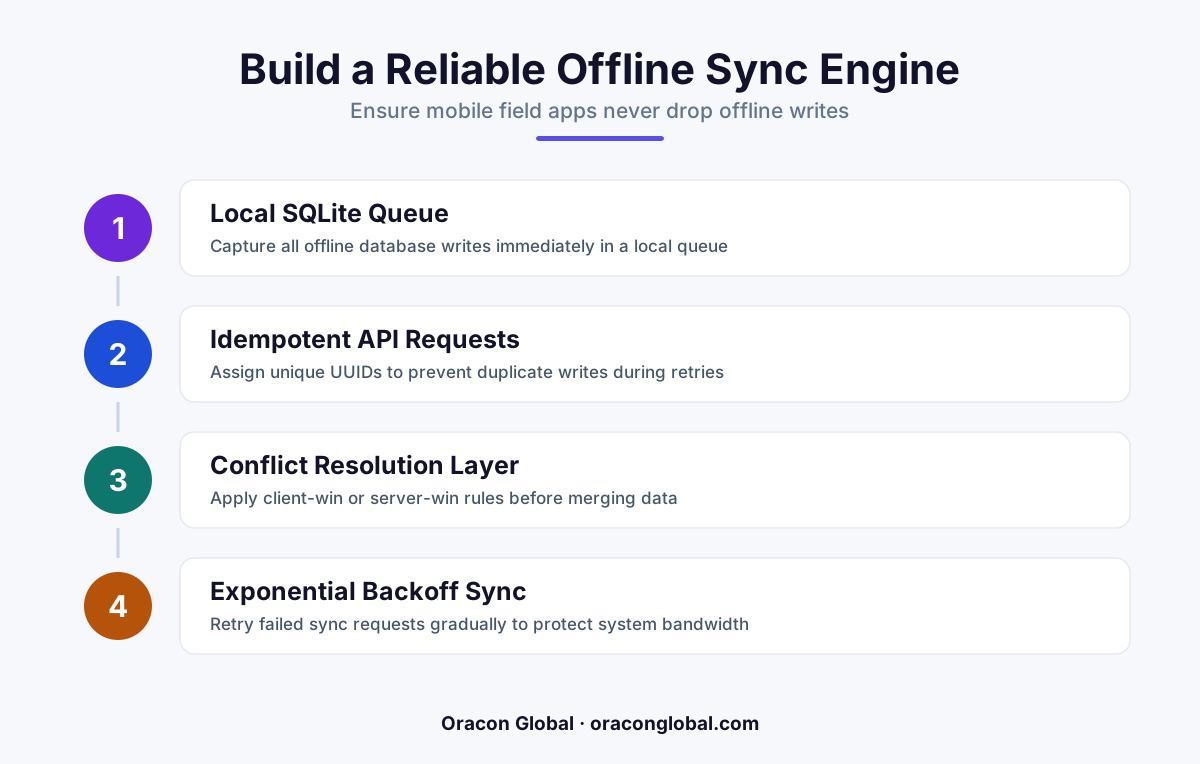
Standard out-of-the-box offline databases fail when multiple field workers upload massive data volumes simultaneously. By building a custom multi-vendor sync engine using local queues, cryptographic sequence hashing, and transactional outbox patterns, you can prevent dropped offline database writes entirely.
Field service workers, logistics drivers, and remote operators do not work in air-conditioned offices with high-speed fiber internet. They operate in remote basements, rural transit routes, and industrial zones where cellular coverage drops constantly. Yet, these professionals rely on native mobile apps to log compliance checks, update inventory, and record customer signatures.
When an app goes offline, it must save those entries locally. But the real engineering challenge begins when the device reconnects to the network. Standard, out-of-the-box database synchronization tools often crumble under high-volume database syncs. When dozens of devices reconnect simultaneously, they flood your backend with competing writes, resulting in dropped data, overwritten records, and frustrated operations teams. To solve this, you need a robust, custom mobile offline sync engine designed for real-world field conditions.
Why Traditional Offline Database Syncs Break
Most standard mobile frameworks handle offline data using a naive approach: they save changes locally and push them to the server when a connection returns. If two users edit the same piece of data offline, the system typically relies on a last-write-wins protocol. This design is highly vulnerable to issues during peak operational hours.
Consider a field service team auditing electrical substations. Technician A updates a safety log at 2:15 PM while deep underground without service. Technician B, working above ground with a stable connection, updates the same record at 2:20 PM. When Technician A returns to the surface at 2:30 PM, their app syncs. Under a last-write-wins rule, Technician A's older offline write might silently overwrite the newer online data, or worse, get rejected entirely by the server. This causes a dropped write, leaving your database inaccurate.
To prevent this, custom field service app development must focus on preserving the intent of every single action, rather than simply matching current database states. This requires a dedicated, transaction-safe local architecture.
Building a Reliable Native Mobile Database Writes Pipeline
To guarantee that no local data is lost, you must build an event-driven sync architecture directly inside the mobile client. This process relies on three fundamental architectural pillars:
- The Local Transactional Outbox: Instead of directly modifying the local representation of your database, every user action (such as saving a form, updating a status, or uploading a signature) is written to an immutable queue in a local SQLite database. The action is recorded as a pending event transaction first.
- Cryptographic Sequence Idempotency: Every offline event is stamped with a unique, cryptographically secure sequence token and a device-specific ID. This ensures that even if the mobile app transmits the same event three times due to a flickering cellular connection, the backend database will only process it once.
- Optimistic UI Rendering: To keep the mobile app responsive, the user interface reflects the change instantly using local state. Behind the scenes, the outbox queue manages the heavy lifting of network retries without blocking the field worker's workflow.
Designing the Multi-Vendor Reconciler on the Backend
Once the offline data payloads successfully reach your servers, your backend must handle the high-volume incoming traffic without locking your database tables. This is where a custom reconciliation layer becomes essential. Standard APIs try to write directly to the primary database, which leads to timeouts when hundreds of field devices reconnect at the same moment.
A resilient database sync architecture separates the intake of data from the actual database write. We achieve this by routing all incoming mobile sync requests into an event stream. The server acknowledges receipt of the raw payload immediately, allowing the mobile device to clear its local outbox queue. The backend then processes the event stream asynchronously, validating each change, resolving logical conflicts, and updating your systems of record in the correct order.
How to Handle Conflicting Edits Gracefully
When two contradictory edits occur offline, a custom sync engine uses predefined business rules instead of blind database overwrites. The table below illustrates how different conflict scenarios are safely resolved:
| Conflict Type | The Problem | The Custom Sync Engine Resolution |
|---|---|---|
| Concurrent Status Edits | Two technicians update the status of the same asset offline. | State machine validation. The system transitions only to the most logically advanced state (e.g., "Completed" supersedes "In Progress"). |
| Simultaneous Field Form Edits | Two users edit different text fields on the same inspection sheet. | Field-level patching. The engine merges the changes, updating only the specific fields modified by each user rather than overwriting the entire row. |
| Sequential Asset Deduplication | A field worker creates a new asset record offline that already exists in the central database. | Deterministic hashing. The engine matches high-confidence fields (like serial numbers) and merges the offline history into the existing profile. |
Protecting Your Core Systems and Legacy APIs
Modern mobile apps often need to sync data with multiple third-party systems, such as legacy ERPs, inventory management platforms, and customer databases. These external systems are rarely built to handle thousands of rapid-fire API writes when a field team reconnects at the end of a shift.
By implementing a custom multi-vendor sync engine, you create a protective buffer between your mobile fleet and your core business systems. The engine takes the high-volume native mobile database writes, sanitizes them, and schedules them. If a legacy vendor API goes down or rate-limits your system, the sync engine pauses the outbound queue and retries gracefully, keeping your field workers completely unaffected.
This decoupling ensures that your core databases remain responsive and stable, no matter how chaotic the network conditions are in the field. Your business receives accurate, chronological data updates, and your development team avoids the headache of manually untangling corrupted records.
Ownership and Control of Your Sync Infrastructure
Relying on generic third-party sync platforms often introduces costly monthly licensing fees and traps your core business logic inside a proprietary black box. When your operations scale, these platforms can become bottleneck points that are difficult to customize or debug.
Building custom enterprise sync systems ensures that your business retains absolute control. At Oracon Global, our senior in-house engineering team designs and builds high-performance mobile architectures and custom sync engines tailored to your exact operational workflows. Best of all, you retain 100% ownership of the source code and all intellectual property, ensuring your software remains an asset you completely control.
If you are ready to eliminate lost data, stop dropped offline writes, and build mobile field tools that work flawlessly under any network condition, we are here to help. Contact Oracon Global today to discuss your next custom mobile and database architecture project.
Frequently asked questions
Why do native mobile apps drop database writes when re-establishing connection?
Standard database syncs rely on simple timestamps, which cause conflicts when multiple field users edit the same records offline. When reconnecting, the last write wins, silently overwriting and dropping earlier changes.
What is a multi-vendor sync engine?
It is an architectural layer that coordinates data writes across different databases, legacy ERP systems, and cloud backends, ensuring that mobile apps can talk to multiple vendor platforms without losing data consistency.
How does a local transactional outbox prevent offline data loss?
It saves every app action as an immutable change event inside a secure local SQLite database on the mobile device first, guaranteeing the event is safely recorded before any network request is attempted.
Do we need to rewrite our entire legacy backend to support this?
No. A custom sync engine acts as an intelligent middleware layer, receiving structured event payloads from the mobile apps and translating them into safe, ordered writes for your existing legacy systems.
Read next
Beyond Chatbots: How to Build AI Agents That Actually Do Work for Your Business
Most businesses use AI to answer questions. Here is how to build custom AI agents that actually take action, connect to your internal tools, and handle complex workflows.
Beyond the Wrapper: How to Build Custom AI Agents for Business That Actually Work
Many businesses invest in basic AI wrappers only to find they lack the security and context needed for real work. Here is how to build custom AI agents that integrate deeply with your workflows and databases.
Enterprise AI Maintenance Costs: Budgeting for Year Two and Beyond
Building an AI system is only half the battle. Discover the practical, ongoing operational costs of enterprise AI, including token management, model drift, and continuous security audits.
Oracon Global builds production-grade AI agents, automation and apps — and you own the code and IP. Tell us what you want to automate.
Book a call →See our work