

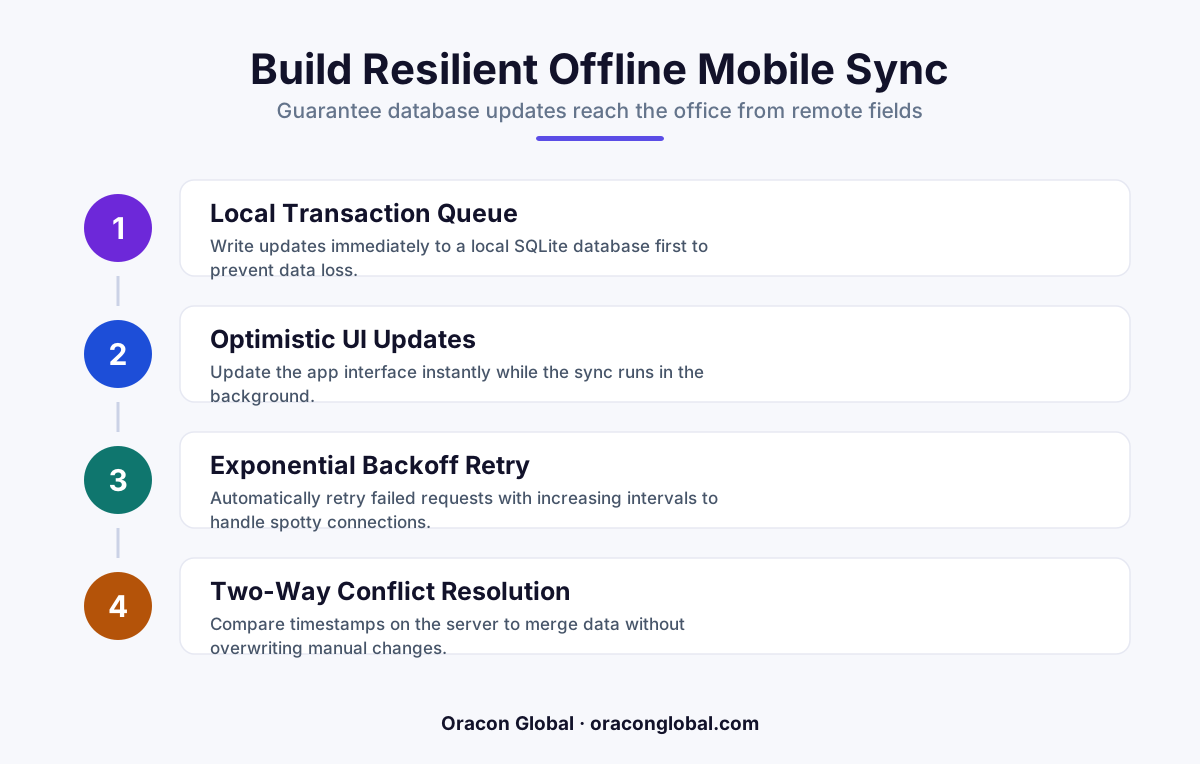
Standard out-of-the-box sync solutions fail when mobile field apps try to coordinate updates across multiple third-party legacy databases. By building a custom local transactional queue in SQLite and pairing it with a deterministic conflict-resolution engine, you can guarantee zero data loss even during prolonged offline stretches.
Field inspectors working in remote areas, industrial basements, or rural job sites face a common, frustrating reality: spotty cellular coverage. When a technician fills out a complex structural inspection report and hits submit, they expect that data to be safe. But under the hood, standard mobile setups often drop these critical database writes when networks flicker.
When your business operations rely on multiple backend systems—such as an inventory platform, an ERP, and a scheduling engine—a simple network reconnect can trigger a chaotic race condition. If your mobile app tries to push raw API calls directly over a weak connection, some updates succeed, others time out, and your core databases fall completely out of alignment.
To prevent these silent failures, businesses need a robust, custom offline field app sync layer built directly into their mobile architecture. Here is how we design and build transactional, multi-vendor sync layers for React Native offline database applications to ensure zero dropped writes under any network conditions.
The Structural Flaws in Off-the-Shelf Mobile Sync
Many development teams attempt to solve connectivity issues by using basic out-of-the-box local storage libraries or generic sync wrappers. While these work fine for simple, single-database applications, they quickly break down under the demands of enterprise field operations. The failure points generally fall into three categories:
- API Call Chaining: A single inspection form might need to update a CRM, push a work order update to an ERP, and upload a compliance photo to cloud storage. If the connection drops mid-chain, the app enters an inconsistent state where the photo is saved but the inspection status remains marked as incomplete.
- Naive Timestamp Overwrites: If two technicians edit the same equipment record offline at different times, a standard "last write wins" sync strategy will blindly overwrite valuable data, erasing critical historical context.
- JSON Serialization Failures: When complex, nested inspection forms are stored as loose JSON strings in local storage, a minor schema change in a backend API can render the queued data unparsable, causing the app to permanently drop the unsynced inspections upon reconnection.
Step 1: Implementing a Local Transactional Queue
To guarantee that no write is ever lost, the React Native application must treat local storage as the absolute source of truth. Rather than attempting to send data directly to external APIs, every user action must be recorded as an immutable transaction step in a local SQLite database before any network request is initiated.
This approach relies on an append-only event queue. When an inspector completes a section of a form, the app writes a structured transaction record to the local database, containing:
- A unique cryptographic transaction ID.
- An explicit event type (e.g.,
UPDATE_INSPECTION_STATUS). - The raw, structured data payload.
- A monotonic sequence number to preserve the exact order of operations.
- A state flag (e.g.,
pending,processing, orfailed).
Because SQLite supports ACID transactions, the local write succeeds instantly, giving the inspector a fast, responsive user interface. The task of sending that data to remote servers is handed off to a separate, isolated background process.
Step 2: Designing the Multi-Vendor Sync Dispatcher
Once a stable network connection is detected, the background synchronization engine wakes up and processes the local queue. Instead of firing off raw API calls in parallel, a custom sync manager reads the queue sequentially.
To handle multi-vendor data integration safely, the sync layer uses a modular adapter pattern. Each external vendor—whether it is a legacy database, a modern SaaS platform, or an internal logistics engine—has its own dedicated translation adapter. This adapter is responsible for pulling a transaction from the local queue, mapping the SQLite schema to the specific vendor's API payload format, and executing the call.
If a specific vendor API is down or throttles the request, the adapter catches the error and marks the transaction as retrying. The sync layer then pauses the queue, preventing subsequent dependent transactions from executing out of order and causing cascading validation failures.
Step 3: Implementing Deterministic Conflict Resolution
A major challenge with any mobile database conflict resolution system is handling concurrent edits. If an operator at headquarters updates an asset's safety status while a field technician is performing an offline inspection on that same asset, a conflict occurs upon reconnection.
To resolve this without human intervention, we replace simple timestamp comparison with a deterministic state machine. When the mobile app reconnects, the sync layer runs the local transaction through a series of business-logic validation gates:
"Instead of asking which update happened last, the sync layer evaluates which role has semantic authority over the specific data field. A field inspector's on-site safety reading should always override an office administrator's automated database update."
If a conflict cannot be resolved automatically, the transaction is safely moved to an exception queue, and an administrative alert is triggered. The rest of the sync queue continues to process normally, ensuring that one stuck record does not block thousands of successful field updates.
Why Custom Architecture Beats Generic Templates
Every field operation has its own unique regulatory constraints, legacy integrations, and data validation rules. While generic low-code or template-based mobile sync engines promise quick setups, they lack the deep transactional safety required to protect critical operational data.
By building a dedicated, local transactional queue and matching it with tailored backend integrations, businesses can protect their data integrity, eliminate manual double-entry, and provide field technicians with a reliable tool that works anywhere in the world.
Build a Resilient Mobile Architecture with Oracon Global
At Oracon Global, our senior in-house development team builds highly resilient custom mobile and web applications tailored for complex enterprise environments. From transactional offline-first mobile apps to intelligent background automation, we design systems that protect your business operations from network disruptions.
We work closely with your team to deliver clean, modern software architectures, and our clients retain 100% ownership of their code and intellectual property. If you are ready to eliminate dropped writes and streamline your remote field operations, contact Oracon Global today to discuss your development goals.
Frequently asked questions
Why do default React Native sync libraries fail during complex field inspections?
Most generic libraries rely on basic timestamp comparison and assume a single monolithic database backend, making them drop nested records or fail entirely when syncing across multiple legacy third-party APIs.
How does a local transactional write queue prevent mobile data loss?
Instead of updating the local database and sending a network request simultaneously, every user action is saved as an immutable transaction step inside a local SQLite table before any network transfer is attempted.
What is the best way to handle data conflicts when a field app reconnects?
A deterministic state machine should evaluate incoming updates against a hardcoded set of business rules—such as prioritizing newer inspector notes over legacy office database defaults—rather than relying on raw timestamps.
Will building a custom sync layer slow down app performance for field technicians?
No, because all user writes are processed instantly against the local database, while the heavier synchronization and queue-processing tasks run quietly in the background without blocking the user interface.
Read next
Beyond Chatbots: How to Build AI Agents That Actually Do Work for Your Business
Most businesses use AI to answer questions. Here is how to build custom AI agents that actually take action, connect to your internal tools, and handle complex workflows.
Beyond the Wrapper: How to Build Custom AI Agents for Business That Actually Work
Many businesses invest in basic AI wrappers only to find they lack the security and context needed for real work. Here is how to build custom AI agents that integrate deeply with your workflows and databases.
Enterprise AI Maintenance Costs: Budgeting for Year Two and Beyond
Building an AI system is only half the battle. Discover the practical, ongoing operational costs of enterprise AI, including token management, model drift, and continuous security audits.
Oracon Global builds production-grade AI agents, automation and apps — and you own the code and IP. Tell us what you want to automate.
Book a call →See our work