

Delayed webhooks can cause AI agents to execute business workflows based on outdated information. By implementing a real-time API event bus with sequence tracking and state verification, you can ensure your AI digital employees always act on the latest, correct data.
Imagine your customer cancels an order. Two seconds later, they change their mind and click "re-activate." Your billing system fires off two webhooks. But because of network latency or a temporary server hiccup on the payment provider's end, the "cancelled" webhook gets delayed. It arrives at your system three minutes after the "re-activated" webhook.
A human operator looking at the timeline might spot the anomaly. A traditional hardcoded system might throw an error. But an autonomous AI agent, designed to react to incoming data streams in real time, will simply process the webhooks in the order they arrive. It reads the late "cancelled" webhook, assumes the user wants to terminate the account, and terminates it—entirely reversing the user's actual, latest intent.
When you transition from simple chat interfaces to production-grade AI digital employees, managing the sequence of asynchronous data becomes a critical engineering challenge. To prevent your autonomous agents from making costly mistakes due to network delays, you need a dedicated real-time API event bus.
The Structural Flaw in Agentic Webhook Consumption
Traditional web applications are inherently transactional. They update a row in a database and display the current state on a screen. If an update arrives late, a user refresh usually fixes the visual discrepancy. However, AI agents do not just display data—they execute actions. They send emails, authorize refunds, update inventory levels, and dispatch field technicians.
Because agents are designed to be proactive, they treat every incoming API payload as an instruction to evaluate state and take action. If your AI agent workflows rely on direct, unbuffered webhook integrations, you are exposing your business logic to several systemic risks:
- State Inversion: The agent acts on stale data, reversing a newer transaction with an older, delayed payload.
- Race Conditions: Multiple webhooks arriving near-simultaneously cause parallel agent runs that overwrite each other’s database updates.
- Cascading API Failures: An agent processing an out-of-order event attempts to call a third-party API with invalid parameters, triggering a chain of retries and system bans.
How a Real-Time API Event Bus Resolves the Issue
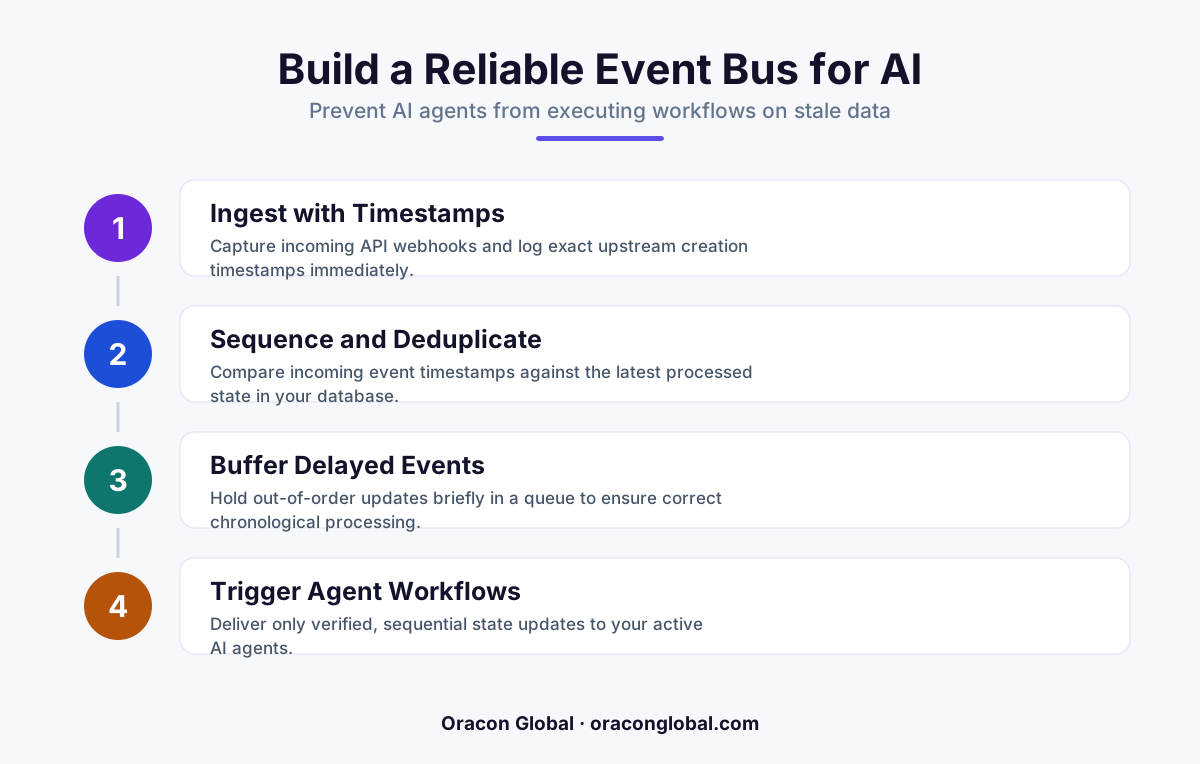
To keep your agentic workflows reliable, you must decouple the arrival of an API event from its execution. A custom real-time API event bus acts as a smart traffic controller. Instead of allowing webhooks to hit your AI agent's tools directly, all incoming payloads are routed through a centralized middleware layer designed to enforce chronological order, deduplicate requests, and verify state.
Here is how a robust event-driven architecture handles incoming webhooks safely:
1. Cryptographic Ingestion and Idempotency Filtering
Every incoming webhook is immediately logged with a unique idempotency key (often derived from the payload's unique transaction ID) and stored in a high-speed, in-memory cache. If a third-party service sends a duplicate webhook due to an unacknowledged delivery attempt, the event bus silently discards it before the AI agent even knows it exists.
2. Monotonic Sequence Verification
Relying on timestamps created by third-party systems is dangerous because system clocks drift. Instead, a resilient event bus uses monotonic sequence numbers or logical clocks (such as Lamport timestamps) embedded in the event metadata. The bus checks the incoming event's sequence number against the last processed sequence for that specific entity (e.g., an order or a user profile). If a gap is detected—meaning an earlier event has not arrived yet—the new event is held in a buffer queue.
3. Time-Windowed Buffering
For highly sensitive workflows, the event bus introduces a brief, sub-second holding pattern (typically 200ms to 500ms). This buffer allows closely spaced, out-of-order webhooks to assemble in the correct order before being dispatched to the AI agent. To the end user, this delay is imperceptible, but to the agent's decision-making engine, it makes the difference between correct execution and a broken workflow.
Building the Event Bus Architecture
When building a custom event bus to protect your AI investments, simplicity and speed are your best allies. You do not need to over-engineer the system with heavy enterprise service buses. A lightweight, highly performant stack can be built using standard cloud components.
A production-grade AI digital employee is only as reliable as the data piping feeding it. If you feed an agent out-of-order telemetry or transaction updates, it will confidently make the wrong decision in milliseconds.
A typical implementation uses an in-memory database like Redis for real-time stream buffering and state tracking, combined with a durable message broker like RabbitMQ or AWS SQS to manage retry queues. When a webhook arrives, the event bus performs three rapid checks:
- Is this event older than our current database state? If yes, discard or archive it without triggering the AI agent.
- Is there a missing sequence number? If yes, push the current event to a holding queue and wait a designated number of milliseconds for the missing event to arrive.
- Is the payload structurally valid? Verify that the schema matches the agent's tool expectations, preventing formatting errors from breaking the workflow.
Ensuring Long-Term Resiliency for Your AI Investments
As you scale your operations, the number of API integrations your business relies on will only grow. Building a custom event bus ensures that your software architecture remains modular. If a third-party vendor updates their API schema or experiences delivery latency, you only need to adjust your event bus parser, rather than rewriting the core prompts and tools of your AI agents.
At Oracon Global, we build robust, production-grade AI systems, custom web and mobile apps, and custom integrations that stand up to real-world infrastructure failures. Our senior in-house engineering team designs systems where you own 100% of the code and intellectual property from day one.
If you are planning to deploy autonomous AI agents or digital employees to manage your business workflows, let's build a foundation that ensures they act on the right data, every single time. Reach out to the team at Oracon Global today to discuss your architecture needs.
Frequently asked questions
Why do out-of-order webhooks break AI agent workflows?
AI agents act autonomously based on incoming data. If an older API update arrives after a newer one, the agent may process the stale state as current, leading to incorrect actions like duplicate shipping or wrong billing.
What is a real-time API event bus?
It is a dedicated middleware layer that ingests, re-orders, and validates API payloads and webhooks before delivering them to your processing applications or AI agents.
Can database timestamps solve webhook delay issues?
Not reliably. Network delays and different system clocks mean the arrival time of a webhook rarely matches when the actual event occurred. A sequence validator is required.
Do we need to rewrite our entire legacy software to implement this?
No. A custom event bus can sit as an independent middleware layer between your existing third-party APIs and your custom AI agent orchestrator.
Read next
Beyond Chatbots: How to Build AI Agents That Actually Do Work for Your Business
Most businesses use AI to answer questions. Here is how to build custom AI agents that actually take action, connect to your internal tools, and handle complex workflows.
Beyond the Wrapper: How to Build Custom AI Agents for Business That Actually Work
Many businesses invest in basic AI wrappers only to find they lack the security and context needed for real work. Here is how to build custom AI agents that integrate deeply with your workflows and databases.
Enterprise AI Maintenance Costs: Budgeting for Year Two and Beyond
Building an AI system is only half the battle. Discover the practical, ongoing operational costs of enterprise AI, including token management, model drift, and continuous security audits.
Oracon Global builds production-grade AI agents, automation and apps — and you own the code and IP. Tell us what you want to automate.
Book a call →See our work