

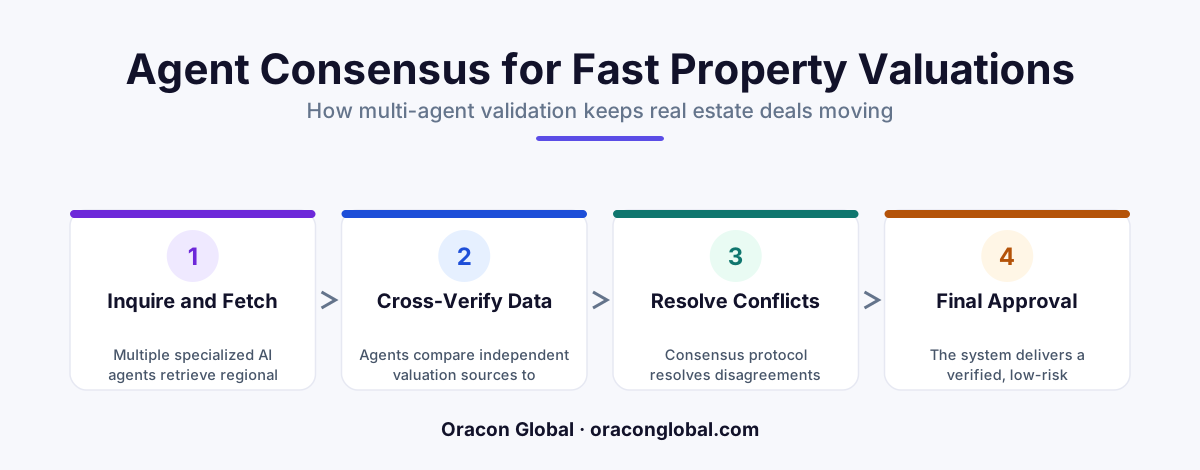
When real estate platforms rely on a single LLM or automated model for property valuations, minor data anomalies can lead to wild pricing discrepancies that halt transactions. By building a custom multi-agent consensus layer, you can run multiple specialized agents—each analyzing different data sources—and use a programmatic arbitration engine to produce a highly reliable, risk-mitigated valuation.
Automated valuation models have promised to strip the friction out of real estate transactions. Yet, in high-volume property acquisitions and portfolio management, relying on a single AI model to determine asset values introduces a fragile single point of failure. A single anomalous data point, an unrecorded property update, or a mismatched regional comparable can cause a model to spit out a highly skewed number. When these automated real estate valuations deviate too far from reality, underwriters halt the deal, investment committees freeze, and active asset transactions grind to a standstill.
To scale automated operations safely, forward-thinking PropTech platforms and investment funds are moving away from monolithic valuation pipelines. Instead, they are implementing a custom multi-agent consensus layer. This architecture deploys a network of specialized, narrow AI agents to evaluate a single property from different operational angles. By forcing these agents to debate, reconcile, and vote on the final valuation, you can dramatically reduce transaction-halting errors and ensure your automated property valuation pipeline remains reliable, resilient, and enterprise-ready.
The Structural Flaw of Monolithic Real Estate Valuation AI
Most legacy systems and early-stage real estate valuation AI platforms rely on a single mathematical model or a solitary large language model (LLM) connected to a vector database. While this approach works for quick residential estimates, it struggles under the weight of institutional transactions. Real estate data is notoriously messy, fragmented, and localized.
When a monolithic model is fed a property profile, it attempts to process disparate data streams—such as historic tax assessments, recent MLS comparables, macro-economic interest rates, and local zoning laws—all at once. If the local county registry is three months behind on recording a neighborhood sale, or if a nearby zoning change is misclassified, the model has no internal peer-review mechanism to flag the anomaly. It simply outputs an inaccurate valuation. By the time human underwriters or compliance officers catch the error, days or weeks of deal momentum have been lost, creating severe real estate transaction bottlenecks.
Architecting a Multi-Agent Consensus Layer
A multi-agent consensus layer replaces the single-source pipeline with an orchestration of independent, specialized digital workers. Instead of one system doing all the work, you break the valuation down into discrete tasks managed by dedicated agents. These agents run in parallel, evaluate their specific domain, and then submit their findings to a central arbiter.
1. The Specialized Agent Fleet
In a production-grade PropTech AI development project, we typically structure the consensus layer using at least three distinct types of agents:
- The Registry and Tax Agent: Focuses exclusively on hard public records, historical deed transfers, tax assessments, and geographic boundary data.
- The Market Dynamics Agent: Scrapes and analyzes active local MLS data, tracking days-on-market metrics, price-cut trends, and regional demand velocity.
- The Macro-Economic Sentinel: Analyzes broader regional trends, local employment changes, school district ratings, and prevailing mortgage interest rates to adjust the baseline risk premium.
2. The Reconciliation and Arbitration Engine
Once each agent generates its independent valuation and confidence score, they do not simply average the results. Instead, they pass their calculations to a programmatic arbitration engine. This engine acts as the consensus layer, executing a multi-step validation protocol:
Step 1: Outlier Identification
The engine checks if any agent's valuation falls outside a pre-configured variance threshold (such as 5% or 10% of the median value).
Step 2: Confidence Weighting
The system adjusts the influence of each agent based on its data confidence. For example, if active MLS listings in a zip code are sparse, the Market Dynamics Agent's confidence rating drops, and the engine automatically weights the Registry and Tax Agent's historical data more heavily.
Step 3: Consensus Voting
If the weighted valuations converge within the acceptable variance threshold, the engine approves the valuation, signs off on the data payload, and pushes the transaction to the next automated phase in your ERP.
Handling Discrepancies Without Halting the Deal Flow
What happens when the consensus layer cannot reach an agreement? If the Registry Agent flags a tax assessment that suggests a property is worth $450,000, but the Market Dynamics Agent insists local comps justify a price of $600,000, a monolithic system would simply stall or output a highly risky compromise figure.
A custom consensus layer resolves this by triggering a localized, automated dispute resolution workflow. Instead of halting the transaction entirely, the system initiates targeted micro-queries. It can instruct a secondary validation agent to pull structural permit histories to see if a major unrecorded renovation occurred, or it can programmatically request a manual visual verification of the street-view history.
If the discrepancy cannot be resolved programmatically within milliseconds, the system executes a graceful fallback. It packages the entire agent debate history—complete with raw data sources, individual agent confidence scores, and the exact points of friction—and routes it to a human-in-the-loop dashboard. Human appraisers do not have to start from scratch; they simply act as the final tie-breaker, armed with clean, structured arguments from the AI agents. This targeted escalation saves hours of manual forensic auditing and keeps the transaction pipeline moving.
Key Integration Points for PropTech Platforms
Building a consensus layer does not require you to rip out your existing software stack or scrap the models you have already trained. It is designed to sit as an orchestration middleware between your data ingestion points and your core transaction ledger. To make the architecture resilient, the system should feature:
- Event-Driven Microservices: Build the agent communications on message brokers like RabbitMQ or Apache Kafka to ensure that database timeouts or third-party API lag do not crash the entire consensus process.
- State Machine Management: Maintain a clear historical record of how consensus was reached for every single asset. This ensures complete auditability for institutional partners, lenders, and compliance officers who need to know exactly why a property was valued at a specific price.
- 100% IP Ownership: Because valuation methodologies are often a core competitive advantage for real estate funds and PropTech companies, building your consensus layer on custom architecture ensures you own your code, agent prompts, and routing logic outright—without paying ongoing platform taxes or risking vendor lock-in.
Unblocking Your Real Estate Workflows
As the real estate market increasingly relies on automation to screen, underwrite, and close transactions, the systems that calculate asset values must be bulletproof. A single hallucinating AI model should never have the power to freeze a multi-million-dollar transaction queue.
By implementing a custom multi-agent consensus layer, you can transform your automated property valuation pipeline from a fragile, high-maintenance system into a self-correcting, highly reliable asset. This approach shields your transaction flows from unexpected data anomalies, protects your investment margins, and builds deep operational trust with your stakeholders.
If you are ready to build a reliable, custom AI architecture tailored to your unique real estate workflows, the senior team at Oracon Global can help you design, build, and deploy it. Our in-house engineers build custom AI agents, workflow automations, and enterprise platforms while ensuring you retain 100% ownership of your code and IP. Reach out to Oracon Global today to discuss how we can build your next custom software solution.
Frequently asked questions
Why do single AI models cause bottlenecks in real estate transactions?
A single model often relies on a limited set of parameters or stale public registries. If it encounters anomalous data, such as an unrecorded renovation or a skewed regional comp, it can produce an unrealistic valuation that triggers red flags for underwriters and halts the transaction.
What is a multi-agent consensus layer?
It is an architectural framework where multiple independent AI agents evaluate the same asset using different data sources (such as tax histories, local MLS feeds, and macro-economic trends) and then reconcile their findings through a structured programmatic voting or arbitration system.
How does this system handle major discrepancies between agents?
When valuation differences exceed a pre-set tolerance threshold (e.g., more than 5%), the consensus layer triggers a programmatic arbitration workflow, programmatically querying localized secondary databases or gracefully routing the asset to a human appraiser for final review.
Do we have to rebuild our existing valuation models to implement this?
No. A consensus layer acts as an orchestration middleware that sits on top of your existing database and external APIs, allowing you to wrap your current models and run them alongside new specialized agents.
Read next
Beyond Chatbots: How to Build AI Agents That Actually Do Work for Your Business
Most businesses use AI to answer questions. Here is how to build custom AI agents that actually take action, connect to your internal tools, and handle complex workflows.
Beyond the Wrapper: How to Build Custom AI Agents for Business That Actually Work
Many businesses invest in basic AI wrappers only to find they lack the security and context needed for real work. Here is how to build custom AI agents that integrate deeply with your workflows and databases.
Enterprise AI Maintenance Costs: Budgeting for Year Two and Beyond
Building an AI system is only half the battle. Discover the practical, ongoing operational costs of enterprise AI, including token management, model drift, and continuous security audits.
Oracon Global builds production-grade AI agents, automation and apps — and you own the code and IP. Tell us what you want to automate.
Book a call →See our work