

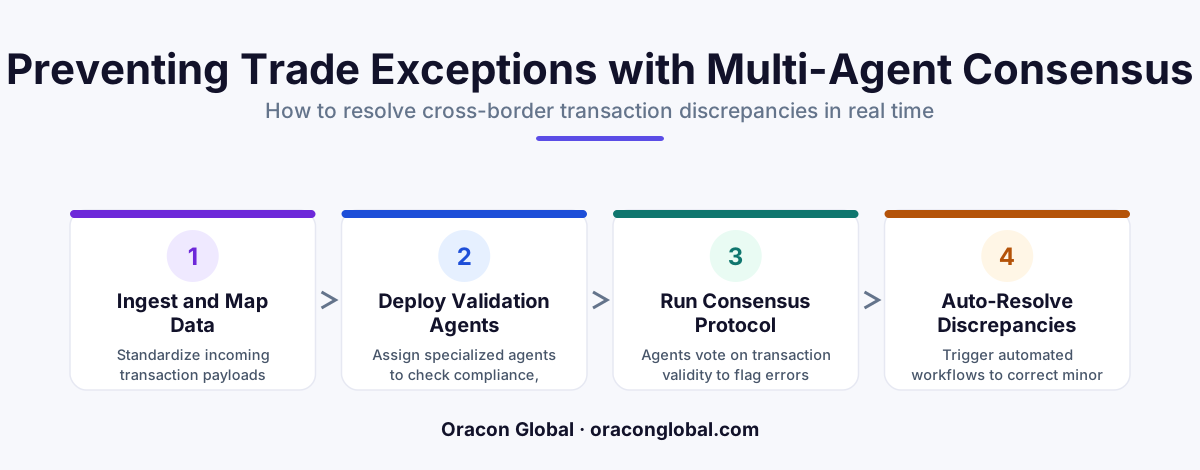
Trade exceptions in cross-border settlements cost financial operations millions in manual remediation. By deploying a custom multi-agent consensus network, firms can use specialized AI agents to cross-validate counterparty data, check compliance, and resolve data mismatches autonomously before the settlement window closes.
In cross-border financial transactions, minor data discrepancies can bring a multi-million dollar settlement pipeline to a grinding halt. A mismatched settlement instruction, a slight spelling variation in a counterparty name, or an outdated intermediary bank code can trigger a trade exception. When this happens, human operations teams must manually hunt down the error, check multiple systems, and resubmit the trade.
These delays are more than just an administrative headache. They lead to failed trades, overnight liquidity costs, regulatory penalties, and strained counterparty relationships. Traditional validation rules often fail because they are too rigid to handle the messy, unstructured nature of international trade documents and legacy messaging formats.
The solution is not to hire more operations staff or build more fragile, rule-based software. Instead, forward-thinking financial platforms are building a multi-agent consensus network. By deploying a team of specialized AI agents that must agree on the validity of a transaction, you can catch and resolve trade exceptions in real time before they ever reach your core settlement engine.
The Anatomy of a Trade Exception in Cross-Border Settlement
To understand why a multi-agent consensus network is so effective, we must look at where cross-border pipelines break down. Unlike domestic payments, a cross-border settlement involves multiple jurisdictions, distinct clearing houses, currency conversions, and varying compliance requirements. Data flows through a mix of APIs, legacy SWIFT messages, and even PDF trade confirms.
Most trade exceptions occur due to three main categories of mismatches:
- Structural Mismatches: Incorrectly formatted settlement instructions, missing intermediary bank details, or invalid routing numbers.
- Data Mismatches: Discrepancies between the trade confirmation and the ledger, such as mismatched asset quantities, transaction values, or settlement dates.
- Regulatory Mismatches: Outdated KYC documentation, sudden changes in local sanction lists, or missing tax declarations.
Standard automation tools look at these fields in isolation. If a field does not match a strict regex pattern, the system throws a flag. A multi-agent network, however, looks at the transaction context holistically, mimicking the exact analytical path a senior human operations specialist would take.
How a Multi-Agent Consensus Network Works
Instead of relying on a single, massive LLM to review a transaction, a consensus network breaks the task down among specialized, narrow AI agents. Each agent has a specific job, its own set of tools, and a distinct perspective on the data. For a transaction to pass, these agents must reach a consensus.
Consider a typical structure for a cross-border transaction validation team:
1. The Data Ingestion Agent
This agent acts as the gatekeeper. It ingest incoming trade tickets, SWIFT messages, and PDF confirmations. It normalizes unstructured text into a clean, standardized JSON schema, ensuring all downstream agents are looking at the exact same data points.
2. The Counterparty Verification Agent
This agent is plugged into your internal CRM, entity master databases, and external business registries. Its sole responsibility is to verify that the sender, receiver, and intermediary banks are legitimate, matching, and active. It resolves minor discrepancies, such as identifying that "XYZ Ltd." and "XYZ Limited" refer to the same legal entity.
3. The Settlement Instruction Agent
This agent validates the routing paths. It cross-checks standard settlement instructions (SSIs) against historical successful trades and active clearing directory databases. It ensures that the specified payment rails can support the asset class and currency of the trade.
4. The Compliance and Sanctions Agent
This agent monitors real-time regulatory compliance. It runs the transaction details against global watchlists, politically exposed persons (PEP) databases, and local jurisdictional rules to ensure the trade does not violate international trade laws or internal risk tolerances.
The Consensus Mechanism: Resolving Mismatches Autonomously
Once all agents have analyzed the trade, they do not simply write their findings to a database. They engage in an active evaluation process to achieve AI consensus validation. This is critical for preventing false positives and ensuring high-fidelity decisions.
If the Counterparty Agent flags a name mismatch, but the Settlement Instruction Agent confirms the routing numbers and historical transaction patterns are identical to a trade from last week, the network does not immediately reject the transaction. Instead, the agents negotiate:
- The Counterparty Agent presents the mismatch to the network.
- The Settlement Agent shares its confidence score based on the historical routing match.
- The network evaluates the combined risk. If the overall confidence score meets your predefined threshold, the network updates the record with the correct standardized legal name and clears the trade.
- If the confidence score falls below the threshold, the network packages the agent logs, highlights the exact discrepancy, and routes it to a human-in-the-loop dashboard for rapid manual sign-off.
This cooperative workflow ensures that simple typographical errors are resolved in milliseconds without halting the pipeline, while genuine risks are instantly escalated to your team.
Designing the Integration Layer with Legacy Financial Systems
Building a sophisticated multi-agent network is only half the battle; it must integrate seamlessly with your existing infrastructure. Modern financial automation systems cannot require a complete rewrite of your core ledger or ERP software.
To implement this successfully, the consensus network should sit as an asynchronous middleware layer between your trade capture system and your core settlement engine. The network listens to trade events via webhooks or message queues, performs its validation, and appends a "Consensus Passed" cryptographic signature to the transaction payload. Your settlement engine is configured to only execute trades carrying this valid signature.
This keeps your core financial systems decoupled from the AI layer, preserving system stability, maintaining audit trails, and ensuring you can update agent parameters without touching your primary ledger code.
Secure, Enterprise-Grade AI Built for Scale
When dealing with cross-border transaction pipelines, data security, IP ownership, and performance are non-negotiable. Using generic, out-of-the-box AI wrappers or relying on third-party platforms that train on your transactional data introduces unacceptable compliance risks.
At Oracon Global, we build custom AI agents, workflow automations, and enterprise systems tailored to your exact business operations. When you partner with our senior in-house engineering team, you get a robust, production-grade system engineered for high-throughput environments. Most importantly, you retain 100% ownership of your code and intellectual property, ensuring your proprietary transaction logic remains entirely yours.
Ready to eliminate trade exceptions and streamline your cross-border settlement pipeline?
Contact us at Oracon Global today to discuss how we can build a custom multi-agent consensus network for your financial operations.
===Frequently asked questions
What is a financial trade exception?
A trade exception occurs when there is a mismatch in trade details, settlement instructions, or regulatory data between counterparties, causing the transaction to halt in the pipeline.
How does a multi-agent consensus network resolve trade exceptions?
It assigns different specialized AI agents to inspect the same transaction from unique perspectives, such as matching settlement instructions or checking compliance, requiring them to reach a consensus before clearing the trade.
Can this system connect to legacy financial networks like SWIFT?
Yes, a custom-built agent network can translate structured and unstructured data from legacy formats like SWIFT MT/MX messages or proprietary PDFs into unified schemas for validation.
Does this replace human compliance officers?
No, it acts as an autonomous first line of defense. The network flags highly complex or unresolvable mismatches to a human-in-the-loop dashboard for final approval.
Read next
Beyond Chatbots: How to Build AI Agents That Actually Do Work for Your Business
Most businesses use AI to answer questions. Here is how to build custom AI agents that actually take action, connect to your internal tools, and handle complex workflows.
Beyond the Wrapper: How to Build Custom AI Agents for Business That Actually Work
Many businesses invest in basic AI wrappers only to find they lack the security and context needed for real work. Here is how to build custom AI agents that integrate deeply with your workflows and databases.
Enterprise AI Maintenance Costs: Budgeting for Year Two and Beyond
Building an AI system is only half the battle. Discover the practical, ongoing operational costs of enterprise AI, including token management, model drift, and continuous security audits.
Oracon Global builds production-grade AI agents, automation and apps — and you own the code and IP. Tell us what you want to automate.
Book a call →See our work