

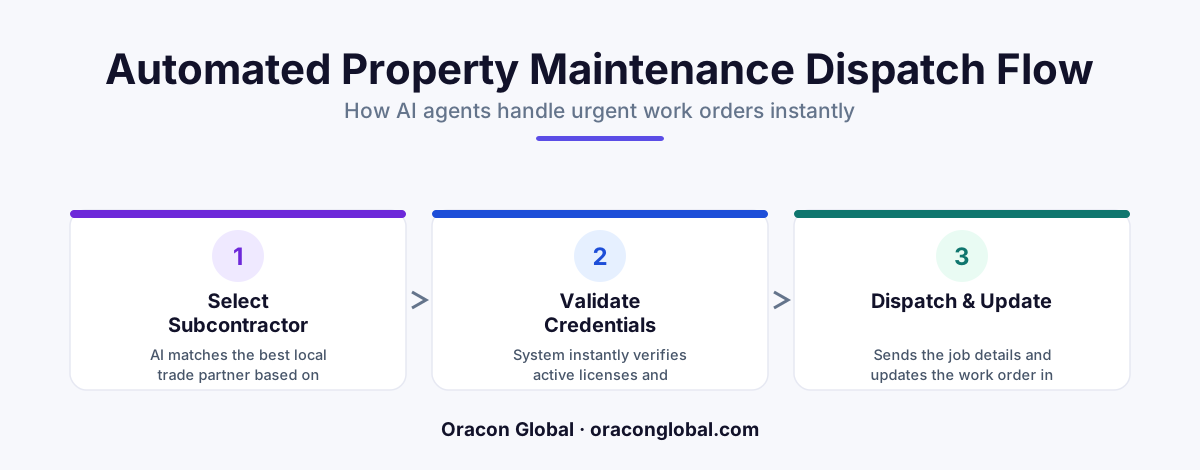
A custom multi-agent dispatch engine uses specialized AI agents to automate property maintenance triage, technician dispatch, and legacy database synchronization. By routing emergencies based on real-time proximity, skill set, and inventory availability, companies can reduce response times from hours to minutes while keeping their human operations team in control of critical approvals.
When a pipe bursts in a commercial building or an apartment complex at two o'clock on a Sunday morning, every minute of delay costs money. Water damages structure, tenants panic, and emergency rates spike. Yet, in most traditional property management firms, the dispatch pipeline is surprisingly manual.
An incoming call or email is routed to an on-call dispatcher, who must manually read the request, determine if it is a true emergency, search a database of available technicians, check their specific certifications, verify if the right replacement parts are in stock, and then call the technician to schedule the job. If the technician does not answer, the process starts over.
By building a custom multi-agent dispatch engine, companies can fully automate this operational bottleneck. Instead of relying on a single generalist chatbot, this architecture coordinates a network of specialized, autonomous digital employees to triage emergencies, assign tasks, and write clean updates back to your core database. Here is how to design and build one that actually works in production.
The Structural Architecture of a Multi-Agent Dispatch Engine
A single LLM prompt box cannot handle the complexity of emergency property maintenance. It will hallucinate dispatch rules, lose track of technician schedules, or misinterpret geographic distances. To build a reliable system, you must break the workflow down into small, single-purpose AI agents that communicate through a central coordinator.
A production-ready dispatch engine requires three primary functional layers:
- The Intake and Triage Agent: Monitors incoming communication channels (SMS, email, web forms, or transcribed voice calls), extracts key entities like property address, issue severity, and system type, and classifies the priority of the maintenance request.
- The Resource and Routing Agent: Queries your internal systems to find the closest certified field technician with the correct inventory on their truck to solve the specific problem.
- The Database Reconciliation Agent: Translates the agentic actions into structured database writes, updating your AI-native ERP integration or legacy property management platform without corrupting active transactional tables.
By isolating these responsibilities, you prevent any single agent from hitting token context limits, while making the entire system significantly easier to debug, test, and audit.
Step 1: Parsing and Triaging the Emergency Intake
The system starts at the point of ingestion. When a tenant submits a maintenance ticket, the intake agent must instantly decide if the situation warrants an immediate emergency dispatch or if it can wait for normal business hours.
This agent does not need creative freedom. Instead, it is constrained by a strict JSON schema. It extracts key variables such as the tenant's phone number, the specific building unit, and the category of the failure (e.g., HVAC, plumbing, electrical, or structural locks). It then compares this information against your business's defined emergency matrix.
If the issue matches an emergency definition—such as a lack of heat in freezing temperatures or active water flooding—the intake agent immediately triggers a webhook to spin up the scheduling workflow, bypassing standard non-urgent queues entirely.
Step 2: Real-Time Location and Skill Set Matching
Once an emergency is verified, the scheduling agent takes over to find the optimal human resource. To do this, the agent must interact with dynamic external APIs and database states. This step relies on real-time maintenance routing metrics.
The matching algorithm follows a deterministic sequence managed by the agent:
- Skill Set Filter: The agent queries the technician database to filter for personnel holding active certifications for the specific hazard (for instance, a certified commercial electrician for panel failures).
- Location and Proximity Lookup: The agent queries live GPS telemetry from active technician trucks or uses a mapping API to calculate true travel times from current locations to the distressed property.
- Truck Inventory Check: The agent cross-references the required parts list (such as a specific water pump size) with the digital truck inventory ledger synced to your dispatch system.
By combining vector search for historical job matching with hard relational queries for real-time tracking, the resource agent produces a ranked list of the top three qualified technicians who are physically closest to the site.
Step 3: Handling the Legacy ERP Write-Back
A major failure point for off-the-shelf automation platforms is writing data back to old, finicky property management systems. If your AI agent attempts to directly write unformatted unstructured text to a legacy SQL database, it can trigger transaction locks, break database schemas, or create duplicate work orders.
Your database reconciliation agent acts as a translation layer. It formats the dispatch output into a clean, structured payload required by your ERP. If the legacy system uses SOAP or REST APIs, the agent maps fields like "technician_id", "dispatch_time", and "estimated_completion_time" directly into the corresponding database fields.
To ensure absolute database safety, we design these custom engines with an isolated staging queue. If the legacy API times out or rejects a payload, the agent places the task in an automated retry queue and sends a silent alert to your system administrator rather than dropping the transaction entirely.
Building a Robust Human-in-the-Loop Safeguard
No matter how smart your multi-agent dispatch engine is, it should never have unchecked control over your budget or critical vendor agreements. High-cost dispatch actions—such as calling out a third-party contractor on double-time holiday pay—must pass through a deterministic human-in-the-loop validation gate.
For example, you can set a rule that if the estimated dispatch cost exceeds a specific threshold, the scheduling agent pauses the state machine. It sends a push notification to the on-call manager containing a summary of the emergency, the suggested technician, and an "Approve/Deny" button. Once the manager clicks approve, the state machine resumes automatically, notifying the technician and updating the ERP.
"A truly resilient AI agent does not replace human oversight; it structures the operational environment so humans only have to step in to handle anomalies and critical approvals."
Why Off-the-Shelf Software Fails for Specialized Dispatching
Many property operators try to build these automated dispatch pipelines using basic no-code tools and visual workflow builders. While these tools are great for simple email notifications, they struggle to manage complex, multi-agent systems at scale.
No-code systems lack the deep state-management capabilities required to coordinate parallel agents. They struggle to parse messy, multi-format emails from angry tenants, handle real-time GPS telemetry, or connect securely to legacy on-premise databases. A custom-built engine written in clean, optimized code is the only way to guarantee the latency, security, and reliability needed to run a 24/7 emergency operation.
Own Your Operational Future
Building a custom multi-agent dispatch engine is not about chasing a tech trend. It is about locking in operational margins, protecting physical real estate assets, and providing exceptional tenant service when things go wrong.
At Oracon Global, our senior in-house engineering team designs and develops custom AI agents, automated workflows, and AI-native software architectures tailored to your exact business operations. We write clean, resilient code, deploy it to your infrastructure, and hand over 100% of the IP ownership directly to you.
Ready to automate your high-volume dispatch operations and eliminate manual coordination delays? Let us discuss how we can build a custom dispatch solution for your team.
===Frequently asked questions
What is a multi-agent dispatch engine?
It is an orchestrated system of specialized, autonomous AI agents designed to handle different parts of a complex workflow—such as triage, technician matching, and database updates—collaboratively and in real time.
How do you prevent the AI from dispatching technicians to the wrong emergency?
The architecture uses deterministic guardrails, real-time geolocation validation APIs, and an mandatory human-in-the-loop approval gate for high-risk or high-cost work orders.
Can this engine integrate with older legacy ERP systems?
Yes, the system uses custom middleware or schema translation layers to format agentic outputs into structured JSON or XML that legacy SQL-based property management software can digest.
Do we own the intellectual property of the custom dispatch engine?
Yes, when you build a custom solution with Oracon Global, your business retains 100% ownership of the source code, database architectures, and intellectual property.
Read next
Beyond Chatbots: How to Build AI Agents That Actually Do Work for Your Business
Most businesses use AI to answer questions. Here is how to build custom AI agents that actually take action, connect to your internal tools, and handle complex workflows.
Beyond the Wrapper: How to Build Custom AI Agents for Business That Actually Work
Many businesses invest in basic AI wrappers only to find they lack the security and context needed for real work. Here is how to build custom AI agents that integrate deeply with your workflows and databases.
Enterprise AI Maintenance Costs: Budgeting for Year Two and Beyond
Building an AI system is only half the battle. Discover the practical, ongoing operational costs of enterprise AI, including token management, model drift, and continuous security audits.
Oracon Global builds production-grade AI agents, automation and apps — and you own the code and IP. Tell us what you want to automate.
Book a call →See our work