

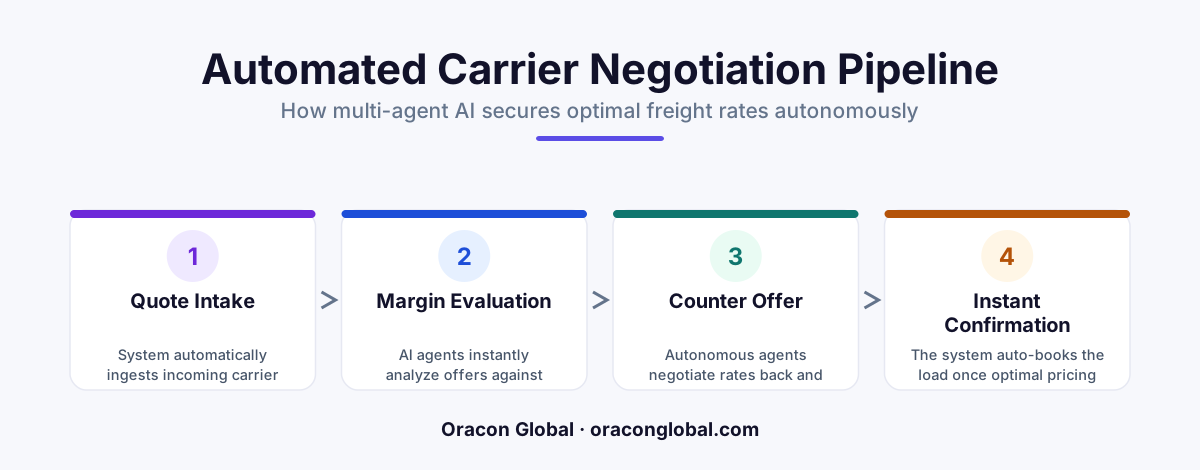
A custom multi-agent negotiation pipeline solves the bottleneck of manual rate confirmations in freight brokerage. By splitting roles between a market analyst agent and a carrier-facing negotiation agent, logistics firms can automate spot-market bookings without eroding their operating margins.
In freight brokerage, speed is the difference between booking a profitable load and losing it to a competitor. When a shipper posts a load, brokers scramble to find a reliable carrier, negotiate a rate, and dispatch the rate confirmation. Yet, the traditional spot-market negotiation process is incredibly manual. Brokers spend hours chasing carriers via email, phone, and messaging boards, trying to agree on a price that satisfies the carrier while protecting the brokerage's margin.
Many logistics companies looking into freight brokerage automation try to solve this with simple email templates or basic chatbots. However, a standard chatbot lacks the contextual intelligence to negotiate. If you give an AI agent too much creative freedom, it might agree to a carrier's high rate just to close the deal, causing immediate margin erosion. Conversely, if the AI is too rigid, carriers will simply walk away.
The solution is a custom multi-agent negotiation pipeline. By dividing the labor between specialized AI agents for logistics, you can automate rate confirmations at scale while ensuring your financial guardrails are defended with mathematical precision.
Why Single-Agent AI Architectures Fail in Logistics Negotiations
To understand why a multi-agent approach is necessary, consider what a human broker does during a negotiation. They do not just read an email and type back a number. They run a mental calculation of market trends, review historical lane data, assess current spot-market volatility, and gauge the carrier's urgency.
When you ask a single LLM (Large Language Model) to handle both the mathematical calculation of a safe margin and the conversational nuances of a negotiation, it inevitably struggles. LLMs are probabilistic text-generation engines; they are not native calculator engines. A single-agent setup is highly prone to calculation errors or "hallucinations" under pressure, which can lead to booking a load at a loss.
To safely automate rate confirmation workflows, we must decouple the analytical decision-making from the conversational execution. This requires a multi-agent system where each agent has a single, highly defined responsibility.
The Architecture of a Multi-Agent Negotiation Pipeline
A production-grade negotiation pipeline relies on three core components working in harmony: a Pricing Analyst Agent, a Negotiation Agent, and a hardcoded Financial Guardrail Layer. Here is how they interact to close a deal on custom logistics workflow automation platforms.
1. The Pricing Analyst Agent (The Brain)
The Pricing Analyst Agent does not talk to carriers. It lives inside your secure backend. When a new load needs a carrier, this agent retrieves historical lane pricing, checks current weather and traffic data, reads your internal TMS (Transportation Management System) data, and pulls current spot market averages. It outputs a strict three-tier pricing structure for the specific shipment:
- Target Buy Rate: The ideal rate that maximizes your margin.
- Midpoint Rate: A fair market rate that keeps negotiations moving.
- Ceiling Rate: The absolute maximum the brokerage can pay without eroding the target operating margin.
2. The Negotiation Agent (The Voice)
The Negotiation Agent is carrier-facing. It handles email, SMS, or web portal communications. It is primed to be polite, professional, and efficient. However, it does not know your actual profit margins or business strategy. It only knows the three-tier pricing structure passed to it by the Pricing Analyst Agent for that specific transaction.
3. The Financial Guardrail Layer (The Enforcer)
To protect your bottom line, the Negotiation Agent cannot make offers on its own. Every draft email or message it generates must pass through a hardcoded database schema check. If the Negotiation Agent tries to send an offer that exceeds the Ceiling Rate generated by the Pricing Analyst, the system blocks the outgoing message and flags it for human broker review.
How the Negotiation Flow Works in Real Time
Let us look at how this pipeline processes a spot-market negotiation from start to finish without manual human intervention.
- Load Posting and Inbound Offer: A carrier views a posted load and emails an offer of $2,400.
- Intake and Parsing: The system parses the email, identifies the carrier, the MC number, and the bid.
- Analysis: The Pricing Analyst Agent assesses the lane and calculates that the Ceiling Rate for this load is $2,200, with a Target Buy Rate of $1,900.
- The Counter-Offer: The Negotiation Agent drafts a professional response, offering $1,950 based on the current market average, highlighting quick-pay options to add value.
- The Counter-Response: The carrier replies, asking to meet in the middle at $2,150.
- Validation and Execution: Because $2,150 is below the $2,200 Ceiling Rate, the system approves the rate. The Negotiation Agent automatically draft-generates the rate confirmation sheet, writes the update directly to your custom TMS, and emails the PDF to the carrier for digital signature.
"By splitting analytical pricing decisions from carrier conversations, logistics providers can scale their daily booking volume by 5x without adding head count or risking unprofitable runaways."
Integrating with Legacy Systems and Custom Logistics Software
One of the biggest hurdles in logistics is the reliance on legacy TMS software. Many freight brokerages operate on older databases that do not support modern API webhooks.
When we build custom logistics software at Oracon Global, we design middleware wrappers around these legacy systems. This allows our AI agents to securely read shipment details and write back confirmed rate information without requiring a complete, high-risk overhaul of your core database. The AI agents interact with the middleware, which safely formats and commits the transaction to the legacy system.
Defending Your Margin with Oracon Global
Automating your logistics workflow does not mean hands-off abandonment of your business rules. A successful AI strategy is built on control, clear boundaries, and strict IP ownership.
At Oracon Global, our senior in-house team builds tailored AI digital employees, custom integrations, and workflow automation solutions designed to solve real operational bottlenecks. When you build with us, you retain 100% ownership of your code and intellectual property, ensuring your competitive advantage stays yours. You can explore our live technology demonstrations directly on our website to see how we build high-performance, production-ready systems.
Are you ready to automate your rate confirmations and free your brokers to focus on relationship-building? Contact Oracon Global today to discuss how we can build a secure, custom negotiation pipeline for your logistics business.
Frequently asked questions
Why can't a single AI agent handle freight rate negotiations?
A single agent often struggles to balance mathematical margin calculations with conversational negotiation. Splitting the work between a pricing analyst agent and a communication agent ensures margin safety and natural dialogue.
How do you prevent the AI from agreeing to an unprofitable rate?
By hardcoding strict financial guardrails into the database layer. The negotiation agent cannot generate or sign a rate confirmation that exceeds the maximum buy rate calculated by your internal pricing engine.
Does this replace the freight broker entirely?
No. It automates high-volume, low-margin spot bookings. When a negotiation falls outside safe parameters or requires manual exception handling, the pipeline routes the conversation to a human broker with full context.
Can this integrate with legacy Transportation Management Systems (TMS)?
Yes. A custom multi-agent pipeline connects to legacy TMS platforms via custom API wrappers or middleware layers, reading shipment details and writing back confirmed rate sheets automatically.
Read next
Beyond Chatbots: How to Build AI Agents That Actually Do Work for Your Business
Most businesses use AI to answer questions. Here is how to build custom AI agents that actually take action, connect to your internal tools, and handle complex workflows.
Beyond the Wrapper: How to Build Custom AI Agents for Business That Actually Work
Many businesses invest in basic AI wrappers only to find they lack the security and context needed for real work. Here is how to build custom AI agents that integrate deeply with your workflows and databases.
Enterprise AI Maintenance Costs: Budgeting for Year Two and Beyond
Building an AI system is only half the battle. Discover the practical, ongoing operational costs of enterprise AI, including token management, model drift, and continuous security audits.
Oracon Global builds production-grade AI agents, automation and apps — and you own the code and IP. Tell us what you want to automate.
Book a call →See our work