

A custom multi-agent sourcing pipeline uses specialized, interconnected AI digital employees to instantly cross-reference your manufacturing parts list with real-time supplier databases. This eliminates manual spreadsheet errors, flags price hikes automatically, and ensures you always purchase materials at the best available global rates.
If you run a manufacturing business, you know the headache of managing a bill of materials. Keeping track of hundreds of parts, raw materials, and sub-assemblies is difficult enough on its own. It becomes a massive bottleneck when you have to manually compare those parts against constantly shifting global supplier pricing sheets to find the best rates.
Doing this work in manual spreadsheets is slow, frustrating, and prone to costly mistakes. By the time your procurement team finishes checking prices for a complex build, those prices have often changed again. To solve this, forward-thinking manufacturers are turning to a modern solution: a custom multi-agent sourcing pipeline.
In this guide, we will break down exactly how this technology works, how it automates the bill of materials audit process, and how you can build one for your business using simple, everyday language.
What is a Bill of Materials and Why is Auditing It So Hard?
Before we look at the technology, let us define our terms clearly.
Bill of Materials (BOM): This is the ultimate ingredient list for your product. It contains every single screw, metal sheet, microchip, and packaging box required to build your final product.
Supplier Pricing Sheets: These are live or weekly updated documents provided by global vendors that list the current costs of raw materials and parts.
To understand the problem, imagine baking a complex cake that requires fifty different ingredients. To get the best prices, you have to check five different local grocery stores every single morning because their prices change daily. Doing this by hand for one cake is annoying. Doing it for thousands of manufacturing parts across dozens of global suppliers is nearly impossible without help.
A manual bill of materials audit often leads to missed discounts, accidental overpayments, and production delays. A custom multi-agent sourcing pipeline solves this by doing the tedious double-checking for you, instantly and automatically.
What is a Multi-Agent Sourcing Pipeline?
To understand this system, we need to define what an "AI agent" is in a professional business setting.
AI Agent: A specialized software program designed to perform a specific task, make logical decisions, and work alongside other programs to achieve a goal.
A multi-agent sourcing pipeline is simply a team of these specialized digital workers. Instead of having one giant, slow AI program try to do everything, you build several smaller, highly focused AI agents. Each agent has one job that it does exceptionally well. They talk to each other, pass files back and forth, and collaborate just like a human procurement team.
The Members of Your Digital Sourcing Team
In a standard manufacturing setup, we build three distinct agents to handle the workload:
- The Reader Agent: This digital assistant opens your bill of materials, reads every part number, and organizes the list so the other agents can understand it.
- The Scraper Agent: This assistant constantly monitors your global supplier pricing sheets, whether they are stored in live web portals, emailed PDFs, or shared Excel files.
- The Auditor Agent: This assistant compares the data from the Reader and the Scraper, flags price increases, identifies cheaper alternatives, and calculates your total savings.
How the Pipeline Audits Your Materials in Four Steps
Let us look at a real-world scenario to see how these agents work together to save your business money on raw materials.
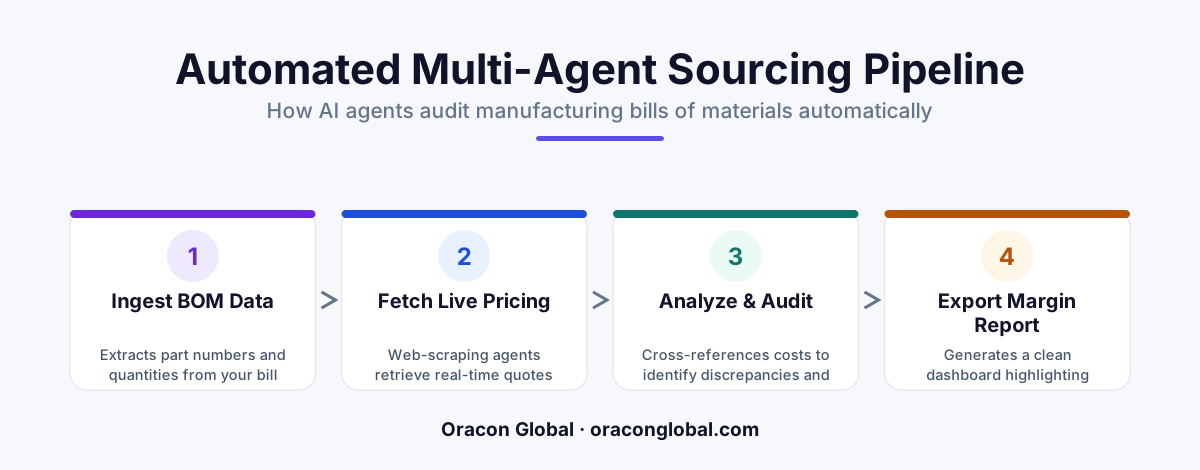
Step 1: Reading and Parsing the BOM
The process starts when you upload a new bill of materials to your system. The Reader Agent immediately goes to work. It translates messy human notes, varying part numbers, and formatting differences into a clean, standardized digital checklist.
Step 2: Gathering Live Global Supplier Pricing Sheets
While the Reader Agent organizes your parts list, the Scraper Agent is busy gathering the latest pricing data. It securely logs into your supplier portals, reads the newest Excel sheets, and pulls live market rates. It ensures that the pricing data is fresh, not weeks out of date.
Step 3: Executing the Automated Bill of Materials Audit
Now, the Auditor Agent takes over. It compares your standardized parts list against the live supplier prices. If Supplier A has raised the price of steel brackets by 15%, but Supplier B is offering a bulk discount on the exact same bracket, the Auditor Agent flags this immediately.
Step 4: Presenting the Savings Report
Instead of making you dig through raw data, the pipeline presents a clean, simple dashboard. It shows you exactly which parts have changed in price, how much money you can save by switching vendors for certain components, and a pre-calculated purchase order ready for your approval.
Real-World Example: A Specialized Electronics Manufacturer
To see this in action, let us look at a real-world manufacturing challenge. An electronics company builds custom medical devices. Each device requires over two hundred distinct components, including specialized microchips, custom plastic casings, and specific wiring harnesses.
Before using automated manufacturing procurement tools, their sourcing team spent fifteen hours every week manually checking distributor websites for microchip availability and fluctuating costs. If a chip price spiked unexpectedly, they often did not realize it until after they had submitted their client quote, hurting their profit margins.
By implementing a custom multi-agent sourcing pipeline, the company automated this entire process. Now, the moment a client requests a quote, the AI agents audit the bill of materials against live global supplier pricing sheets in under two minutes. The procurement team receives a completed cost breakdown instantly, ensuring every quote they send out is both accurate and highly profitable.
Key Benefits of Building a Custom Pipeline
While there are generic procurement tools available on the market, building a custom pipeline tailored to your specific operations offers massive advantages:
- Total IP Ownership: At Oracon Global, we build custom solutions where you own 100% of the code and intellectual property. You do not pay ongoing monthly user licensing fees to third-party software vendors.
- Perfect Integration: A custom pipeline connects directly with your existing ERP (Enterprise Resource Planning) software, legacy databases, and custom supplier spreadsheets without requiring you to rebuild your current systems.
- Safe and Secure: Your proprietary product designs and bill of materials remain completely private within your secure cloud database.
- Human-in-the-Loop Control: The AI agents do the heavy lifting of finding the data, but your human managers retain final decision-making power before any purchases are officially executed.
Taking the First Step Toward Automated Procurement
Transitioning to automated manufacturing procurement does not require your team to learn complex programming or scrap your existing software. By starting with a focused, custom multi-agent sourcing pipeline, you can eliminate the daily headache of manual spreadsheet audits, protect your margins, and free your procurement team to focus on building stronger supplier relationships.
At Oracon Global, our senior in-house development team designs, builds, and deploys custom AI agents and workflow automations that fit perfectly into your daily business operations. You can even visit our website to test our live, interactive AI demos to see how our systems handle complex tasks in real time.
Are you ready to automate your manufacturing procurement workflows and stop wasting hours on manual spreadsheets? Contact us at Oracon Global today to discuss how we can build a custom sourcing pipeline tailored to your business.
Frequently asked questions
What is a bill of materials in manufacturing?
A bill of materials, or BOM, is a comprehensive shopping list that contains every raw material, sub-assembly, and individual component needed to manufacture a finished product.
How does a multi-agent sourcing pipeline work?
It connects several specialized AI agents, where one agent reads your bill of materials, another fetches real-time prices from global suppliers, and a third agent compares them to find the best deals.
Do we have to replace our existing ERP or database software to use this?
No, a custom-built AI pipeline can connect directly to your existing ERP, inventory databases, and external supplier spreadsheets using standard secure connections.
How do we prevent the AI from making unauthorized purchases?
The pipeline is designed with a human-in-the-loop approval gate, meaning the AI agents find the savings and prepare the orders, but a human must click approve before any purchase is made.
Read next
Beyond Chatbots: How to Build AI Agents That Actually Do Work for Your Business
Most businesses use AI to answer questions. Here is how to build custom AI agents that actually take action, connect to your internal tools, and handle complex workflows.
Beyond the Wrapper: How to Build Custom AI Agents for Business That Actually Work
Many businesses invest in basic AI wrappers only to find they lack the security and context needed for real work. Here is how to build custom AI agents that integrate deeply with your workflows and databases.
Enterprise AI Maintenance Costs: Budgeting for Year Two and Beyond
Building an AI system is only half the battle. Discover the practical, ongoing operational costs of enterprise AI, including token management, model drift, and continuous security audits.
Oracon Global builds production-grade AI agents, automation and apps — and you own the code and IP. Tell us what you want to automate.
Book a call →See our work