

This guide outlines the technical architecture for a multi-agent AI underwriting assistant that cross-references commercial loan applications with local zoning laws and deed registries. By using specialized, deterministic agents for document extraction, geospatial mapping, and compliance verification, lenders can cut down diligence times from weeks to minutes while maintaining complete data isolation and audit trails.
In commercial real estate lending, the diligence phase is a notorious bottleneck. Underwriters spend dozens of hours cross-referencing commercial loan applications with municipal zoning codes, environmental records, property tax histories, and historical title deeds. A single overlooked clause in a deed restrictions document or an unexpected setback requirement in a local zoning ordinance can stall a transaction or expose a lender to millions in unhedged risk.
Historically, automating this workflow was impossible because the data lives in fragmented silos: unsearchable scanned PDFs, legacy municipal GIS databases, and archaic county clerk portals. However, by deploying a custom multi-agent underwriting assistant, financial institutions and fintech platforms can automate the tedious retrieval, extraction, and cross-referencing phases of commercial loan underwriting automation.
Here is a practical guide on how to build a production-grade multi-agent system designed to audit commercial loan applications against local zoning and title deeds.
The Architecture: Why Single-Prompt LLMs Fail at Commercial Underwriting
A common mistake when experimenting with generative AI is trying to feed an entire loan package, a 200-page zoning handbook, and a title deed into a single prompt. This approach leads to context window overflow, extreme latency, and dangerous hallucinations. Legal and financial documents require absolute precision; close enough is not good enough.
To solve this, we use a multi-agent AI architecture. Instead of one large model trying to do everything, we build a network of specialized digital employees. Each agent has a narrow scope of work, access to specific tools, and explicit instructions on how to validate data. These agents work in parallel and communicate via a structured state machine.
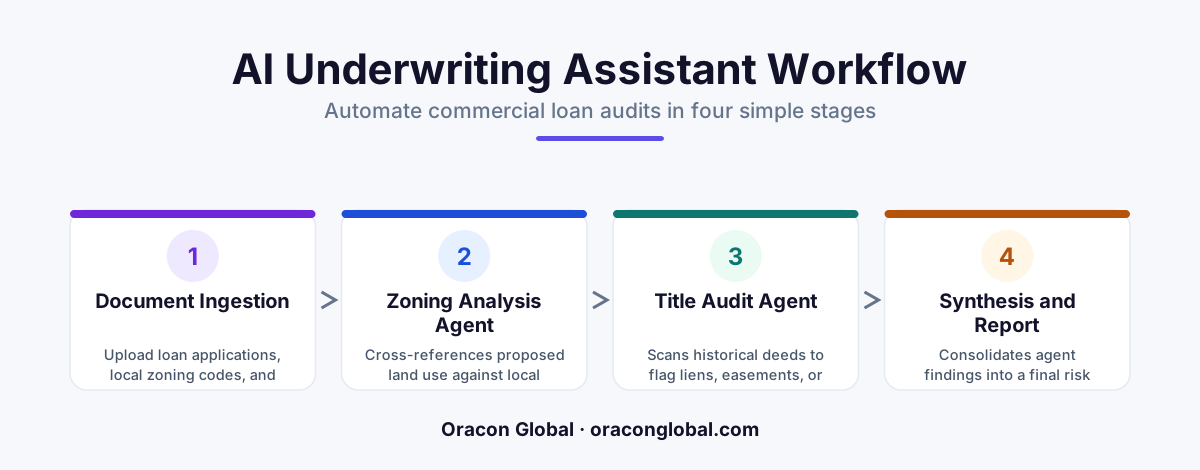
1. The Intake and Document Parser Agent
This agent is the entry point of the pipeline. Its job is to accept the loan application, identify all attached documents, and extract key metadata. It uses advanced OCR (Optical Character Recognition) and document layout analysis to parse messy PDFs, appraisal reports, and deed scans into structured JSON data. It extracts fields such as the legal property description, assessor parcel numbers (APN), proposed land use codes, and building dimensions.
2. The Title Deed Auditor Agent
Once the legal description and APN are extracted, the Title Deed Auditor Agent goes to work. It queries local county recorder APIs or securely accesses pre-fetched title registries to pull the official deed history. It analyzes the covenants, conditions, and restrictions (CC&Rs), searching for easement issues, active liens, or historical use limitations that conflict with the borrower's proposed development plan.
3. The Zoning and Land Use Agent
This agent specializes in municipal code compliance. It takes the property's physical coordinates or parcel ID and cross-references them with municipal GIS shapefiles and zoning maps. It then searches the local municipal zoning code (often a massive, frequently updated PDF or web database) to pull regulations specific to that parcel, such as building height limits, parking space ratios, and setback requirements.
4. The Synthesis and Risk Grading Agent
The final agent acting in this pipeline acts as the lead underwriter. It compiles the findings from the Deed Auditor and the Zoning Agent, compares them directly against the borrower's loan application, flags discrepancies, and generates a structured risk report for the human underwriting team.
Building the Hybrid RAG Pipeline for Automated Zoning Compliance
To make automated zoning compliance reliable, the Zoning Agent must have access to real-time, highly localized data. This requires building a hybrid Retrieval-Augmented Generation (RAG) pipeline. Simply vectorizing a city's municipal code is not enough because zoning codes are highly structured, hierarchical documents where Section A.1 directly overrides Section B.2 under specific spatial conditions.
Our approach combines vector search with a structured relational database or graph database:
- Vector Database: Used for semantic searches across broad municipal policy documents, environmental impact guidelines, and general land-use definitions.
- Relational Metadata Layer: Used to map specific parcel IDs directly to their exact zoning classifications (e.g., C-3 for Commercial Heavy, R-1 for Single-Family Residential) and legal setback tables. This ensures the agent retrieves the exact numeric constraints (e.g., "Maximum height: 45 feet") instead of guessing based on semantic similarity.
By coupling vector search with strict relational constraints, the zoning agent can accurately flag when a borrower proposes a 5-story warehouse in a zone restricted to 3-story retail structures.
The Deed Audit: Extracting Restrictions and Easements
A property deed audit is particularly challenging because deeds often contain complex legal jargon dating back decades. The Deed Auditor Agent uses specialized prompt chaining and fine-tuned extraction models to look for specific risk factors:
- Use Restrictions: Looking for clauses that permanently ban certain commercial activities (e.g., "No sale of alcohol on the premises").
- Active Easements: Identifying utility, access, or environmental easements that restrict where physical structures can be built on the parcel.
- Encroachments: Checking boundary survey data against historical deeds to ensure adjacent properties have not built structures over the lot lines.
If the deed agent identifies an active easement running directly through the center of the proposed building footprint, it immediately raises a critical flag in the underwriting dashboard.
Enforcing Deterministic Rules with a Human-in-the-Loop Veto
While AI agents are excellent at processing massive volumes of unstructured document data, they should never have the final say on a multi-million-dollar commercial loan approval. A robust commercial loan underwriting automation platform must be designed with strict boundaries.
We build these systems with a state machine that enforces hardcoded business logic. For example, if the Zoning Agent detects a 10% discrepancy in required parking spaces, the system does not reject the application automatically. Instead, it pauses the workflow, highlights the exact clause in the municipal code, maps it to the applicant's architectural layout, and routes it to a human underwriter's dashboard for manual review or waiver assessment.
This human-in-the-loop design ensures that the AI handles 90% of the cognitive lifting—finding the documents, parsing the text, and highlighting conflicts—while the human underwriting team retains absolute control over risk decisions.
Deploying a Secure, Private AI Solution
When dealing with sensitive financial documents, tax records, and proprietary development plans, security is non-negotiable. Off-the-shelf AI wrappers and generic public models pose massive data privacy risks. Lenders require enterprise-grade tenant isolation, secure API connections to legacy banking cores, and complete ownership of their codebase.
At Oracon Global, we build custom, full-stack AI agents and digital employees tailored to your exact operational workflows. We believe that you should never be locked into proprietary vendor platforms, which is why our clients own 100% of their code and intellectual property.
If you are ready to modernize your commercial real estate underwriting process, eliminate diligence bottlenecks, and build a secure, proprietary multi-agent assistant, we can help you design and deploy it.
Would you like to discuss how we can integrate a custom multi-agent underwriting assistant into your existing lending platform or ERP system? Get in touch with our senior engineering team at Oracon Global today.
Frequently asked questions
Why use multiple AI agents instead of a single LLM for underwriting?
A single LLM lacks the capability to handle conflicting documents, perform complex legal analysis, and query GIS databases simultaneously without hallucinating. A multi-agent architecture assigns specialized tasks to dedicated agents, ensuring deterministic checks and rigorous verification.
How do you prevent the AI from hallucinating zoning regulations?
We use a hybrid RAG retrieval pipeline that grounds the agents in verified municipal zoning PDFs, GIS shapefiles, and local deed registries, backed by hardcoded validation rules that flag discrepancies for human review.
Can this system handle scanned, low-quality property deeds?
Yes, the ingestion pipeline uses advanced OCR engines coupled with vision-capable models to extract structured text from historical, hand-annotated, or poorly scanned deed documents before passing them to the audit agents.
Who owns the intellectual property of the custom underwriting assistant?
When you build custom AI solutions with Oracon Global, you retain 100% ownership of the code, custom integrations, and intellectual property.
Read next
Beyond Chatbots: How to Build AI Agents That Actually Do Work for Your Business
Most businesses use AI to answer questions. Here is how to build custom AI agents that actually take action, connect to your internal tools, and handle complex workflows.
Beyond the Wrapper: How to Build Custom AI Agents for Business That Actually Work
Many businesses invest in basic AI wrappers only to find they lack the security and context needed for real work. Here is how to build custom AI agents that integrate deeply with your workflows and databases.
Enterprise AI Maintenance Costs: Budgeting for Year Two and Beyond
Building an AI system is only half the battle. Discover the practical, ongoing operational costs of enterprise AI, including token management, model drift, and continuous security audits.
Oracon Global builds production-grade AI agents, automation and apps — and you own the code and IP. Tell us what you want to automate.
Book a call →See our work