

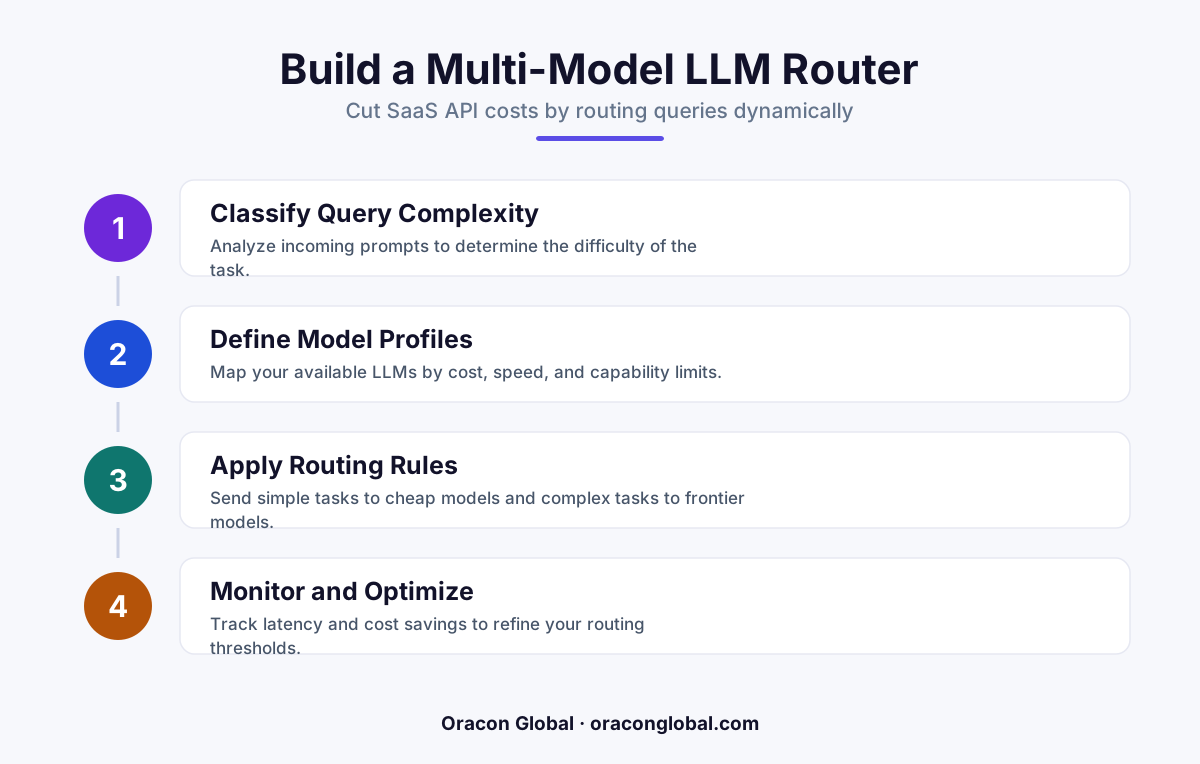
Running a B2B SaaS on a single frontier LLM like GPT-4o or Claude 3.5 Sonnet is a fast way to destroy your profit margins. By building a custom multi-model router, you can automatically send low-complexity requests to lightweight, open-source models while reserving expensive frontier models only for tasks that truly require deep reasoning.
In the early stages of building an AI-powered SaaS product, using the absolute best LLM on the market is a smart move. It helps you prove your concept, delight early users, and ensure your system handles edge cases gracefully. But as your user base scales from a hundred active users to thousands, relying exclusively on a single premium frontier model can quickly destroy your SaaS profit margins.
Every time a user asks your application to perform a simple task, like classifying a support ticket, formatting a date, or translating a short sentence, sending that request to a top-tier frontier model is a waste of money. You are essentially paying premium, enterprise-grade cognitive rates for tasks that a lightweight, fraction-of-a-cent model could handle in milliseconds. To run a sustainable, profitable software business, you need a smart way to manage your LLM cost optimization. The answer is a custom multi-model router.
The Unit Economics of the Single-LLM Trap
Most SaaS applications do not require deep cognitive reasoning for 100% of their operations. In a typical B2B workflow, up to 70% of user queries are simple, repetitive, or administrative. Here is the problem: if your application backend is hardcoded to call one premium LLM API for everything, your unit economics will collapse under scale.
Frontier models are priced for heavy reasoning. When your application processes thousands of background jobs, automated emails, and database syncs, those token costs compound. If your subscription pricing is fixed, your high-volume users will actually cost you money. A custom multi-model router acts as an intelligent traffic controller. It evaluates the complexity of every incoming request and directs it to the cheapest, fastest model capable of doing the job perfectly.
How a Custom Multi-Model Router Works in Practice
Instead of sending user prompts directly to an external API, your application sends them to an internal routing layer. This layer performs a quick, low-overhead evaluation to categorize the task before choosing the destination model. Here is how the process works step-by-step:
- Query Classification: The router analyzes the incoming prompt using a lightweight semantic classifier, a small fine-tuned model, or a fast keyword matrix.
- Complexity Scoring: The system assigns a complexity score to the request. Is it a creative writing task? A complex code generation request? Or a simple multiple-choice classification?
- Model Selection: Based on the score, the router assigns the task. Simple tasks go to fast, low-cost open-source models. Complex reasoning, multi-step math, or highly nuanced creative tasks are routed to premium frontier models.
- Fallback Execution: If the chosen model fails or returns an error, the router automatically upgrades the query to the next tier, ensuring a seamless user experience.
Three Routing Strategies to Protect Your Bottom Line
Depending on your application's architecture and user behavior, we typically recommend one of three custom routing strategies to maximize your SaaS API costs savings:
1. Static, Intent-Based Routing
This is the most straightforward approach. It is highly effective for SaaS products with structured, predictable workflows. If a user clicks "Generate Weekly PDF Report," the application knows this requires heavy data synthesis and routes it to a premium model. If a user clicks "Archive and Summarize Thread," the system routes it to a faster, cheaper, smaller model. This adds zero latency because the route is determined by the specific feature the user is interacting with.
2. Dynamic Semantic Routing
For open-ended chat interfaces or conversational AI agents, static routing does not work. Instead, we build a fast semantic classification layer. By converting the user's prompt into a lightweight vector embedding, the router checks it against a database of typical low-complexity tasks. This evaluation takes under 15 milliseconds and costs virtually nothing, yet it can divert up to 60% of your traffic away from expensive APIs.
3. Heuristic and Length-Based Filters
Sometimes, the simplest approach is the most robust. By analyzing prompt length, the presence of specific keywords, or system tool requirements, the router can quickly filter out basic requests. For example, any prompt under 50 words that asks for basic formatting can be immediately offloaded to a lightweight model, preserving your high-tier API budget for long-form documents.
The Added Benefits: Latency and Redundancy
While protecting your profit margins is the primary driver, implementing a custom router delivers two massive secondary benefits to your SaaS product:
First, smaller models are incredibly fast. By routing simpler tasks to lightweight endpoints, your users will experience near-instantaneous response times for the majority of their interactions, dramatically improving user satisfaction.
Second, it builds systemic redundancy directly into your software. If a major frontier AI provider experiences an outage, your application does not have to go dark. Your custom router can immediately detect the API failure and redirect critical traffic to alternative backup models, keeping your SaaS online and reliable when your competitors are facing downtime.
Build for Scale with a Senior Engineering Team
Implementing an intelligent routing layer requires deep backend expertise. It is not just about writing a few conditional statements; it is about building a robust, low-latency middleware architecture that handles state management, API fallbacks, and real-time cost tracking without adding drag to your user experience.
At Oracon Global, our senior in-house development team specializes in building production-ready AI systems, custom workflow automation, and scalable SaaS platforms. We help businesses design and deploy custom AI solutions where you retain 100% ownership of your code and intellectual property.
Ready to optimize your AI infrastructure and protect your software profit margins? Get in touch with us at Oracon Global today to discuss how we can build a highly efficient, custom architecture tailored to your business needs.
Frequently asked questions
What is a multi-model router in AI SaaS development?
A multi-model router is an intelligent middleware layer that analyzes incoming user queries and routes them to the most cost-effective LLM capable of handling that specific task.
How does an LLM router protect SaaS profit margins?
It prevents your application from using expensive frontier models for simple tasks like classification, sentiment analysis, or basic text formatting, reducing your API bill by up to 70%.
Does a multi-model router add latency to the user experience?
No, when built correctly with a lightweight evaluation model or a semantic classifier, the routing decision takes only a few milliseconds, which is often offset by the faster generation speeds of smaller models.
Can we implement this routing system using open-source models?
Yes, a custom router can easily direct simpler tasks to highly efficient, open-source models hosted on cost-effective infrastructure, while reserving proprietary models for complex reasoning.
Read next
Beyond Chatbots: How to Build AI Agents That Actually Do Work for Your Business
Most businesses use AI to answer questions. Here is how to build custom AI agents that actually take action, connect to your internal tools, and handle complex workflows.
Beyond the Wrapper: How to Build Custom AI Agents for Business That Actually Work
Many businesses invest in basic AI wrappers only to find they lack the security and context needed for real work. Here is how to build custom AI agents that integrate deeply with your workflows and databases.
Enterprise AI Maintenance Costs: Budgeting for Year Two and Beyond
Building an AI system is only half the battle. Discover the practical, ongoing operational costs of enterprise AI, including token management, model drift, and continuous security audits.
Oracon Global builds production-grade AI agents, automation and apps — and you own the code and IP. Tell us what you want to automate.
Book a call →See our work