

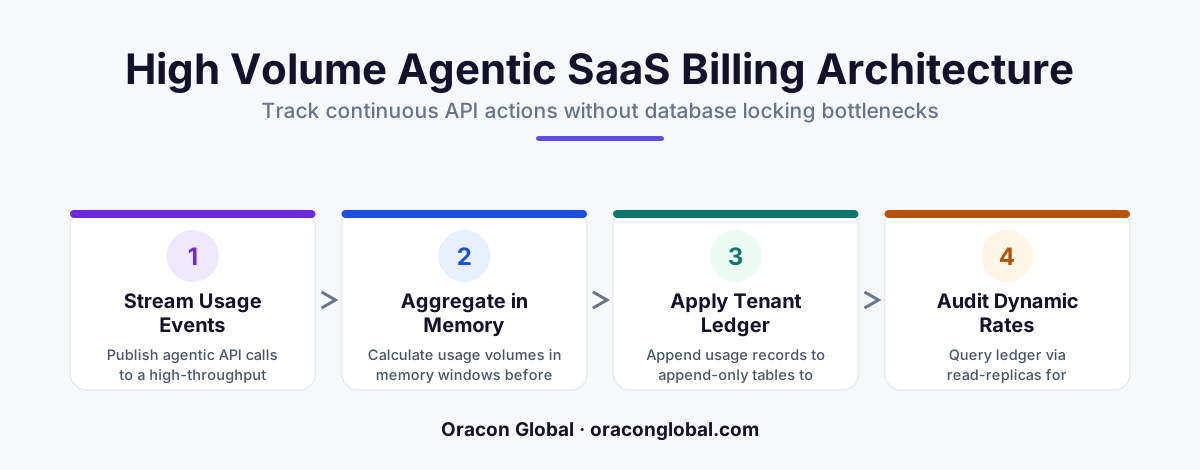
To charge for AI agent workflows without database locks, decouple your transactional database from your billing engine using an event-driven ledger. By routing usage events through an append-only message stream to a time-series datastore, dynamic pricing APIs can safely audit tenant consumption without blocking active SaaS operations.
As software transitions from human-interactive dashboards to autonomous AI agents, the way we charge for software must change. The classic seat-based SaaS model is breaking down. When a single tenant deploys ten autonomous agents that perform thousands of API calls, background tasks, and database queries per hour, charging per user login no longer aligns with your actual operating costs. You need a usage-based or outcome-based billing system.
However, building a custom multi-tenant subscription engine for agentic SaaS billing introduces a severe technical bottleneck: database write contention. If your database attempts to update a tenant's usage balance on every single agent action, you will run into massive database locks. Your application will slow to a crawl, webhooks will time out, and your infrastructure bills will spike.
To run a highly profitable SaaS, you need a system where dynamic pricing APIs can audit usage logs in real time to calculate bills without degrading your primary application database. Here is how to design and build a lock-free, highly scalable billing architecture for the agentic era.
The Database Lock Problem in Agentic SaaS Billing
In a standard subscription platform, a user might load a page, update a record, and log out. This generates very few write operations. The billing database simply keeps track of a static subscription tier, which is checked occasionally during authentication.
With autonomous AI agents, a single tenant's agent might execute a multi-step workflow that triggers dozens of parallel tool executions, vector searches, and external API integrations. If your application database tries to execute an SQL statement like this every time an agent takes an action:
UPDATE tenant_subscriptions SET credit_balance = credit_balance - 0.001 WHERE tenant_id = 'tenant_123';You will quickly hit a wall. When hundreds of parallel agents attempt to update the exact same row for tenant_123 at the same millisecond, the database engine forces these transactions to wait in line. This is a database lock. In high-throughput systems, lock contention leads to connection pool exhaustion, application latency spikes, and eventual system crashes.
Step 1: Decouple Transactional State from the Billing Ledger
The first rule of building a high-volume billing engine is to never mix transactional application state with usage accumulation. Your core application database should focus exclusively on running your multi-tenant SaaS. Usage tracking should be handled out-of-band.
Instead of updating a single balance row, your application should emit lightweight usage events. Every time an AI agent completes a task, it sends an event payload to an asynchronous ingestion queue. A typical event payload looks like this:
- Event ID: Unique UUID to prevent double-processing.
- Tenant ID: The identifier for the multi-tenant workspace.
- Agent ID: The specific autonomous agent performing the work.
- Metric: What is being measured (e.g.,
tokens_processed,api_calls,workflow_steps). - Quantity: The numeric volume of the metric.
- Timestamp: High-precision UTC execution time.
By moving this data out of the main database path, your AI agents can run at full speed without waiting for billing confirmations.
Step 2: Implement an Append-Only Event Stream
To ensure that your dynamic pricing APIs can audit data reliably without causing database locks, you must build an append-only event stream. Instead of modifying existing database rows, your system should only write new rows.
In an append-only architecture, a write is incredibly cheap. Databases are exceptionally fast at appending new rows to the end of a table because they do not have to search for existing records or negotiate complex locks. You can use a message broker like Apache Kafka or AWS Kinesis to buffer these incoming events, which are then flushed in micro-batches to a specialized time-series database or a dedicated billing ledger database.
When it is time to calculate a tenant's current usage, your billing system does not look at a single mutable field. Instead, it runs an aggregation query over a specific time window. While this sounds computationally expensive, modern time-series databases can aggregate millions of rows in milliseconds using pre-computed hyperloglogs and materialized rollups.
Step 3: Leverage Materialized Views for Real-Time Auditing
Dynamic pricing APIs need to know a tenant's usage limits in real time to prevent overages or block runaway agents. However, running a massive SUM query across billions of raw event rows on every single API request is highly inefficient.
The solution is to use materialized views that refresh on a non-blocking schedule, or to maintain an in-memory cache using a fast key-value store. Here is how the flow works:
- The raw billing events are written directly to the append-only ledger database.
- A background worker reads these events and updates a fast cache (like Redis) asynchronously.
- When an AI agent requests permission to run a task, the application queries the in-memory cache to verify the tenant has sufficient credits.
- Because the cache lookup is read-only and decoupled from the write ledger, it takes less than 2 milliseconds and introduces zero database locks.
Step 4: Designing Dynamic Pricing APIs for Auditability
Enterprise clients using agentic SaaS will inevitably demand detailed transparency. They will want to know exactly why they were billed a specific amount, down to the individual LLM token or external tool call. Your billing engine must be auditable by design.
Because you built an append-only event ledger, auditing is incredibly simple. To resolve a billing dispute, your dynamic pricing API can query the raw event table for a specific tenant and date range. You can expose this data directly to your customers through a billing portal dashboard, showing them a clear, itemized receipt of every agentic action taken on their behalf.
This level of data integrity is virtually impossible to achieve if you are simply updating a single balance counter in PostgreSQL, as the granular history of how that balance was reached is lost forever.
Choosing the Right Stack for Your Multi-Tenant Subscription Engine
When building this infrastructure, choosing the right database and processing tools is critical. For most scaling SaaS applications, a hybrid approach works best:
- Ingestion Layer: Use a fast, distributed queue to ingest events without dropping packets during traffic spikes.
- Ledger Storage: A time-series database or a relational database configured with optimized partitioned tables is ideal for storing the raw append-only usage logs.
- Cache Layer: An in-memory key-value store provides rapid, lock-free credit checks for active agents.
- Application Layer: Your primary multi-tenant SaaS application database remains completely untouched by the high-volume billing traffic, ensuring consistent performance for your users.
Build Your Production-Grade Agentic Infrastructure
Transitioning your SaaS to support autonomous AI agents requires a fundamental shift in how you build your backend architecture. Moving away from legacy relational database locks and embracing event-driven, append-only ledgers is the only way to build a reliable, scale-ready usage billing system.
At Oracon Global, our senior in-house development team builds robust, production-grade AI agents, workflow automation systems, and custom SaaS platforms designed to handle enterprise workloads. We deliver custom software with clean architectures that scale seamlessly, and our clients own 100% of their code and intellectual property.
If you are planning to build a custom multi-tenant SaaS or migrate your existing platform to support agentic workflows, contact the team at Oracon Global today to discuss your technical architecture.
Frequently asked questions
Why do traditional SaaS subscription engines fail when applied to agentic SaaS?
Traditional subscription engines rely on seat-based licensing or simple monthly API limits updated via direct database writes. Agentic SaaS requires continuous, high-volume tracking of autonomous workflows, which leads to database lock contention if built on legacy relational database structures.
What is a database lock in usage-based billing?
A database lock occurs when a transaction holds access to a specific table row or page (such as updating a tenant's current balance) while another process tries to read or write to it. High-frequency updates from active AI agents can cause database queries to pile up, degrading SaaS application performance.
How does an append-only ledger prevent database locks?
Instead of constantly overwriting a single balance row in a database, an append-only ledger writes each usage event as a new, immutable row. Because writes are purely additive and do not modify existing data, the database does not need to acquire exclusive row locks, keeping the system fast.
How can dynamic pricing APIs audit usage data safely?
By keeping transactional application data separate from usage data, dynamic pricing APIs can query a dedicated read-replica or a specialized time-series database. This ensures that complex audit queries do not consume the resources needed to run the main multi-tenant application.
Read next
Beyond Chatbots: How to Build AI Agents That Actually Do Work for Your Business
Most businesses use AI to answer questions. Here is how to build custom AI agents that actually take action, connect to your internal tools, and handle complex workflows.
Beyond the Wrapper: How to Build Custom AI Agents for Business That Actually Work
Many businesses invest in basic AI wrappers only to find they lack the security and context needed for real work. Here is how to build custom AI agents that integrate deeply with your workflows and databases.
Enterprise AI Maintenance Costs: Budgeting for Year Two and Beyond
Building an AI system is only half the battle. Discover the practical, ongoing operational costs of enterprise AI, including token management, model drift, and continuous security audits.
Oracon Global builds production-grade AI agents, automation and apps — and you own the code and IP. Tell us what you want to automate.
Book a call →See our work