

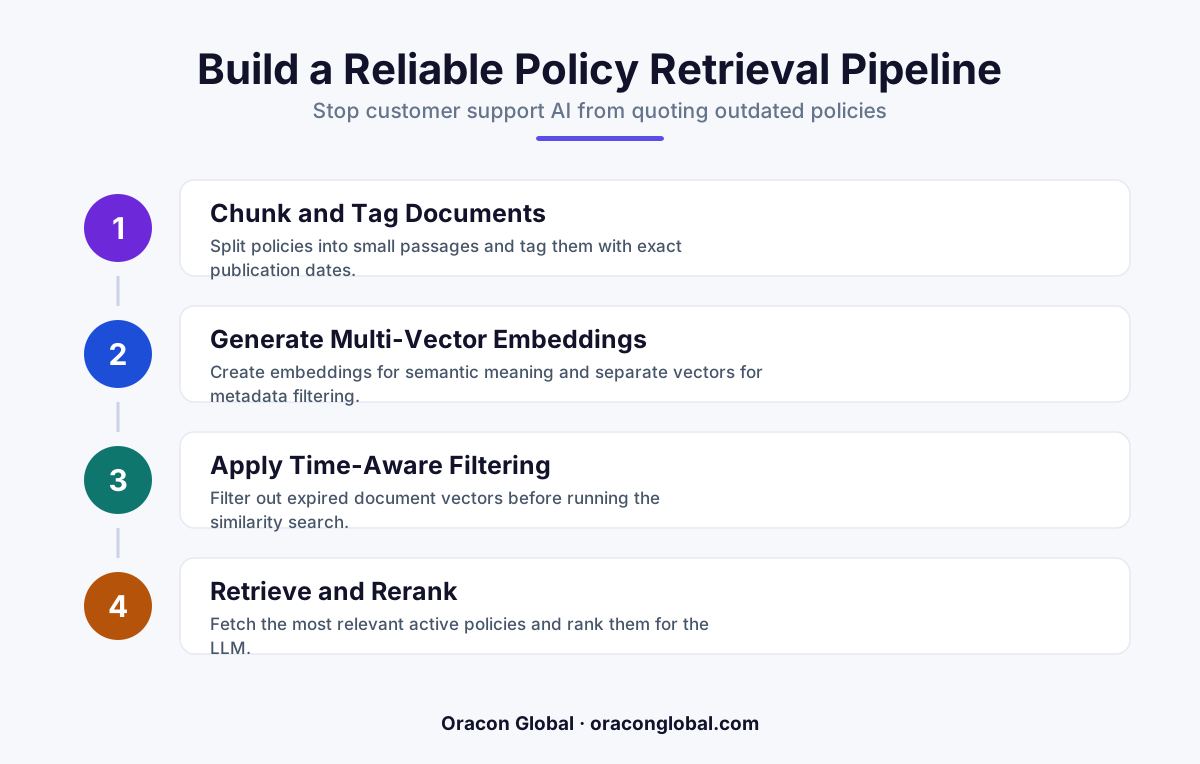
Standard search databases often confuse old and new business policies because the text looks nearly identical. By implementing a custom multi-vector retrieval pipeline with parent-child document mapping, explicit temporal metadata routing, and summary-level vector representations, you can ensure your customer support AI only references active, verified operational rules.
There is a specific moment of panic known to almost every e-commerce operator and customer experience director: the moment your customer support AI confidently promises a customer a full cash refund on an item purchased nine months ago, quoting a policy that your finance team retired last spring.
When you rely on basic Retrieval-Augmented Generation (RAG) to power your customer support automation, these errors are not just common—they are mathematically predictable. Standard vector databases do not understand the passage of time. They measure semantic similarity. To an algorithm, a document titled "Holiday Returns Policy 2024" looks almost identical to "Holiday Returns Policy 2026." They share 95% of the same vocabulary, structure, and intent. If the older document happens to match the user's phrasing slightly better, the database will happily serve it to the LLM, resulting in a costly hallucination.
To solve this, engineering teams must move beyond basic semantic search. The solution is to build a custom multi-vector retrieval pipeline that explicitly separates, categorizes, and filters information based on operational reality, metadata, and document hierarchies. Here is how to architect a system that keeps your customer support AI grounded in active policies.
The Structural Flaw of Simple Vector Search
In a standard RAG setup, your policy documents are broken down into arbitrary, fixed-size chunks of text, converted into mathematical representations called vector embeddings, and stored in a database. When a customer asks a question, the system searches for the chunks that are closest in meaning to the query.
While this works beautifully for static knowledge bases, it breaks down in dynamic business environments because of three core limitations:
- Loss of Document Context: A single chunk of text explaining "exceptions to the 14-day window" does not inherently contain the context of whether it belongs to the active general policy or a retired promotional campaign.
- Chronological Blindness: Vector distances do not prioritize recency. An outdated policy page can easily outrank a newer one if its phrasing matches the user's conversational style more closely.
- Granularity Mismatch: Small chunks of text are great for pinpointing specific answers, but they lack the macro-level context of the entire policy. Conversely, large chunks preserve context but dilute the specific details needed to answer a customer's question.
A custom multi-vector retrieval pipeline addresses these issues by decoupler-linking the text chunks used for synthesis from the vectors used for search, allowing for targeted, context-aware information retrieval.
Architecting the Multi-Vector Pipeline
To build an enterprise-grade multi-vector retrieval pipeline, you need to structure your data ingestion and search process into three distinct layers: the Document Store, the Multi-Vector Representation Layer, and the Deterministic Query Router.
1. The Document Store (The Source of Truth)
Instead of relying solely on a vector database to store both your raw text and mathematical embeddings, split them. Use a relational database or a document-oriented database (like PostgreSQL or MongoDB) as your absolute source of truth. Each policy document is stored as a whole, clean, version-controlled record. This ensures that when the AI finds the correct policy, it retrieves the official, unfragmented text for context generation.
2. The Multi-Vector Representation Layer
For every single document in your source of truth, you generate multiple distinct vectors, rather than just one. These include:
- Summary Vectors: A high-level, LLM-generated summary of the entire policy. This is used to quickly identify which high-level topic (e.g., electronics returns versus apparel returns) the user is asking about.
- Granular Chunk Vectors: Detailed, smaller fragments of the policy containing specific numbers, timeframes, and terms.
- Hypothetical Question Vectors: A set of 5 to 10 common customer questions that this specific policy document is designed to answer. Searching against actual questions is often far more accurate than searching against raw policy prose.
These vectors all point back to the parent document in your relational database. If a search matches a chunk vector or a hypothetical question vector, the system pulls the parent document, guaranteeing the AI model has the complete, unified context.
3. Temporal Metadata and Deterministic Routing
To eliminate the risk of the system retrieving deprecated documents, you must implement a metadata filtering layer. Every document in your source store must carry strict operational metadata, such as:
{ "status": "active", "effective_date": "2026-01-01", "expiration_date": "2026-12-31", "region": "US" }
Before the database performs any mathematical semantic search, it executes a hard relational filter. If the current date is February 15, 2026, the query pre-filter automatically excludes any document where the status is "archived" or the expiration date has passed. This step completely eliminates the primary source of AI hallucination prevention issues.
Step-by-Step Implementation Flow
When engineering this pipeline for a production environment, the runtime execution follows a strict, highly controlled sequence to maintain speed and safety:
Step 1: Intent Extraction and Query Normalization
When a customer asks, "Can I get my money back on a jacket I bought last month?", a lightweight, specialized model normalizes the query. It extracts key variables such as the current date, the user's location, and the core intent (returns/refunds).
Step 2: Metadata Pre-Filtering
The system constructs a database query that combines semantic search with hard logical constraints. It tells the vector database: "Find the most relevant return policy details, but only consider documents marked as active for the US region as of today's date."
Step 3: Multi-Vector Search and Parent Retrieval
The database searches across the summary and question vectors. Once it finds the closest match, it uses the relational link to pull the correct, full parent document from your secure document store, rather than raw, isolated text chunks.
Step 4: Prompt Construction and Guardrails
The system inserts the verified, up-to-date policy directly into the prompt context for the customer support AI, alongside a strict instruction: "Use only the provided document to answer. If the policy does not explicitly cover the user's scenario, route the customer to a live support representative."
Operationalizing the Pipeline for Your Team
Building a robust enterprise RAG architecture is not a one-time setup; it requires continuous sync with your business operations. As your marketing and operations teams launch new promotions, adjust shipping rates, or revise service terms, your ingestion pipeline must automatically update the document store, deprecate old vectors, and generate new ones.
By investing in a custom-built custom knowledge retrieval infrastructure, you protect your brand from costly customer service promises, minimize human agent intervention, and ensure your autonomous AI systems act as reliable, accurate representatives of your business guidelines.
If you are looking to deploy production-ready AI systems that integrate seamlessly with your operational data without the risk of hallucination, our senior in-house team at Oracon Global is here to help. We build custom AI agents, robust retrieval engines, and enterprise software solutions tailored to your exact business logic, with 100% code and IP ownership belonging to you. Reach out to Oracon Global today to discuss how we can build a resilient AI architecture for your business.
Frequently asked questions
Why do standard vector databases retrieve outdated policies when newer ones are available?
Standard vector databases look for semantic similarity, not chronological recency. Because a 2024 return policy looks almost identical to a 2026 return policy in terms of vocabulary and structure, the database often scores the older document higher simply because of minor keyword matches.
What is a multi-vector retrieval pipeline?
It is an advanced data architecture that stores multiple distinct vector embeddings for a single piece of business information. Instead of embedding an entire 50-page PDF, it stores separate vectors for small text chunks, high-level summaries, and specific metadata parameters like expiration dates.
How does temporal metadata routing prevent AI hallucinations?
Temporal metadata routing attaches hardcoded "active" and "deprecated" date tags to your policy documents. Before the AI database performs a semantic search, a hard filter runs to exclude any information outside the currently valid date range, neutralizing the risk of retrieving stale terms.
Do we need to rewrite our entire customer support software to implement this?
No. A custom multi-vector retrieval pipeline lives as a middleware layer between your existing knowledge bases (like Google Drive, Notion, or internal wikis) and your large language model, meaning it plugs directly into your current customer support workflow without a total rebuild.
Read next
Beyond Chatbots: How to Build AI Agents That Actually Do Work for Your Business
Most businesses use AI to answer questions. Here is how to build custom AI agents that actually take action, connect to your internal tools, and handle complex workflows.
Beyond the Wrapper: How to Build Custom AI Agents for Business That Actually Work
Many businesses invest in basic AI wrappers only to find they lack the security and context needed for real work. Here is how to build custom AI agents that integrate deeply with your workflows and databases.
Enterprise AI Maintenance Costs: Budgeting for Year Two and Beyond
Building an AI system is only half the battle. Discover the practical, ongoing operational costs of enterprise AI, including token management, model drift, and continuous security audits.
Oracon Global builds production-grade AI agents, automation and apps — and you own the code and IP. Tell us what you want to automate.
Book a call →See our work