

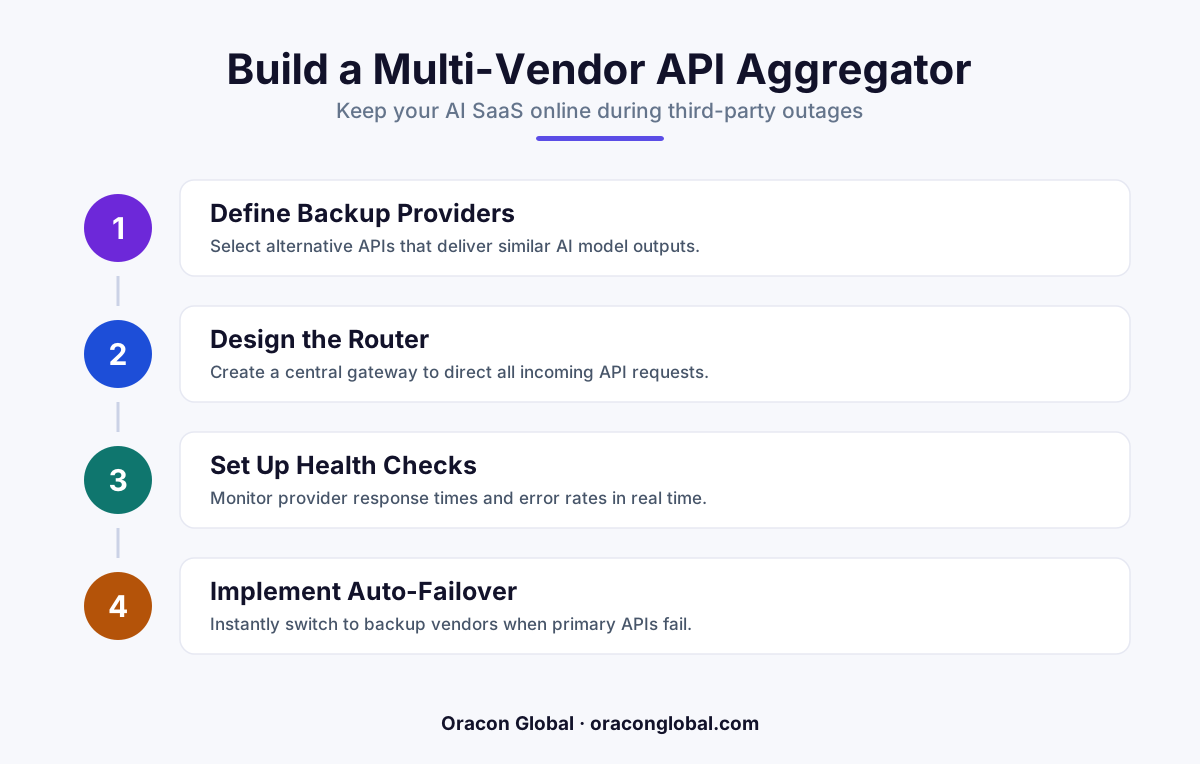
An AI SaaS platform is only as reliable as its upstream API dependencies. By building a custom multi-vendor API aggregator, you decouple your core application logic from specific providers, enabling automatic failover, real-time rate-limit mitigation, and uninterrupted service.
Building an AI-powered SaaS platform is an exciting journey, but it comes with a structural vulnerability that many founders only discover during their first major outage. If your application relies on a single external LLM provider, transcription service, or vector hosting solution, your business is effectively at the mercy of their uptime. When their servers experience a hiccup, your platform goes dark, leaving your users frustrated and your support queue overflowing.
Relying on standard API integrations often leads to a compounding failure cycle known as a downtime spiral. When one provider slows down, your application queues back up, resource usage spikes, and your entire system can crash. To prevent this, scaling platforms need a multi-vendor API aggregator. This custom architectural layer sits between your core application and your third-party providers, ensuring your AI SaaS platform reliability remains uncompromised, even when your primary vendors go offline.
The Hidden Costs of Third-Party API Downtime
In traditional software development, an API failure might mean a single non-essential feature temporarily stops working. In an AI-native SaaS, however, third-party APIs are often the engine of the entire product. If your primary language model provider or document parsing service experiences third-party API downtime, your core product simply ceases to function.
When an outage occurs, the damage extends beyond immediate user frustration:
- Cascading timeouts: Delayed responses from an upstream vendor block your application workers, quickly exhausting your database connection pools.
- Financial waste: Broken or half-executed multi-step workflows still consume infrastructure resources without delivering value to your customers.
- Churn risks: Professional users expect business-critical software to work on demand. Frequent interruptions quickly drive them to more stable competitors.
How a Custom Multi-Vendor API Aggregator Solves the Dependency Problem
A multi-vendor API aggregator acts as an intelligent traffic controller for your external dependencies. Instead of writing code that connects directly to a specific service, your application sends its requests to your internal aggregator. The aggregator then decides the best place to route that request in real time.
If your primary provider returns a 503 error, experiences a latency spike, or hits a rate limit, the aggregator seamlessly redirects the request to a pre-configured secondary provider. Your end users never notice a gap in service, and your engineering team avoids a high-stress emergency patch deployment.
1. Designing the Unified Payload Schema
The first step in building a reliable aggregator is decoupling your application logic from vendor-specific payload structures. Different providers require different input structures and parameters. Your aggregator should accept a single, standardized format from your frontend and translate it into the specific structure required by whichever vendor is currently active.
2. Implementing Intelligent Failover Logic
A true redundant API architecture does more than just switch providers when a hard error occurs. It monitors performance metrics to anticipate failures. Your aggregator can be configured to redirect traffic under several conditions:
- HTTP Status Codes: Instant failover when receiving 5xx server errors or 429 rate-limit warnings.
- Latency Thresholds: If the primary vendor takes longer than a specified threshold (e.g., 4 seconds) to respond, the aggregator initiates a parallel or backup request to a secondary provider.
- Circuit Breakers: If a vendor fails three times in a row, the aggregator temporarily "trips" the circuit, routing all traffic to the backup provider for a set cooldown period to prevent wasted requests.
3. Dynamic Load Balancing and Cost Optimization
Beyond downtime protection, an aggregator allows you to manage your operating margins. You can route non-urgent, high-volume tasks to more cost-effective, open-source models hosted on independent infrastructure, while reserving premium, high-latency providers for complex, user-facing queries. This optimization happens entirely behind the scenes, without modifying your core software code.
Key Architectural Pillars of a Resilient API Failover System
To ensure your custom aggregator doesn't become a single point of failure itself, it must be engineered with resilience in mind. A robust API failover system for AI relies on three main technical pillars:
"A resilient system doesn't just hope for the best; it actively assumes every external dependency will fail at some point and has a silent, automated backup plan ready to execute in milliseconds."
Lightweight Execution and Low Latency
Because the aggregator is an extra layer between your app and the internet, it must be incredibly fast. Building the aggregator using lightweight runtimes ensures that routing decisions add negligible latency (often under 10 milliseconds) to the overall request cycle.
State Management and Rate Limit Tracking
To prevent hitting rate limits across multiple vendors simultaneously, the aggregator should track token usage and request counts in a shared, fast-access memory cache. This allows the system to proactively throttle or distribute requests before a vendor blocks your access keys.
Asynchronous Queueing for Non-Urgent Tasks
For background tasks like batch document processing or offline data synchronization, the aggregator should utilize an asynchronous message queue. If all available vendors are temporarily experiencing high latency, the aggregator safely holds the tasks in a queue and processes them as soon as healthy connections are restored.
Owning Your Infrastructure for Long-Term SaaS Success
Using third-party multi-tenant middleware to manage your API connections might seem like an easy shortcut, but it introduces another layer of platform risk and ongoing subscription costs. Building a custom, in-house aggregator ensures that you retain complete control over your routing rules, security protocols, and intellectual property.
When you own your integration infrastructure, you are never locked into a single ecosystem. You can swap providers, run private open-source models, and adjust your routing logic instantly as the AI landscape evolves and new, more efficient models become available.
At Oracon Global, our senior in-house engineering team designs and builds secure, production-grade software architectures that help SaaS platforms scale reliably. We focus on creating robust backend systems, intuitive custom applications, and clean, resilient integrations that ensure your software remains online and performant under heavy production workloads.
If you are ready to protect your application from external service disruptions and build a highly resilient API infrastructure, contact us at Oracon Global today to discuss how we can support your development goals.
Frequently asked questions
What is a multi-vendor API aggregator?
It is a custom middleware layer that sits between your AI application and third-party API providers, automatically routing requests based on service availability, cost, and latency.
Why can't I just use standard SDKs for my AI SaaS?
Hardcoding specific vendor SDKs creates tight coupling, meaning a single provider outage or rate-limit spike will immediately crash your user-facing features.
How does a custom aggregator handle data format differences between vendors?
The aggregator uses an internal translation schema to map your application's unified request into the specific payloads required by different third-party services.
Will adding an aggregator layer increase my application's latency?
When built correctly with lightweight, compiled languages or optimized runtimes, the routing overhead is negligible (often under 10 milliseconds), which is easily offset by avoiding total request failures.
Read next
Beyond Chatbots: How to Build AI Agents That Actually Do Work for Your Business
Most businesses use AI to answer questions. Here is how to build custom AI agents that actually take action, connect to your internal tools, and handle complex workflows.
Beyond the Wrapper: How to Build Custom AI Agents for Business That Actually Work
Many businesses invest in basic AI wrappers only to find they lack the security and context needed for real work. Here is how to build custom AI agents that integrate deeply with your workflows and databases.
Enterprise AI Maintenance Costs: Budgeting for Year Two and Beyond
Building an AI system is only half the battle. Discover the practical, ongoing operational costs of enterprise AI, including token management, model drift, and continuous security audits.
Oracon Global builds production-grade AI agents, automation and apps — and you own the code and IP. Tell us what you want to automate.
Book a call →See our work