

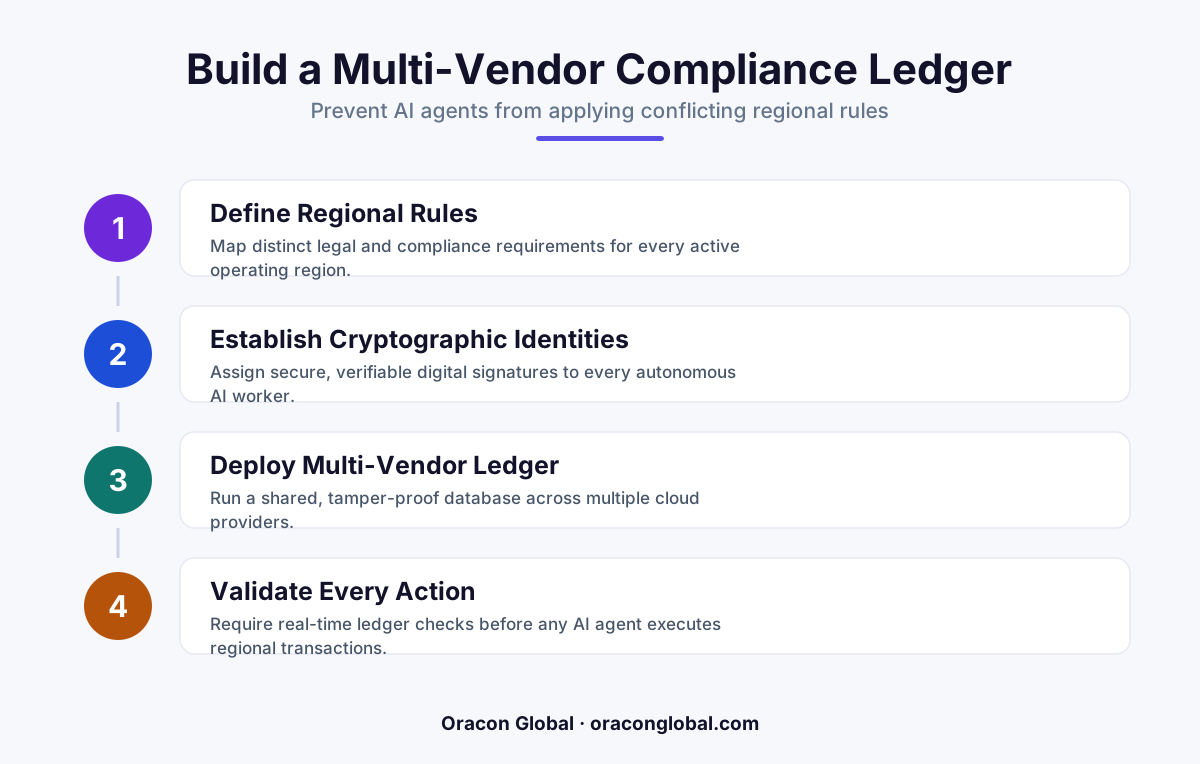
Operating AI digital employees across multiple jurisdictions often leads to compliance conflicts when different models pull from overlapping regional databases. A custom multi-vendor audit ledger solves this by serving as a centralized, immutable verification layer that intercepts and audits AI compliance rules before they are shared or acted upon.
Deploying AI digital employees to handle customer service, contract processing, or operational workflows across multiple regions is one of the fastest ways to scale enterprise efficiency. However, global operations introduce a major challenge: regional compliance rules are rarely uniform. What is perfectly legal and compliant in one state or country can lead to severe regulatory penalties in another.
When you use different AI models, vector databases, or third-party APIs across your business, your digital workforce can easily mix up these localized rules. An AI agent might accidentally apply California data privacy standards to a transaction in Germany, or quote European shipping regulations to a client in Canada. To prevent these costly mistakes, enterprise teams are building a custom multi-vendor audit ledger. This dedicated architectural layer serves as an immutable, real-time boundary that ensures your AI digital employees never share or act on conflicting regional compliance rules.
The Problem with Multi-Vendor AI and Regional Boundaries
Most modern AI setups are multi-vendor by nature. You might use one large language model (LLM) for processing complex documents, another lighter model for quick customer support chats, and various regional databases to store localized legal policies.
Without a central point of control, these systems operate in silos. A Retrieval-Augmented Generation (RAG) pipeline in one region might retrieve an outdated or slightly different version of a compliance policy than a pipeline in another. When an AI digital employee attempts to reconcile these rules, it relies on the probabilistic reasoning of the LLM. It tries to guess which rule is correct, often blending conflicting clauses together and generating a highly convincing, yet legally incorrect, response.
This risk is particularly high in industries like logistics, finance, and healthcare, where compliance policies change rapidly. Relying on an AI model to correctly interpret and prioritize overlapping regional regulations without a strict, hardcoded validation layer is a recipe for compliance failure.
What is a Custom Multi-Vendor Audit Ledger?
A custom multi-vendor audit ledger is an independent, centralized middleware system that intercepts, verifies, and logs every compliance-related query and response generated by your AI agents. It does not replace your AI models; instead, it acts as an automated compliance auditor that sits between your AI digital employees and your regional operations.
The ledger operates on three core principles:
- Immutability: Every compliance check, policy retrieval, and agent decision is recorded in a tamper-proof database, creating a clear audit trail for regulators.
- Geofenced Schema Enforcement: The ledger maps every incoming request to a specific geographic region and enforces strict, hardcoded validation rules that the AI cannot override.
- Conflict Resolution Middleware: If an AI agent pulls conflicting rules from two different regional databases, the ledger flags the conflict and applies pre-defined business logic to resolve it before the agent can deliver the information.
How the Architecture Works
Building an effective ledger requires decoupling your compliance databases from the AI models' direct access. Instead of letting your AI agents query regional compliance databases directly, all queries route through the ledger.
1. The Ingestion and Localization Gateway
When an AI digital employee needs to verify a policy (for example, checking a regional refund policy or data storage requirement), it sends a structured request to the ledger. This request must include metadata about the target region, the customer's location, and the specific operational department. The ledger uses this metadata to establish a strict geographic boundary for the query.
2. The Schema Validation Layer
Once the region is identified, the ledger retrieves the approved compliance schema for that specific jurisdiction. These schemas are maintained as hardcoded JSON structures or database records, not LLM prompts. If the AI tries to inject a rule that violates the regional schema—such as applying a US-specific tax exemption to an EU-based invoice—the ledger instantly blocks the transaction.
3. The Consensus and Reconciliation Engine
In cases where multiple vendors or systems provide overlapping data, the ledger runs a consensus check. It compares the retrieved policies against a master regulatory index. If the variance between the retrieved rules exceeds a set threshold, the ledger pauses the AI's workflow and escalates the issue to a human administrator, preventing the system from hallucinating a compromise between conflicting laws.
"By decoupling compliance validation from the generative capabilities of LLMs, businesses can safely run autonomous agents without the risk of regulatory drift or regional rule mixing."
Key Benefits of an Independent Audit Ledger
Implementing a dedicated ledger for your global AI operations offers several structural advantages over simple prompt engineering or system instructions:
Zero Relying on Prompt-Based Safety
System prompts and guardrails built directly into LLMs are prone to prompt injections and drift. A database-backed ledger ensures that safety is enforced at the code and database level, entirely separate from the creative reasoning of the AI model.
A Single Source of Truth for Regulators
Should a regulatory body audit your operations, you do not have to parse messy LLM chat logs to prove compliance. The ledger provides a structured, chronological record showing exactly which regional rules were applied to every transaction, why they were chosen, and how they were validated.
Seamless Multi-Vendor Flexibility
Because the ledger is built as an independent API layer, you can swap out your underlying LLMs or database providers at any time. Whether you use OpenAI, Anthropic, or open-source models running on local servers, the ledger remains the stable, unchanging anchor for your compliance logic.
Building vs. Buying Your Compliance Infrastructure
While off-the-shelf AI safety tools exist, they are rarely designed to handle the complex, multi-tenant, and highly localized compliance needs of global enterprises. Off-the-shelf software often lacks the deep integration points required to connect with legacy regional ERPs, localized databases, and custom workflow engines.
A custom-built ledger allows you to design data models that perfectly match your operational structure. You retain complete ownership of the code and intellectual property, ensuring that your core compliance data never has to pass through third-party monitoring platforms that could introduce new security vulnerabilities.
Take Control of Your Enterprise AI Compliance
As you scale your digital workforce, protecting your business from conflicting regional policies is essential for maintaining operational integrity. A custom audit ledger provides the strict, reliable boundaries your AI agents need to perform safely and accurately in every market you serve.
At Oracon Global, our experienced in-house team specializes in building custom AI agents, robust middleware integrations, and high-performance workflow automations designed for secure, worldwide delivery. We build custom software where you own 100% of the code and IP.
Ready to secure your AI operations? Contact Oracon Global today to discuss how we can build a custom compliance framework tailored to your global business.
Frequently asked questions
Why do AI digital employees confuse regional compliance rules?
When AI systems use different underlying LLMs or access multiple regional databases, they lack a unified state tracking layer. Without a central ledger, an AI agent operating in Europe might mistakenly apply US data residency rules or state-level tax codes to a local transaction.
What is a multi-vendor audit ledger?
It is an independent, database-backed middleware layer that sits between your various AI models, agents, and external APIs. It records every policy lookup, translates conflicting rules, and enforces a strict, localized truth boundary that no AI agent can override.
Do we have to replace our existing AI models to implement this ledger?
No. A custom ledger is built as an external, API-first orchestration layer. It integrates seamlessly with your current LLMs, RAG databases, and legacy systems, acting as an automated auditor rather than a replacement for your AI workforce.
How does this prevent legal liability for enterprise operations?
By keeping an immutable record of every compliance verification and programmatically blocking conflicting rules, the ledger ensures that your AI agents never deliver unlawful or incorrect advice to clients, staff, or regional regulatory authorities.
Read next
Beyond Chatbots: How to Build AI Agents That Actually Do Work for Your Business
Most businesses use AI to answer questions. Here is how to build custom AI agents that actually take action, connect to your internal tools, and handle complex workflows.
Beyond the Wrapper: How to Build Custom AI Agents for Business That Actually Work
Many businesses invest in basic AI wrappers only to find they lack the security and context needed for real work. Here is how to build custom AI agents that integrate deeply with your workflows and databases.
Enterprise AI Maintenance Costs: Budgeting for Year Two and Beyond
Building an AI system is only half the battle. Discover the practical, ongoing operational costs of enterprise AI, including token management, model drift, and continuous security audits.
Oracon Global builds production-grade AI agents, automation and apps — and you own the code and IP. Tell us what you want to automate.
Book a call →See our work