

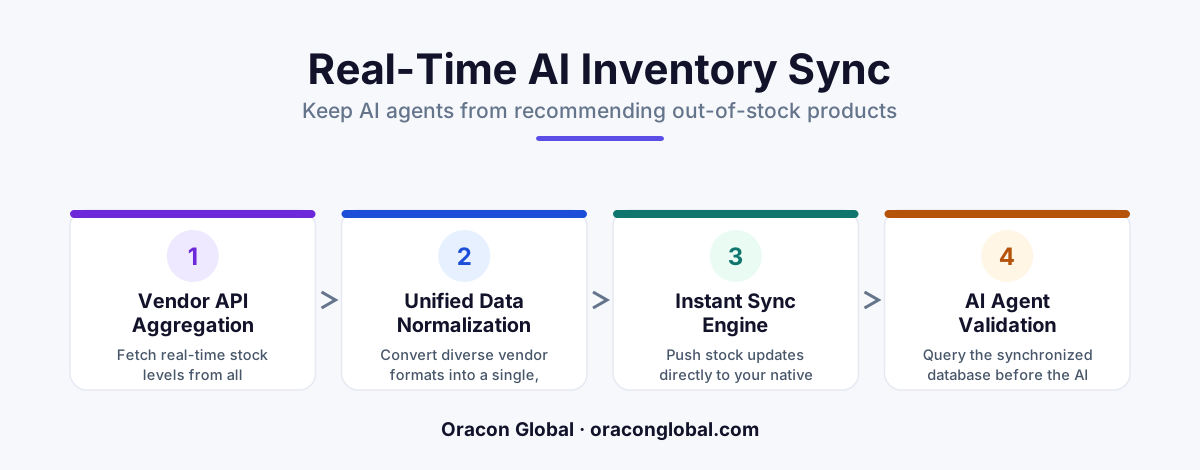
Legacy inventory feeds and slow API webhooks cannot keep pace with the real-time decision loops of autonomous AI agents. By building a custom multi-vendor inventory sync layer with an in-memory caching state, event-driven message queues, and a strict pre-flight availability check, you can completely prevent your AI sales assistants from pitching out-of-stock SKUs to your users.
Imagine your custom mobile commerce app has a highly intelligent, conversational AI assistant. A customer asks the assistant to recommend a waterproof hiking boot for an upcoming trip. The assistant analyzes the user's past purchases, cross-references active weather data, and enthusiastically recommends a premium boot, walking the customer right to the edge of a purchase.
The customer clicks "Add to Cart" only to meet a frustrating red warning: Out of stock in your size.
For a human shopper, browsing a traditional grid of products and seeing an "out of stock" label is a minor inconvenience. But when your interactive AI sales agents actively pitch, describe, and sell a specific product that cannot be bought, it feels like a broken promise. It damages brand trust, drives up cart abandonment, and wastes valuable LLM API tokens on dead-end conversations.
To solve this, modern retail brands are building a dedicated multi-vendor inventory sync layer. This middleware architecture acts as a single source of truth, ensuring that what your AI knows matches what is actually sitting on your warehouse or supplier shelves at that exact millisecond.
The Latency Gap: Why AI Agents Fail on Legacy Feeds
Traditional e-commerce architectures were never designed for autonomous, conversational interfaces. They rely on batch processes: a supplier uploads a CSV of stock levels overnight, or a webhook runs every hour to update the database.
This creates a dangerous latency gap. If a vendor runs out of a popular SKU at 10:15 AM, but your native mobile app doesn't receive the sync update until 11:00 AM, your AI assistant spends 45 minutes selling a ghost product.
Furthermore, multi-vendor environments compound this complexity. Vendor A might use a modern REST API with webhooks, Vendor B might rely on an older SOAP service, and Vendor C might drop an XML file onto an FTP server. Your AI agent cannot native-translate these disjointed data streams in real time without suffering massive latency spikes or hallucinating stock numbers.
Building a Multi-Vendor Inventory Sync Layer: The Core Architecture
To keep your native commerce apps fast and your AI recommendations accurate, you need an intermediary layer that decouples your inventory sources from your user-facing AI models. This system relies on three core pillars.
1. The Ingestion and Normalization Pipeline
Instead of pointing your AI agent directly at three different vendor portals, you direct all vendor inventory updates into an event-driven ingestion pipeline. This pipeline uses serverless functions to parse incoming data—whether it arrives via a webhook, an API poll, or a flat file—and translates it into a single, standardized JSON schema. This schema tracks basic metadata: SKU, Vendor ID, Location, Quantity Available, and Reserved Stock.
2. The In-Memory Active Cache
Database queries to standard relational databases are too slow to run in the middle of a live conversational loop. To keep latency low, the normalized inventory data is fed into an ultra-fast, in-memory database like Redis. This acts as a real-time hot cache. Every time a vendor inventory level changes, the cache is updated instantly. When the AI agent needs to verify availability, it queries this in-memory cache, getting a response in single-digit milliseconds.
3. The Pre-Flight Reservation Engine
This is the secret weapon for avoiding out-of-stock recommendations. Before your AI agent compiles its final conversational response to a user, the application code runs a silent "pre-flight check" against the sync layer. If the stock of a recommended item is below a safe threshold (for example, fewer than 3 items remaining), the system temporarily flags the item as unavailable to the AI, forcing it to suggest a highly available alternative instead.
Step-by-Step Data Flow: From Supplier to Conversational UI
To visualize how this custom architecture operates in real time, let's trace a single inventory change through a system built for high-volume real-time inventory management:
- The Event Trigger: A third-party supplier sells their last unit of a specific product on another channel. Their system broadcasts an inventory update API call.
- Ingestion & Validation: Your custom sync layer receives the event, normalizes the payload, and validates that the SKU exists in your core app database.
- Cache Update & Flagging: The sync layer writes the new stock level (0) to the Redis cache. If the stock level drops below your safety buffer, an "unavailable" flag is flipped instantly.
- The AI Prompt Check: In the native mobile app, a user asks the AI agent for recommendations.
- The Live Filter: Before sending the system prompt to the LLM, your application backend queries the Redis cache for the active category. It passes only the SKUs that are marked as "fully available" into the AI's short-term context window.
- The Safe Recommendation: The AI agent generates a response recommending only guaranteed, in-stock products, completely unaware that the out-of-stock item ever existed.
"A high-performing AI agent is only as good as the guardrails around its data. If you feed an advanced LLM stale inventory metrics, it will confidently sell products you do not own, turning a premium conversational experience into a customer service headache."
Key Benefits of a Custom Middleware Approach
Building a dedicated sync layer rather than relying on out-of-the-box e-commerce plugins offers several distinct advantages for growing brands:
- Zero LLM Hallucinations: By stripping out-of-stock SKUs from the prompt context before the AI processes it, you completely eliminate the chance of the AI making false promises.
- 100% IP Ownership: When you build a custom middleware layer, your business owns the intellectual property and code. You are not locked into expensive, rigid third-party platform licenses that limit how many vendors you can connect.
- Unmatched App Speed: Because the heavy lifting of data translation and multi-vendor syncing happens on the backend middleware, your native mobile app remains incredibly lightweight, responsive, and fast.
- Scalability for New Vendors: Adding a new supplier is as simple as writing a new adapter for your normalization pipeline. Your AI agent and your core app code do not need to be rebuilt or retrained.
Ready to Build Your AI-Native Commerce Engine?
As shopping behaviors shift from manual clicking to conversational search and autonomous AI assistants, inventory precision is no longer optional. A custom-built, multi-vendor inventory sync layer bridges the gap between slow, fragmented supply chain realities and the instant expectations of modern mobile app users.
At Oracon Global, our senior in-house engineering team designs and ships high-performance software, robust AI integrations, and custom middleware solutions for businesses worldwide. We build tailored systems that you own entirely—with 100% code and IP ownership handed over to your team upon completion.
If you are ready to eliminate out-of-stock recommendations and build a resilient e-commerce architecture for your native commerce apps, connect with our team at Oracon Global today to discuss your project.
Frequently asked questions
Why can't we just use standard e-commerce platform APIs to feed our AI agents?
Standard APIs rely on polling or delayed webhooks, creating a latency gap. While a human shopper might see an "out of stock" badge on a product page, an AI agent reading from a cached vector database or a delayed API feed will continue recommending that unavailable SKU in conversational threads, leading to failed checkouts.
How does a custom multi-vendor inventory sync layer solve this problem?
It acts as an intermediate, high-speed buffer between multiple supplier feeds and your native app. It normalizes inconsistent data formats, tracks stock changes in an in-memory cache, and runs an automated pre-flight check right before the AI agent generates a response.
Will this sync layer slow down the response time of our AI agent?
No. By separating the heavy multi-vendor data processing from the active user session and using a fast, in-memory cache (like Redis) for the final pre-flight verification, the check takes only milliseconds and does not affect the user experience.
Do we need to rewrite our entire e-commerce backend to implement this?
No. A custom inventory sync layer is designed as a middleware component. It sits quietly alongside your existing native commerce apps and legacy databases, fetching data from your vendors and exposing a clean, unified endpoint for your AI agents to query.
Read next
Beyond Chatbots: How to Build AI Agents That Actually Do Work for Your Business
Most businesses use AI to answer questions. Here is how to build custom AI agents that actually take action, connect to your internal tools, and handle complex workflows.
Beyond the Wrapper: How to Build Custom AI Agents for Business That Actually Work
Many businesses invest in basic AI wrappers only to find they lack the security and context needed for real work. Here is how to build custom AI agents that integrate deeply with your workflows and databases.
Enterprise AI Maintenance Costs: Budgeting for Year Two and Beyond
Building an AI system is only half the battle. Discover the practical, ongoing operational costs of enterprise AI, including token management, model drift, and continuous security audits.
Oracon Global builds production-grade AI agents, automation and apps — and you own the code and IP. Tell us what you want to automate.
Book a call →See our work