

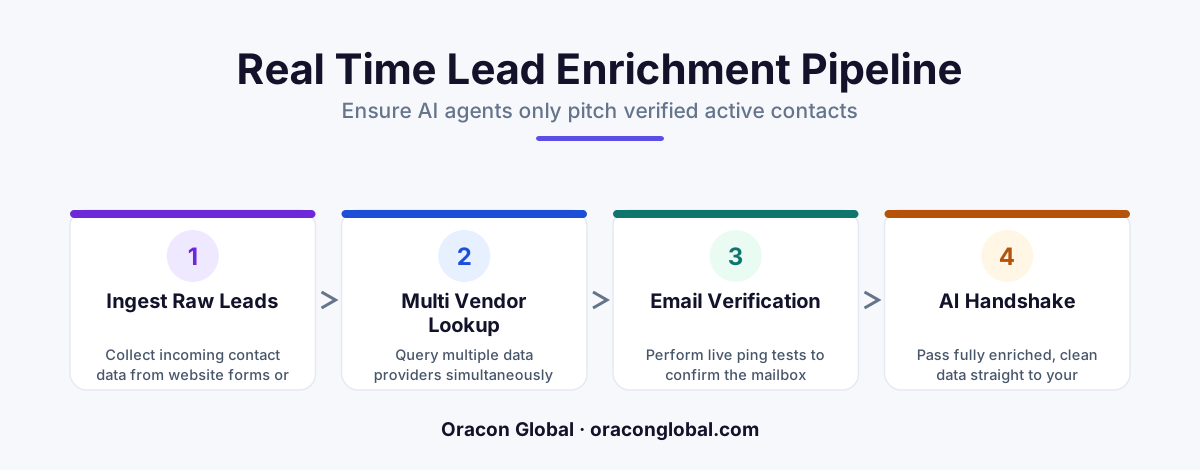
AI sales agents fail when they pitch using outdated LinkedIn profiles, dead corporate emails, or incorrect job titles. By building a custom multi-vendor lead enrichment pipeline, you can orchestrate live data checks across multiple APIs, set fallback rules, and guarantee your autonomous agents only communicate with accurate, verified contacts.
AI sales agents are incredibly efficient at drafting personalized outbound messages, identifying buying signals, and managing follow-ups at a scale no human team can match. However, this high-speed automation introduces a major operational risk: if your underlying contact data is stale, your AI agent will enthusiastically deliver highly personalized, incredibly polished pitches to people who left their jobs six months ago.
When a human sales representative encounters an outdated LinkedIn profile or a bounced email, they pause, research, and correct course. An autonomous AI agent, lacking human intuition, will simply keep pushing emails to dead inboxes or, worse, address a new director by their predecessor's name. This does more than waste your API spend; it systematically burns your domain reputation and damages your brand credibility in the market.
To scale outbound sales automation safely, you need to decouple your AI's reasoning engine from static B2B databases. Here is how to build a custom, multi-vendor lead enrichment pipeline that programmatically verifies and updates business contact details in real time right before your AI sales agents draft a single line of text.
The Hidden Cost of Stale Data in Agentic Outbound
B2B data decays at an alarming rate. Professionals change jobs, companies restructure, and email servers tighten their security protocols daily. Traditional outbound operations tolerate a certain percentage of data decay because human reps naturally spot discrepancies.
AI sales agents do not have a natural eye for context unless you explicitly build it into their operational workflow. If your CRM says John Doe is the VP of IT at Acme Corp, the AI will build its entire pitch around Acme's IT infrastructure. If John Doe actually transitioned to a new company last month, your highly personalized AI outreach instantly signals to the recipient that your business relies on sloppy, automated spam.
A custom lead enrichment pipeline acts as an automated quality gate. It sits quietly between your lead generation source and your AI agent's prompt context, ensuring that every piece of information used to ground the AI's pitch is accurate as of milliseconds ago.
Step 1: Architecting the Multi-Vendor Cascading Logic
No single data provider has a monopoly on perfect B2B contact information. One vendor might excel at direct-dial mobile numbers in North America, another might dominate European email addresses, and a third might offer the fastest real-time updates on executive job changes.
Relying on a single vendor limits your coverage and creates a single point of failure. A custom pipeline solves this by implementing a cascading fallback architecture. Here is how the orchestration flow works:
- Tier 1: Local Cache & CRM Sync. The pipeline checks your internal database first to see if the contact has been verified within the last 14 days. If yes, it passes the data directly to the AI agent to save API costs.
- Tier 2: Primary Identity Verification. If the cache is cold, the system queries your primary B2B data provider to check if the prospect still holds the same job title at the target company.
- Tier 3: Secondary Contact Fetching. If the primary provider returns a blank or low-confidence score for critical fields like email address or direct phone number, the pipeline automatically triggers a secondary API call to a specialized contact finder.
- Tier 4: Live Verification Gate. Before the data is cleared for the AI agent, the pipeline runs the email address through an active, zero-bounce verification service to confirm the inbox is live and accepting mail.
Step 2: Designing the Database Schema for Multi-Source Truth
To run a multi-vendor setup without creating duplicate records or data conflicts, your system needs a strict, unified database schema. Instead of allowing different API payloads to overwrite each other blindly, you must build a database layer that ranks sources by confidence and records metadata timestamps for every single attribute.
For example, your schema should track "job_title_source", "job_title_updated_at", and "job_title_confidence_score" separately from the actual job title string. When the pipeline receives conflicting data, a deterministic set of business rules decides which source wins. This keeps your data clean, organized, and structured in a way that your AI sales agent can query reliably without getting confused by conflicting data fields.
Step 3: Building Real-Time Verification Triggers
A classic mistake in sales automation is enriching leads in massive weekly batches. By the time the AI agent works its way to the bottom of a batch of five thousand leads, a portion of that data is already out of date.
To keep your data fresh, your pipeline must run on an event-driven model. The enrichment process should trigger only when an AI agent selects a lead to put into its active outreach queue.
"By shifting enrichment from a batch-style process to an event-driven, just-in-time check, you ensure that your AI is operating on real-time lead data, protecting your domain from bounces and keeping your messaging highly relevant."
This just-in-time enrichment structure prevents you from spending money to enrich leads that your AI agents might not reach for weeks, significantly lowering your overall operating overhead.
Step 4: Creating Graceful Fallbacks and Human-in-the-Loop Safeguards
What happens when the pipeline runs through all your data vendors and still cannot verify a prospect's email address or current title?
Without a custom guardrail, an autonomous AI agent might try to guess the email format or generate a generic, vague pitch that sounds robotic. Your pipeline must include automated exception handling. If a lead fails to meet a specific validation threshold, the system should automatically route it out of the autonomous queue and place it into a manual review dashboard for a human sales rep to audit.
This hybrid approach keeps your AI running at maximum speed on verified, high-quality prospects while ensuring that more complex, hard-to-verify accounts still get the careful human touch they deserve.
Owning Your Data Infrastructure vs. Off-the-Shelf Wrappers
While there are many off-the-shelf software tools that claim to solve lead enrichment, they often lock you into their own proprietary database providers, charge high subscription markups, and do not allow you to customize the exact logic of how your data is sourced, stored, and filtered.
Building your own custom pipeline gives your business complete control. You can switch data vendors as pricing or coverage changes, write your own proprietary filtering logic, and ensure you own 100% of the IP behind your sales infrastructure. Most importantly, your proprietary pipeline integrates seamlessly with your internal CRM, custom databases, and autonomous AI agents without relying on fragile, third-party connector tools that break without warning.
Build Your Custom AI Infrastructure with Oracon Global
At Oracon Global, we build robust, custom software architectures, workflow automations, and AI agent pipelines designed to solve real business challenges. Our senior, in-house team of engineers works with companies worldwide to design and deploy custom, production-ready systems where you retain absolute ownership of all code and IP.
Whether you need to build a custom lead enrichment pipeline, an AI digital employee, or a custom web or mobile app, we can help you build stable, scalable systems. Contact Oracon Global today to discuss how we can turn your software and automation goals into reality.
Frequently asked questions
Why can't I just use a single data provider for my AI sales agents?
No single data provider has perfect coverage across every industry, region, or job function. Relying on one vendor leads to high bounce rates, missing phone numbers, and outdated titles that cause your AI agents to send highly irrelevant pitches.
How does a multi-vendor lead enrichment pipeline save API costs?
By implementing a cascading fallback logic, you only call expensive real-time verification APIs when cheaper database lookups fail or return low-confidence scores, ensuring you only pay for the exact data quality you need.
What is the risk of letting AI agents use cached B2B contact databases?
B2B contact data decays at roughly 2% to 3% per month as people change jobs, companies rebrand, or domains expire. Pitching cached, unverified data leads to flagged spam domains, burned IP addresses, and fractured brand reputation.
How long does it take to deploy a custom enrichment pipeline?
With a dedicated senior engineering team, a custom-architected multi-vendor sync and enrichment pipeline can be built, integrated with your CRM, and deployed to production in a matter of weeks.
Read next
Beyond Chatbots: How to Build AI Agents That Actually Do Work for Your Business
Most businesses use AI to answer questions. Here is how to build custom AI agents that actually take action, connect to your internal tools, and handle complex workflows.
Beyond the Wrapper: How to Build Custom AI Agents for Business That Actually Work
Many businesses invest in basic AI wrappers only to find they lack the security and context needed for real work. Here is how to build custom AI agents that integrate deeply with your workflows and databases.
Enterprise AI Maintenance Costs: Budgeting for Year Two and Beyond
Building an AI system is only half the battle. Discover the practical, ongoing operational costs of enterprise AI, including token management, model drift, and continuous security audits.
Oracon Global builds production-grade AI agents, automation and apps — and you own the code and IP. Tell us what you want to automate.
Book a call →See our work