

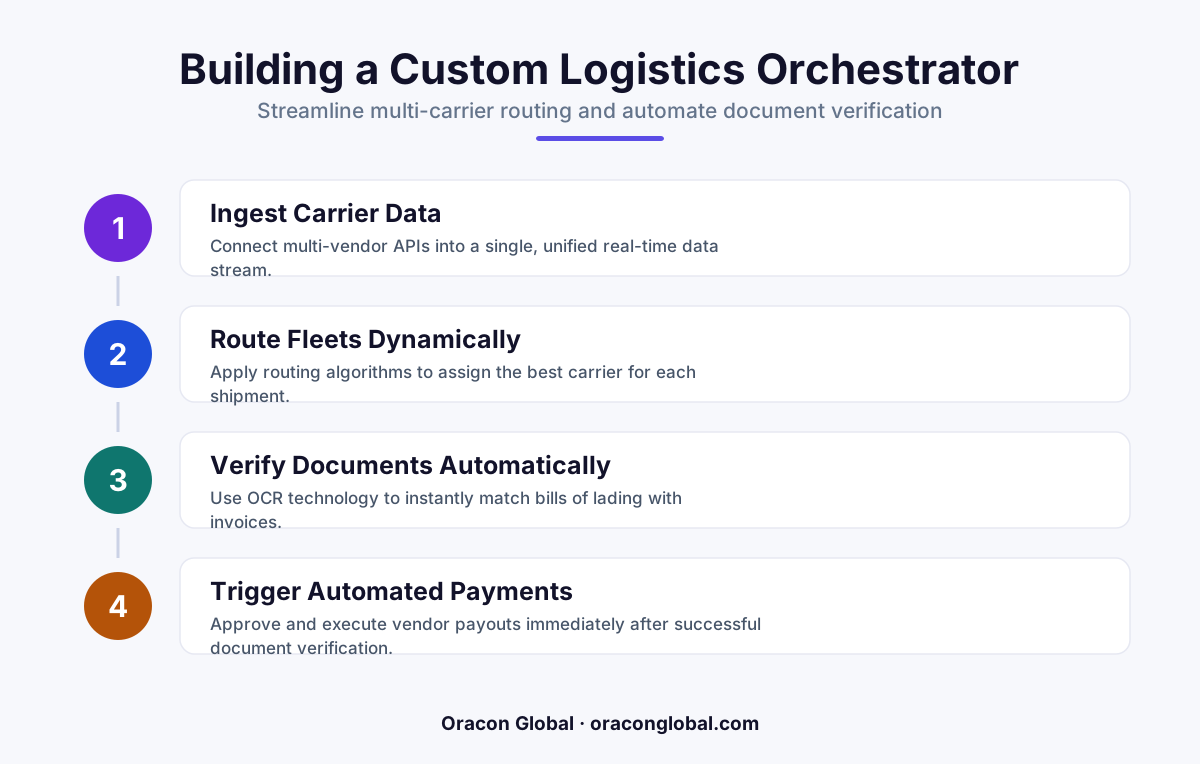
A custom multi-vendor logistics orchestrator bridges the gap between disparate carrier APIs and legacy document formats. By combining real-time fleet routing algorithms with automated bill of lading verification, businesses can eliminate manual tracking updates and prevent costly billing discrepancies.
In global supply chains, relying on a single logistics provider is rarely an option. To stay competitive, businesses split shipments across a network of regional carriers, national freight lines, and local last-mile fleets. However, this multi-vendor approach introduces a massive operational headache: fragmented tracking systems, manual routing decisions, and hours spent manually matching physical paperwork against digital invoices.
When tracking updates are trapped in different carrier portals and bills of lading are physically signed, scanned, and emailed in varying formats, operational blind spots are inevitable. Shipments run late without warning, and billing errors slip through unnoticed.
The solution is to build a custom multi-vendor logistics orchestrator. This centralized platform unifies your entire logistics network, enabling real-time fleet routing and automated bill of lading verification in one cohesive dashboard. Here is how to design and build an orchestration engine that streamlines your shipping operations.
The Core Challenge of Multi-Vendor Logistics
Most logistics departments run on a patchwork of disconnected software. Your warehouse team might use an internal ERP, your regional carriers might communicate via EDI (Electronic Data Interchange), and your local delivery drivers might rely on a proprietary mobile app. This fragmentation creates three distinct vulnerabilities:
- Information Asymmetry: Dispatchers cannot see the real-time location of all active shipments on a single map, making proactive rerouting impossible.
- Manual Document Auditing: Staff must manually cross-reference physical Bills of Lading (BoLs) with digital purchase orders to verify that what was ordered matches what was actually delivered.
- Delayed Decision Making: When a carrier experiences a delay, the system does not automatically reassign subsequent legs of the journey to alternative vendors, resulting in cascading supply chain bottlenecks.
By building a custom orchestrator, you establish a single source of truth that sits above your vendors' individual platforms, translating their data into actionable, automated decisions.
Component 1: Real-Time Fleet Routing and Dynamic Despatch
To optimize shipping lanes across multiple carriers, the orchestrator needs a real-time routing engine. Instead of relying on static, pre-scheduled routes, the system continuously analyzes incoming telemetry data, traffic conditions, and carrier performance.
The routing engine operates through a three-step cycle:
- API Aggregation: The orchestrator pulls live GPS coordinates and status webhooks from every carrier API in your network, normalizing the data into a single, standardized schema.
- Algorithmic Optimization: When a new delivery request enters the system, a routing algorithm calculates the most cost-effective and time-efficient carrier based on current fleet locations, historical transit times, and live traffic data.
- Automated Dispatch: Once the optimal route and carrier are identified, the platform automatically pushes the dispatch details directly to the selected vendor's system via API, eliminating the need for phone calls or manual booking emails.
This dynamic adjustment ensures that if a carrier in your network experiences an unexpected delay, the orchestrator can automatically reroute upcoming pickups to an alternative local fleet to keep deliveries on schedule.
Component 2: Automated Bill of Lading Verification
The Bill of Lading (BoL) is the ultimate legal record of a shipment. Yet, because truck drivers, warehouse staff, and receiving clerks still rely on physical paper documents, verifying these records is notoriously slow and prone to human error.
A custom orchestrator solves this by embedding an automated document verification pipeline directly into the workflow:
Step 1: Multi-Channel Document Intake
Drivers scan the signed physical BoL at the delivery site using a simple mobile web app, or carriers submit digital PDFs via email. The orchestrator automatically routes these incoming files to a secure processing queue.
Step 2: Intelligent Data Extraction
Using optical character recognition (OCR) coupled with structured document analysis, the system identifies and extracts critical fields from the BoL. This includes the carrier name, shipment date, itemized quantities, unit weights, and the presence of physical signatures.
Step 3: Three-Way Automated Reconciliation
The orchestrator automatically cross-references the extracted BoL data against your original Purchase Order (PO) and the carrier's final invoice. If the quantities, weights, and delivery dates align perfectly within acceptable, pre-configured tolerances, the system marks the transaction as verified and pre-approves the invoice for payment.
If a discrepancy is detected—such as a missing signature or a shortfall in delivered pallet counts—the system instantly flags the order, halts automated payment, and alerts your operations team to resolve the issue.
Designing the Orchestrator Architecture
Building an enterprise-grade orchestrator requires an architecture that is resilient to third-party API downtime. Because carrier systems frequently go offline or drop webhooks, your custom platform must be built with durability in mind.
A robust design relies on an event-driven queue system. When a carrier sends a location update or a delivery status change, it is first placed into a secure message broker. The orchestrator processes these messages sequentially. If your internal ERP experiences a brief outage, no data is lost; the system simply retries the sync once the ERP is back online.
Furthermore, because you own 100% of the custom code and intellectual property, your engineering team can build direct integrations for whatever legacy ERPs, warehouse management platforms, or accounting packages your business relies on, without paying recurring integration fees to third-party middleware vendors.
Take Control of Your Logistics Infrastructure
Relying on generic, off-the-shelf logistics dashboards often means dealing with rigid workflows, expensive per-user licensing, and limited carrier integration options. Developing a custom, multi-vendor logistics orchestrator gives your business total control over your routing logic, document processing, and operational data.
At Oracon Global, our senior in-house engineering team specializes in building robust workflow automation, custom logistics software, and deeply integrated AI systems designed to solve complex supply chain challenges. We build tailored solutions where you retain absolute ownership of the source code and IP.
Ready to automate your freight routing and eliminate manual paperwork bottlenecks? Contact Oracon Global today to discuss your project requirements with our technical team.
Frequently asked questions
What is a multi-vendor logistics orchestrator?
It is a centralized software layer that connects to various third-party carrier APIs, dispatch systems, and internal ERPs to coordinate shipping routes, track shipments, and manage documentation from a single interface.
How does automated bill of lading verification work?
The system uses document processing pipelines to extract text, line items, and signatures from bills of lading, then automatically cross-references this data with purchase orders and carrier invoices to spot discrepancies before payment.
Can this orchestrator integrate with legacy ERP systems?
Yes. A custom orchestrator uses translation layers to transform modern JSON data from carrier APIs into XML, SOAP, or flat-file formats required by older, on-premise ERP databases.
Why should we build a custom solution instead of buying off-the-shelf logistics software?
Off-the-shelf software often charges per-user seat licenses, lacks deep integration with your proprietary internal databases, and limits your control over the underlying code. A custom build ensures you own 100% of the IP and can tailor routing rules to your exact operational workflows.
Read next
Beyond Chatbots: How to Build AI Agents That Actually Do Work for Your Business
Most businesses use AI to answer questions. Here is how to build custom AI agents that actually take action, connect to your internal tools, and handle complex workflows.
Beyond the Wrapper: How to Build Custom AI Agents for Business That Actually Work
Many businesses invest in basic AI wrappers only to find they lack the security and context needed for real work. Here is how to build custom AI agents that integrate deeply with your workflows and databases.
Enterprise AI Maintenance Costs: Budgeting for Year Two and Beyond
Building an AI system is only half the battle. Discover the practical, ongoing operational costs of enterprise AI, including token management, model drift, and continuous security audits.
Oracon Global builds production-grade AI agents, automation and apps — and you own the code and IP. Tell us what you want to automate.
Book a call →See our work