

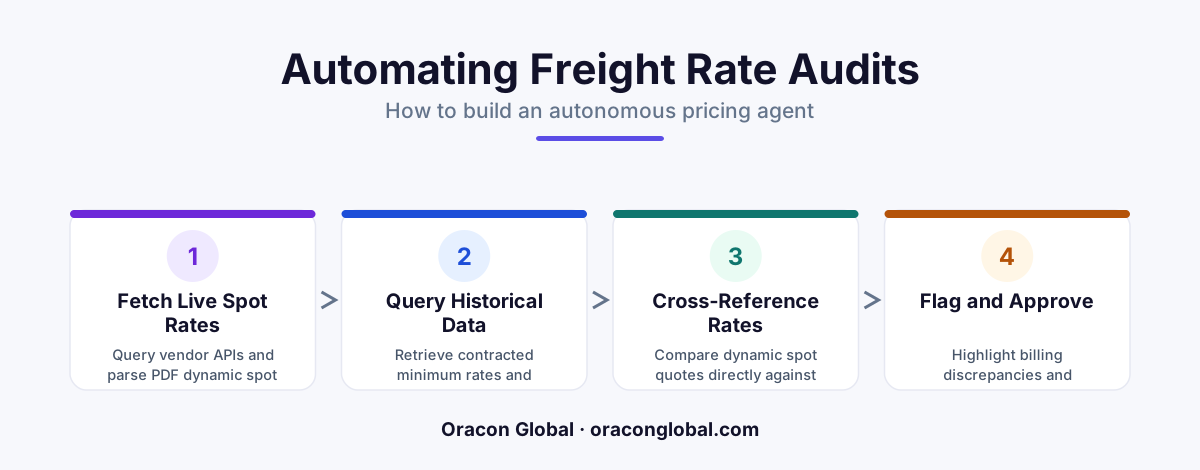
Stop wasting labor on manual freight rate comparisons. By building a custom multi-vendor pricing agent with a persistent vector-relational database, you can automatically parse incoming spot quotes, query carrier APIs, and run real-time audits against contract minimums to protect your shipping margins.
For freight forwarders, the difference between winning a high-volume shipment and losing a key account often comes down to minutes. When a shipper requests an urgent quote, your operations team has to scramble. They must log into multiple ocean or air carrier portals, dig through static PDF rate sheets, query private APIs, and run manual calculations to ensure the spot rate they are quoted doesn't violate historical contract minimums or pre-negotiated volume agreements.
This manual process is slow, prone to human error, and directly eats into your margins. If you quote too high to protect yourself, you lose the business. If you quote too low because you missed a fuel surcharge or a historical rate tier, you lose money on the lane.
The solution is to build a custom multi-vendor pricing agent. This dedicated digital employee acts as a real-time dispatch and auditing layer, automatically pulling live spot rates, comparing them with historical contract data, and presenting your logistics operators with the single most profitable routing decision in seconds.
The Operational Bottleneck of Modern Freight Auditing
Most logistics operations rely on a mix of structured and unstructured data. Your core Transport Management System (TMS) might store your long-term contract rates, but your day-to-day spot quotes live in email threads, digital PDF attachments, and modern carrier portals. This disconnect creates three distinct operational challenges:
- Unstructured Rate Sheets: Carrier spot rates are frequently delivered in custom formats, including excel sheets, text messages, or unstructured PDFs that traditional OCR software fails to read reliably.
- Dynamic API Inconsistencies: Different ocean and air carriers use highly diverse API structures, requiring extensive custom development to aggregate data cleanly.
- Rate Leakage: Without instant, automated cross-referencing, operators often accept a spot rate that is 10% to 15% higher than a pre-negotiated contract minimum simply because they didn't have time to dig up the historical agreement.
By implementing freight forwarding AI automation, you can unify these fragmented data streams. The goal is not to replace your human operators, but to give them an analytical copilot that executes the tedious retrieval and validation steps in the background.
Step 1: Building the Multi-Vendor API Aggregator and Parsing Engine
To begin, your pricing agent needs to ingest rates from two distinct sources: structured carrier APIs and unstructured documents. This requires a dual-track ingestion architecture.
For carriers with modern digital portals, we construct a custom shipping API integration layer. This layer standardizes outward requests and inward payloads. Whether you are querying a maritime carrier or an air freight provider, the agent translates the responses into a single, unified JSON schema containing essential parameters: base freight rate, bunker adjustment factors (BAF), terminal handling charges (THC), transit times, and equipment availability.
For unstructured sources, such as spot rate PDFs received via email, the agent uses a parsing pipeline. Instead of relying on rigid, template-based OCR that breaks when a carrier changes a font or a column layout, we employ an LLM-driven vision and semantic extraction model. This model identifies key value pairs, safely ignoring decorative elements and legal disclaimers, and outputs structured data directly into our agent's decision queue.
Step 2: Designing the Historical Contract Verification Database
To audit live spot rates, the pricing agent must compare them to historical baselines. We achieve this by building a hybrid vector-relational database schema. Your long-term contract minimums, seasonal lane agreements, and historical spot awards are synced from your TMS into a high-performance relational database like PostgreSQL.
This database must index data along several key dimensions:
- Origin-Destination Pairs (Port-to-Port or Door-to-Door): Mapped using standard UN/LOCODE or ZIP code geofencing.
- Equipment Type: Distinguishing between 20GP, 40HC, Reefer, or Less-than-Container Load (LCL) parameters.
- Validity Windows: Tracking seasonal peak season surcharges (PSS) and contract expiration dates.
When a new spot quote is parsed, the agent executes a rapid query to pull any historical contract that matches these dimensions. This ensures that the agent is comparing apples to apples before running its audit calculations.
Step 3: The Dynamic Rate Audit Logic
Once the agent has aggregated the live spot rate and retrieved the relevant historical contract minimums, it initiates the contract rate verification process. This step is governed by deterministic business logic rather than creative AI reasoning, protecting your operations from algorithmic errors or hallucinations.
"By pairing flexible, semantic AI models for document reading with strict, hardcoded relational math for rate comparisons, we build an agent that is both highly adaptable and mathematically flawless."
The agent calculates the Total Cost of Ownership (TCO) for the shipment by summing the base rate and all applicable surcharges. It then compares this TCO to the historical minimum contract rate. If the live spot rate is lower or equal to the contract rate, the agent marks the option as "Pre-Approved." If the spot rate exceeds the historical contract minimum by an established threshold (e.g., 5%), the agent flags it as an anomaly, highlighting the specific surcharges driving the cost increase.
Step 4: Human-in-the-Loop Booking Confirmations
To ensure operational safety, the final decision-making step is governed by a clean, human-in-the-loop dashboard. The pricing agent does not automatically book shipments without authorization. Instead, it populates an internal queue with its findings.
An operator opening the dashboard is presented with a clear side-by-side comparison. They can see the carrier's live spot offer, the historical baseline, the identified variance, and a single-click button to confirm the booking or initiate a automated counter-offer email based on the historical contract parameters.
This approach minimizes administrative overhead, allowing a single logistics operator to process four to five times as many quotes per day with absolute confidence in their margin protection.
Get Started with Custom Logistics Automation
Building a custom multi-vendor pricing agent requires a team that understands both complex enterprise software architecture and the practical realities of global logistics. Off-the-shelf software rarely fits the unique API networks and custom contract structures of a scaling freight forwarder.
At Oracon Global, our senior in-house engineering team designs and builds robust, production-ready AI agents, ERP integrations, and workflow automation systems tailored to your business needs. Best of all, we hand over 100% of the code and intellectual property ownership directly to you.
Ready to automate your rate auditing processes and safeguard your shipping margins? Contact Oracon Global today to discuss your project with our senior engineering team.
Frequently asked questions
Why can't we just use standard RPA bots to compare these freight rates?
Standard RPA bots break when PDFs, emails, or API payloads change layout. A custom pricing agent uses semantic understanding to accurately extract data from messy, unstructured quotes while running strict relational lookups.
How does the agent access historical contract minimums safely?
The agent relies on a read-only sync engine connected to your core TMS or internal database, comparing the live unstructured spot rate data with structured contract records inside a secure Postgres ledger.
Do we lose control over final pricing and carrier booking decisions?
Not at all. The architecture includes a human-in-the-loop approval UI, meaning the agent flags the best rates and anomalies but leaves the final booking confirmation to your logistics operators.
How complex is it to integrate this agent with legacy ocean or air carrier APIs?
While legacy APIs can be messy, the system uses a translation layer that standardizes different carrier responses into a single, clean JSON schema for the agent to evaluate instantly.
Read next
Beyond Chatbots: How to Build AI Agents That Actually Do Work for Your Business
Most businesses use AI to answer questions. Here is how to build custom AI agents that actually take action, connect to your internal tools, and handle complex workflows.
Beyond the Wrapper: How to Build Custom AI Agents for Business That Actually Work
Many businesses invest in basic AI wrappers only to find they lack the security and context needed for real work. Here is how to build custom AI agents that integrate deeply with your workflows and databases.
Enterprise AI Maintenance Costs: Budgeting for Year Two and Beyond
Building an AI system is only half the battle. Discover the practical, ongoing operational costs of enterprise AI, including token management, model drift, and continuous security audits.
Oracon Global builds production-grade AI agents, automation and apps — and you own the code and IP. Tell us what you want to automate.
Book a call →See our work