

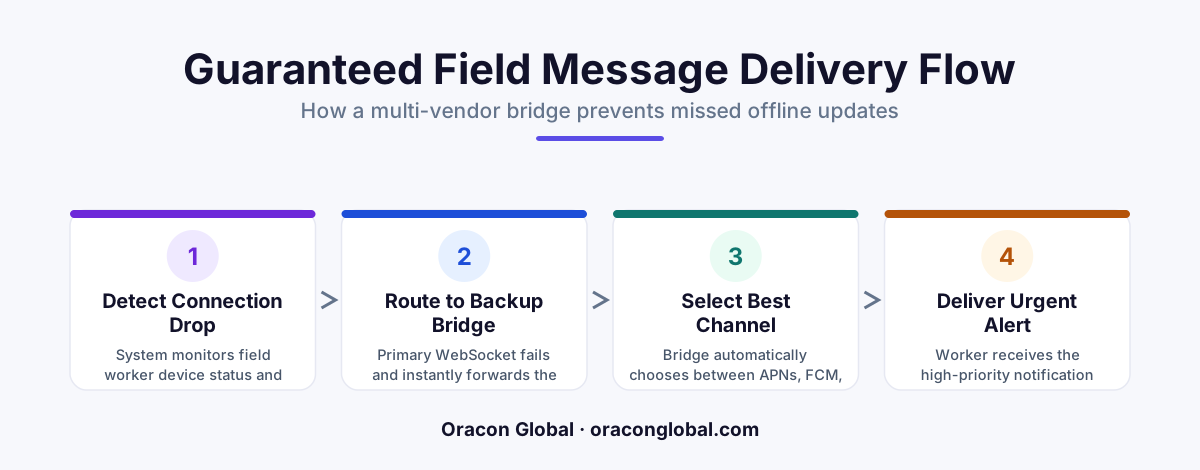
Standard push notification services fail when mobile field workers drop offline or cross carrier blind spots. A custom multi-vendor push notification bridge acts as an intelligent routing layer, caching pending updates and automatically switching to SMS or alternative networks to guarantee delivery of critical real-time updates.
Field operations rely on split-second decisions. Whether it is an emergency utility repair team, a medical transport driver, or a remote logistics crew, receiving real-time field updates can be the difference between a successful operation and a costly failure. Yet, when workers enter basements, remote rural areas, or steel-reinforced industrial sites, cellular coverage drops. Standard mobile push networks simply stop trying after a few failed attempts, leaving your team in the dark.
Relying entirely on a single push provider like Apple Push Notification service (APNs) or Firebase Cloud Messaging (FCM) creates a single point of failure. When a user goes offline, these services queue messages briefly, but they frequently drop them if the offline window extends beyond a few minutes. To solve this, technical teams are turning to a custom multi-vendor push notification bridge. This architecture guarantees delivery of critical data by managing its own message state, tracking active device connections, and dynamically switching delivery paths when primary channels fail.
The Hidden Cost of Fire-and-Forget Notifications
Most standard mobile applications use a direct, fire-and-forget push strategy. Your backend server triggers an API call to FCM or APNs, receives a quick "200 OK" response, and assumes the job is done. However, that success response only means the vendor accepted the message, not that the device received it.
When field operators are actively offline, several failure modes occur simultaneously:
- Silent Drops: Vendor TTL (Time-to-Live) settings expire, silently purging urgent dispatches from the delivery queue.
- Port Blocking: Corporate Wi-Fi networks or public hotspots often block the specific TCP ports required by APNs or FCM, preventing delivery even when the device has active internet access.
- Out-of-Order Delivery: When a device reconnects, messages queue up and flood the device out of order, leading to state confusion inside the app.
To prevent these issues, businesses need a reliable mobile push architecture that retains ownership of the message lifecycle until the physical handset sends a cryptographic acknowledgment back to the server.
Architecting the Multi-Vendor Push Notification Bridge
A custom multi-vendor push notification bridge sits between your core application backend and external communication APIs. Instead of sending messages directly to a single provider, your backend writes the update to a centralized transactional queue. The bridge then manages the intelligent routing, monitoring, and fallback logic.
1. The Centralized Transactional Queue
Every outgoing notification is assigned a unique, deterministic Transaction ID. The message state is stored in a fast, memory-optimized database layer as "Pending." This ensures that even if the primary notification vendor experiences an outage, the message is never lost. The state only transitions to "Delivered" once the mobile client successfully decrypts the payload and calls a secure receipt API on your server.
2. The Dynamic Routing Engine
The core of the bridge is an engine that evaluates the urgency of the message and the last known state of the device. If the target device has not checked in within a specific threshold, or if a primary APNs/FCM push fails to return a delivery confirmation within sixty seconds, the engine automatically escalates. It routes the payload through a secondary vendor or drops back to an alternative delivery channel such as transactional SMS.
3. Client-Side Acknowledgment and Deduplication
Because the bridge uses multiple paths to reach the device, there is a possibility that a user might receive the same update via both a standard push notification and an SMS. To prevent a confusing user experience, the mobile application contains a silent deduplication layer. When an update arrives, the local app checks the Transaction ID. If the ID has already been processed, the duplicate notification is silently discarded from the system tray.
Step-by-Step: The Fallback Pipeline in Action
To understand how this system keeps offline mobile app sync processes reliable, let us look at how an urgent work-order update travels through the bridge when a field technician is inside a concrete utility vault:
- Initiation: Your enterprise system publishes a high-priority dispatch update. The bridge saves this to the database with a "Pending" status and attaches a unique receipt token.
- First Attempt (Standard Push): The bridge targets the device via FCM (for Android) or APNs (for iOS). It sets a strict, localized callback window of 45 seconds.
- Silence Detection: Because the technician is deep underground, the push notification sits undelivered in the cloud. The 45-second timer on your bridge expires without an acknowledgment ping from the client app.
- Channel Escalation: The bridge identifies the message as high-priority and switches to a secondary path. It translates the payload into a compact, encrypted data SMS using a reliable cellular API provider.
- Delivery and Decryption: SMS protocols use a different cellular control channel that often penetrates deep structures far better than standard IP data networks. The phone receives the SMS. The mobile app, listening for these specific incoming SMS formats, extracts the data payload, updates the local database, and displays the alert.
- The Handshake: The mobile app fires off a brief HTTP POST request (or queues it for the absolute second internet access returns) back to your bridge: "Transaction ID 98234 received." The bridge marks the message as "Delivered" and cancels any further fallback attempts.
Ensuring Security and Data Integrity
Routing operational data across multiple external vendors introduces security considerations. Sending raw, sensitive business data or customer PII over SMS or basic push channels is a compliance risk.
The solution is payload minimization and local encryption. The bridge should never send raw database rows. Instead, it sends an encrypted package containing only the Transaction ID and a secure hash. Once the mobile app receives this signal, it uses its local authentication token to fetch the rich details directly from your secure APIs as soon as a stable data connection is established. This ensures that even if an SMS is intercepted, the data remains unreadable.
Building vs. Buying Your Sync Architecture
While off-the-shelf push services are fine for consumer marketing campaigns, they lack the transactional guarantees required for complex enterprise field operations. A custom notification engine allows you to tailor retry intervals, define custom carrier fallbacks, and maintain absolute ownership of your data routing.
Building this infrastructure in-house requires deep expertise in native mobile lifespans, background execution limits on modern iOS and Android systems, and high-throughput transactional database design. At Oracon Global, our senior in-house team specializes in crafting custom web and mobile apps, AI integrations, and resilient sync systems that operate flawlessly under harsh, real-world conditions. When you build with us, you own 100% of the code and intellectual property, ensuring your core operational systems remain an asset to your company.
Are you ready to stop dropping critical updates and build a resilient mobile infrastructure for your field teams? Let us discuss how we can engineer a reliable sync layer tailored to your specific workflows.
Frequently asked questions
Why do standard push notification services fail for offline field workers?
Standard services like APNs or FCM operate on a fire-and-forget or temporary retry basis. If a device remains offline past a short window, or if the local network blocks specific ports, the notification is permanently discarded.
What does a multi-vendor push notification bridge actually do?
It acts as an intelligent intermediary. It monitors delivery receipts, caches pending messages in a centralized queue, and dynamically switches to fallback channels like SMS or secondary push providers when a delivery failure is detected.
How does this system prevent duplicate notifications?
The bridge utilizes a strict message-deduplication layer with unique transaction IDs. Once a mobile client receives and acknowledges an update on any channel, the bridge immediately invalidates that message ID across all other channels.
Is this architecture difficult to integrate with existing legacy databases?
Not if designed correctly. By placing an event-driven transactional queue between your database and the notification bridge, you can capture real-time updates without modifying your core legacy database schemas.
Read next
Beyond Chatbots: How to Build AI Agents That Actually Do Work for Your Business
Most businesses use AI to answer questions. Here is how to build custom AI agents that actually take action, connect to your internal tools, and handle complex workflows.
Beyond the Wrapper: How to Build Custom AI Agents for Business That Actually Work
Many businesses invest in basic AI wrappers only to find they lack the security and context needed for real work. Here is how to build custom AI agents that integrate deeply with your workflows and databases.
Enterprise AI Maintenance Costs: Budgeting for Year Two and Beyond
Building an AI system is only half the battle. Discover the practical, ongoing operational costs of enterprise AI, including token management, model drift, and continuous security audits.
Oracon Global builds production-grade AI agents, automation and apps — and you own the code and IP. Tell us what you want to automate.
Book a call →See our work