

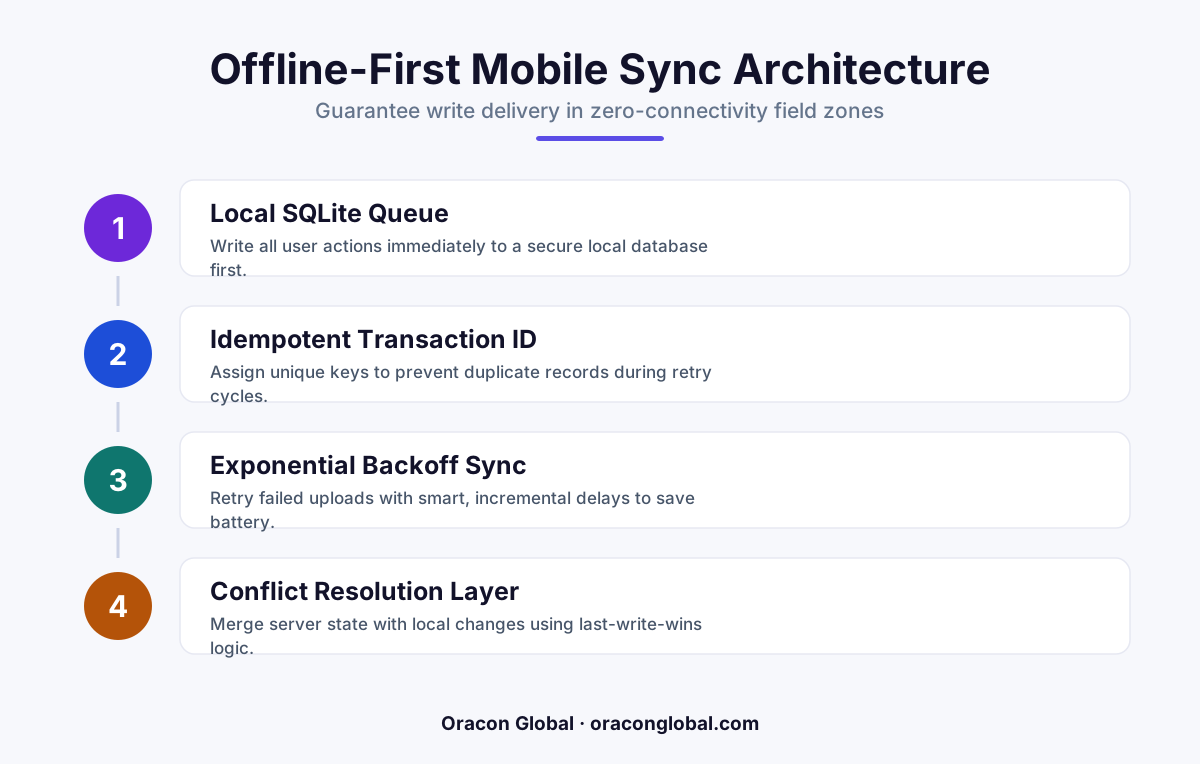
When mobile field apps attempt to write directly to multiple third-party APIs over spotty connections, data inevitably gets lost. A custom multi-vendor sync layer intercepts writes locally, queues them in an offline-first SQLite database, and reconciles them with external services only when a stable connection is verified.
In the comfort of a well-wired modern office, mobile applications work beautifully. Buttons are tapped, APIs respond in milliseconds, and databases update instantly. But for field service teams operating in remote utility sites, deep concrete basements, or rural transport routes, the reality is entirely different.
When field operators rely on native mobile apps to update inventory, log safety checks, or close out work orders, unstable connectivity is the default state. Standard mobile apps built on basic REST architectures tend to fail silently when connections drop. A technician taps "Save," the spinner spins, the connection drops, and the record simply vanishes into the ether. Even worse, the app might register the write locally but fail to update your central ERP, leading to costly billing and scheduling discrepancies across your business.
To solve this, modern operators are moving away from fragile direct-to-API setups. The answer is a custom multi-vendor sync layer—an offline-first architecture that intercepts local database writes, queues them safely on the physical device, and syncs them across multiple third-party vendor systems only when a secure connection is guaranteed. Here is how to build one that works under real-world pressure.
The Core Problem: Why Standard Mobile Apps Fail in the Field
Most development projects rely on standard API integration libraries. These libraries assume that if a network request fails, a simple retry loop will fix it. In a true field environment, this assumption falls apart for three reasons:
- The Zombie Connection: The phone displays two bars of signal, but no actual data packets are moving. The app attempts to write to your CRM or ERP, hangs indefinitely, and eventually times out, leaving the user with no idea if their work was saved.
- Out-of-Order Execution: A technician updates a work order status to "In Progress" while offline, and then to "Completed" five minutes later. If the second update reaches the server before the first due to a erratic connection, the database state corrupts.
- Vendor API Disconnects: When writing to multiple services simultaneously (such as updating an internal field database and a legacy invoicing tool at the same time), one service might succeed while the other fails, creating a split-brain state.
To achieve true field network reliability, we must decouple the user's action in the application interface from the actual physical network transmission.
Step 1: Establishing the Local-First Write Queue
The foundation of a robust multi-vendor sync layer is a local-first database on the mobile device. Instead of sending user inputs directly to an API, the mobile app must write all transactions to an on-device database, such as SQLite or SQLCipher, first.
Every time a field technician submits a form, the app performs a local transaction. It saves the payload to an "Outbox" table along with vital metadata:
- Transaction ID: A cryptographically secure, unique identifier (UUID v4) generated on the device at the exact millisecond of creation.
- Sequence Number: A strictly incrementing local integer that guarantees the system knows the exact chronological order of changes.
- Target Vendor: A flag indicating which external systems (e.g., Salesforce, SAP, or a custom internal database) need to receive this specific update.
- Sync Status: Marked initially as Pending.
Because this database write happens locally on the physical disk of the device, it takes less than ten milliseconds. The technician receives instant confirmation that their work is saved, allowing them to move on to their next task without waiting for a network handshake.
Step 2: Designing the Network State Observer
Once the write is safely queued locally, a dedicated background service on the device monitors network availability. Rather than relying solely on the operating system's native network status check—which often reports a false positive "connected" state—the sync engine should run a lightweight ping check to a stable endpoint.
This network observer acts as a gatekeeper. When it detects a truly stable, high-throughput connection, it wakes up the sync dispatcher. If the connection degrades or latency spikes beyond a predetermined threshold, the observer instantly pauses the queue. This prevents the app from burning device battery power on endless, doomed API retries.
Step 3: Implementing Idempotency and Deduplication
On spotty field networks, duplicate requests are inevitable. A mobile app might successfully send a write payload to your server, but the server's acknowledgement response gets dropped on the return trip. Believing the connection failed, the mobile app will try to send the exact same payload again once connectivity returns.
Without strict protective measures, this leads to duplicate database writes—resulting in double-booked inventory, double-billed clients, or repeated safety entries. To prevent this, the sync layer must enforce strict idempotency at the API gateway layer.
"An idempotent operation is one that can be applied multiple times without changing the result beyond the initial application. In field operations, this is your primary shield against data corruption."
When the sync engine forwards the queued payloads to your backend, it must include the original Transaction ID in the request header. Your server-side gateway checks this ID against a fast-lookup cache (like Redis). If the ID has already been successfully processed within the last 24 hours, the server simply returns a "Success" response immediately, skipping the redundant database write entirely.
Step 4: Graceful Multi-Vendor Reconciliation
In a modern enterprise architecture, a single field action often needs to trigger updates across multiple software suites. For example, completing an inspection might require updating a field operations database, notifying an ERP, and sending a status update to a client communication platform.
A custom sync layer handles this by executing updates as a coordinated workflow. If a write fails for one vendor but succeeds for another, the sync engine flags the specific vendor that failed and keeps the transaction in the queue for that endpoint only. The mobile interface remains clean, while the background service quietly retries the single failed connection behind the scenes until all targets are perfectly reconciled.
Choosing Custom Engineering Over Off-the-Shelf Templates
While basic template apps work fine in controlled office environments, enterprise-level field operations require specialized, resilient software architectures. Building an offline-first system that handles high-concurrency writes, strict sequence preservation, and multi-vendor integrations requires deeply experienced engineering.
At Oracon Global, our senior in-house team specializes in building robust, custom mobile applications, workflow automations, and complex database sync layers designed for demanding real-world conditions. When we build your software, you own 100% of the custom code and intellectual property from day one, giving you full control over your operational technology stack.
Ready to build a mobile ecosystem that never drops a single database write, no matter where your team goes? Contact the team at Oracon Global today to discuss your architecture and design a system built for the field.
Frequently asked questions
Why do standard mobile sync libraries fail on bad field networks?
Standard libraries often rely on a single database connection and basic retry loops. When a user is moving between cell towers or working deep inside concrete structures, these loops timeout, leading to silent write failures and duplicate API requests.
What is a multi-vendor sync layer?
It is a local-first architectural pattern that sits between your mobile app's user interface and your external vendor APIs (like CRMs, ERPs, and inventory tools). It manages queueing, token rotation, and deduplication locally before sending data to the cloud.
Do we need to rewrite our entire backend to implement this sync engine?
No. A custom sync layer is built as a lightweight client-side coordinator (usually paired with a dedicated backend middleware) that routes payloads to your existing vendor endpoints without requiring a database redesign.
How does this architecture prevent duplicate database writes?
Every user action is assigned a unique, deterministic transaction ID on the device. Even if a network drop causes the app to send the same write payload twice, the sync layer catches the duplicate ID at the gateway and ignores the second request.
Read next
Beyond Chatbots: How to Build AI Agents That Actually Do Work for Your Business
Most businesses use AI to answer questions. Here is how to build custom AI agents that actually take action, connect to your internal tools, and handle complex workflows.
Beyond the Wrapper: How to Build Custom AI Agents for Business That Actually Work
Many businesses invest in basic AI wrappers only to find they lack the security and context needed for real work. Here is how to build custom AI agents that integrate deeply with your workflows and databases.
Enterprise AI Maintenance Costs: Budgeting for Year Two and Beyond
Building an AI system is only half the battle. Discover the practical, ongoing operational costs of enterprise AI, including token management, model drift, and continuous security audits.
Oracon Global builds production-grade AI agents, automation and apps — and you own the code and IP. Tell us what you want to automate.
Book a call →See our work