

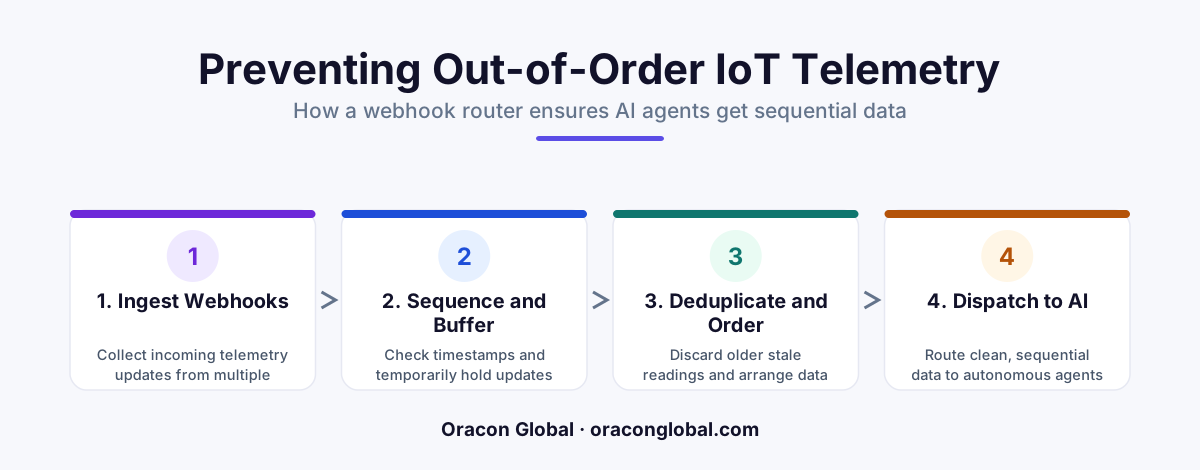
Network jitter and multi-vendor API latencies frequently cause IoT telemetry webhooks to arrive out of chronological order. If an AI agent processes these delayed events sequentially, it will make decisions based on stale data. A custom multi-vendor webhook router solves this by implementing a time-windowed resequencing buffer and state-tracking layer, ensuring your AI agents only execute actions on the absolute latest physical state.
Deploying autonomous AI agents to manage physical operations is one of the most effective ways to cut operational costs. Whether it is an AI digital employee monitoring cold-chain logistics, managing smart warehouse HVAC systems, or tracking industrial manufacturing equipment, giving an agent the power to make real-time decisions based on sensor data is highly efficient. However, a major structural vulnerability often threatens these systems: out-of-order IoT telemetry.
When you rely on multiple hardware vendors, sensor readings are transmitted via webhooks over cellular, Wi-Fi, or satellite networks. Network jitter, routing delays, and vendor-specific API queues mean that a webhook sent at 10:00:00 AM might arrive at your servers after a webhook sent at 10:00:05 AM. If your AI agent processes these events in the order they arrive, it will make critical decisions based on stale, outdated information. To solve this, technical teams must build a custom multi-vendor webhook router to act as an intelligent traffic cop before the data ever reaches the AI.
The Danger of Out-of-Order Telemetry in Agentic Workflows
To understand why this is a critical issue, consider a temperature-controlled medical storage facility managed by an AI agent. The target temperature is a strict 4°C. The following sequence of physical events occurs:
- 10:01:00 AM (Event A): A cooling compressor fails. Temperature spikes to 12°C.
- 10:01:15 AM (Event B): A backup cooling system kicks in. Temperature drops back to 4°C.
Due to a cellular latency spike on the main sensor, the webhook for Event A is delayed in transit. The webhook for Event B arrives at your server first at 10:01:18 AM. The AI agent reads the state: "All systems normal, temperature is 4°C." No action is taken.
Two seconds later, at 10:01:20 AM, the delayed webhook for Event A finally arrives. Because your system processes webhooks sequentially as they land, the AI agent receives a new state update: "Temperature is 12°C." Believing this is the current physical state, the AI agent triggers an emergency alert, schedules an expensive emergency technician, and flags the inventory as compromised—all because it acted on stale, out-of-order data.
For an AI agent to operate safely, it must never receive a state update that is chronologically older than the state it has already processed. Preventing these AI agent failures requires a dedicated routing middleware designed to reconcile multi-vendor telemetry streams in real time.
Step 1: Standardizing Multi-Vendor Payloads
The first challenge of building a robust router is that different IoT hardware manufacturers format their webhook payloads differently. Vendor A might send temperature readings under a temp_celsius key with an ISO-8601 timestamp, while Vendor B sends them under t_f (Fahrenheit) with a Unix epoch timestamp.
Your custom webhook router must feature a normalization engine. When a webhook hits your endpoint, the router must immediately map the vendor-specific payload into a unified schema before performing any routing or ordering logic. This normalized schema must extract three essential elements:
- The Unique Entity ID: The specific machine, vehicle, or facility sensor being monitored.
- The Source Timestamp: The exact millisecond the physical sensor recorded the event, generated by the hardware clock, not the arrival time on your server.
- The State Payload: The standardized key-value pairs representing the telemetry metrics.
Step 2: Implementing a Time-Windowed Resequencing Buffer
Once the incoming webhooks are normalized, they cannot be pushed directly to the AI agent's execution queue. Instead, they must pass through a time-windowed resequencing buffer. This is a critical component of IoT data orchestration.
The resequencing buffer acts as a brief holding zone (typically 2 to 5 seconds, depending on your network tolerances). When a webhook arrives, it is placed into a memory-efficient cache (such as Redis) keyed by the Entity ID. The router holds the events within this micro-window, allowing delayed webhooks to catch up.
Once the time window expires, the router pulls all events collected for that Entity ID, sorts them chronologically by their hardware-generated source timestamp, and flushes them to the AI agent in the correct order. This ensures that the agent always sees the true chronological progression of physical events.
Step 3: Guarding with a Distributed State Tracker
While a resequencing buffer handles minor network jitter, some webhooks may be delayed by minutes or even hours due to offline devices or severe network drops. Holding a buffer open for hours is impractical and introduces unacceptable latency to your real-time data ingestion pipeline.
To handle highly delayed "straggler" webhooks, your router must maintain a distributed state tracker. This tracker stores a single, lightweight record for every active IoT device: the timestamp of the latest event successfully processed by the AI agent.
When a webhook escapes the short resequencing buffer, the router performs a quick comparison check:
If (Incoming Webhook Timestamp < Last Processed Timestamp for Device) { Discard or Archive Webhook (Do not send to AI Agent); } Else { Update Last Processed Timestamp; Send Webhook to AI Agent Queue; }
By enforcing this rule at the router level, you guarantee that your AI agents only move forward in time. Stale data is silently archived for historical auditing, but it is blocked from triggering erroneous, expensive real-world actions.
Designing for Scale and Reliability
Because IoT devices can generate thousands of events per second, this middleware must be built for speed and resilience. Using heavy, low-code automation tools for this layer often results in rate-limiting issues, high database locks, and expensive API overhead.
A production-ready solution requires a custom, event-driven architecture. Building the router with a lightweight runtime like Node.js or Go, paired with a fast, in-memory cache like Redis and an asynchronous message broker like RabbitMQ or Apache Kafka, ensures sub-millisecond routing decisions. If a sudden surge of telemetry data occurs, the queue absorbs the shock, keeping your AI agent's processing queue stable and cost-effective.
Take Control of Your AI-Native Infrastructure
Building autonomous AI systems that interact with the physical world requires more than just connecting an LLM to an API. It requires a resilient, custom-engineered middleware layer that protects your business from the chaotic realities of physical hardware and network latency.
At Oracon Global, our senior in-house engineering team designs and builds robust, full-stack AI applications, custom integrations, and custom middleware that keep business operations running smoothly. We ensure your systems are resilient, scalable, and entirely yours—with 100% code and IP ownership handed over to you upon completion.
Are you building an AI-native operational platform and want to ensure your data pipelines are resilient against real-world errors? Contact the team at Oracon Global today to discuss how we can engineer a stable, high-performance architecture for your business.
Frequently asked questions
Why can't we rely on standard database timestamps to order IoT webhooks?
Database timestamps record when a webhook payload arrived at your server, not when the physical event actually occurred on the IoT device. If an older reading is delayed by network congestion and arrives after a newer reading, the database will incorrectly treat the stale reading as the latest update.
How does a resequencing buffer prevent AI agents from making mistakes?
A resequencing buffer holds incoming webhooks for a micro-window (e.g., 2 to 5 seconds) and sorts them by the device's hardware-generated sensor timestamp. This ensures that the AI agent only receives and acts upon the true chronological sequence of events, ignoring delayed, older updates.
What happens to delayed webhooks that arrive outside the buffer time window?
Webhooks arriving outside the buffer window are compared against a distributed state tracker (like Redis). If the incoming payload's sensor timestamp is older than the last processed timestamp for that specific device, the router discards or archives the update, preventing the AI agent from executing a stale command.
Can we implement this architecture with low-code or no-code tools?
Low-code platforms lack the precise concurrency controls, sub-second state validation, and memory-efficient queue management required to handle thousands of out-of-order webhooks from multiple vendors, which is why a custom-coded middleware layer is necessary.
Read next
Beyond Chatbots: How to Build AI Agents That Actually Do Work for Your Business
Most businesses use AI to answer questions. Here is how to build custom AI agents that actually take action, connect to your internal tools, and handle complex workflows.
Beyond the Wrapper: How to Build Custom AI Agents for Business That Actually Work
Many businesses invest in basic AI wrappers only to find they lack the security and context needed for real work. Here is how to build custom AI agents that integrate deeply with your workflows and databases.
Enterprise AI Maintenance Costs: Budgeting for Year Two and Beyond
Building an AI system is only half the battle. Discover the practical, ongoing operational costs of enterprise AI, including token management, model drift, and continuous security audits.
Oracon Global builds production-grade AI agents, automation and apps — and you own the code and IP. Tell us what you want to automate.
Book a call →See our work