

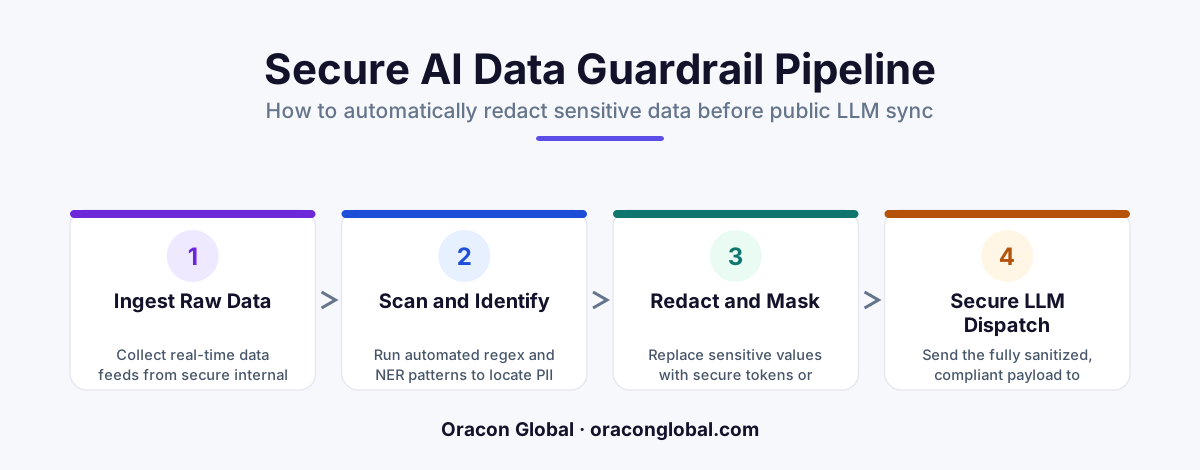
A dynamic policy guardrail engine acts as a secure proxy between your internal databases and public LLM APIs. By intercepting agent payloads in real time, it identifies, hashes, or redacts sensitive PII and confidential pricing metrics, ensuring compliance without degrading the AI's reasoning capabilities.
As businesses rapidly adopt autonomous AI agents to automate workflows, a quiet security crisis is unfolding. To be useful, an AI agent must access your operational data, which often includes customer databases, proprietary pricing structures, and financial ledgers. However, the moment your agent packages this information and sends it to a public Large Language Model (LLM) for processing, that data leaves your security perimeter.
Without protection, your business risks exposing personally identifiable information (PII), proprietary margins, and trade secrets to third-party servers. To solve this, engineering teams must build a dynamic policy guardrail engine. This custom middleware layer intercepts, analyzes, and redacts sensitive data before it ever reaches an external API, allowing you to protect enterprise data while preserving the intelligence of your AI workflows.
The Risk of Unfiltered Agentic Communication
When an AI agent executes a task, such as compiling an invoice or drafting a client response, it gathers raw data from your internal systems. If the agent directly syncs this payload to an external LLM, several things can go wrong:
- Regulatory Non-Compliance: Transmitting raw customer names, emails, or phone numbers violates strict privacy frameworks like GDPR, HIPAA, and CCPA.
- Intellectual Property Exposure: Sharing proprietary pricing algorithms, custom discount tiers, or internal margin targets compromises your competitive advantage.
- Data Retention Vulnerabilities: Even with enterprise data-sharing agreements, sending unencrypted sensitive data to public APIs increases your attack surface.
Relying solely on system prompts to "ignore sensitive data" is a recipe for failure. LLMs are prone to prompt injections and structural bypasses. Security must be enforced by hardcoded, deterministic software before the data leaves your cloud environment.
Architecting the Dynamic Policy Guardrail Engine
A robust guardrail engine operates as an inline secure proxy between your agentic database state and the external LLM API. The goal is simple: identify sensitive data, replace it with secure placeholders, send the clean payload to the LLM, and then restore the real data when the model returns its response.
Step 1: The Inspection Phase (Deterministic Filtering)
The engine first passes all outgoing payloads through a fast, deterministic inspection pipeline. This step does not use slow LLMs. Instead, it relies on high-speed pattern matching (regex) and optimized Named Entity Recognition (NER) models to flag suspicious strings. This flags standard PII patterns such as:
- Social Security and tax identification numbers
- Credit card details and bank routing codes
- Email addresses and phone numbers
- Physical addresses
Step 2: Dictionary-Based Pricing Matching
Unlike standard PII, internal pricing metrics do not follow universal patterns like phone numbers. To catch proprietary pricing, the guardrail engine queries an in-memory database cache (such as Redis) containing your current product SKUs, internal cost sheets, and margin structures. If any value in the payload matches these restricted records, it is flagged for redaction.
Step 3: Semantic Tokenization (Preserving Context)
Simply deleting sensitive information breaks the LLM’s ability to reason. If an agent needs to calculate a discount but the price is missing, the workflow fails. To prevent this, the engine uses tokenization.
For example, if the raw string is: "Offer John Doe a custom rate of $450/hour for our software suite."
The guardrail engine replaces the sensitive variables with semantic, non-sensitive tokens and stores the mapping in a temporary, secure state database:
"Offer [CLIENT_NAME_1] a custom rate of [INTERNAL_RATE_1] for our software suite."
Step 4: The Reverse-Mapping Detokenizer
The LLM receives the tokenized, clean prompt and returns its structured output using those same tokens. Once the response enters your secure server, the engine consults its local, short-lived lookup table, swaps the placeholders back to their original values (e.g., replacing "[CLIENT_NAME_1]" with "John Doe"), and executes the internal action.
Balancing Security with System Performance
A common concern when introducing a middleware security layer is latency. If your guardrail engine takes three seconds to analyze a payload, your AI workflows will grind to a halt. Maintaining real-time performance requires a few architectural best practices.
Lightweight Local Models
Never use an external LLM to audit another LLM's payload. Instead, run small, highly optimized, open-source NER models locally within your own cloud infrastructure. This ensures data processing takes milliseconds, not seconds.
In-Memory State Management
Because the tokenization mapping only needs to live for the duration of a single API call, store these mappings in high-speed, in-memory databases. These records should be configured with a strict Time-To-Live (TTL) of just a few minutes, ensuring sensitive mappings are automatically purged from memory almost immediately after use.
Taking Control of Your AI Security Strategy
Building a dynamic policy guardrail engine ensures your business never has to choose between operational speed and data security. By implementing a secure proxy layer, you retain complete control over what information leaves your business, satisfying compliance officers while allowing your development teams to build highly capable, autonomous AI agents.
At Oracon Global, our senior in-house engineering team specializing in custom AI development design secure, production-grade architectures built to scale. We construct robust AI integrations, custom ERPs, and workflow automations where you retain 100% ownership of the code and intellectual property.
Want to secure your AI workflows and protect your proprietary business data? Contact Oracon Global today to discuss how we can build custom security guardrails tailored to your infrastructure.
Frequently asked questions
What is a dynamic policy guardrail engine?
It is a custom software middleware layer that intercepts data payloads sent from your internal systems to external Large Language Models (LLMs), automatically identifying and redacting sensitive information in real time.
How does the engine redact data without ruining the AI agent's ability to understand context?
Instead of simply erasing text, the engine uses secure tokenization or cryptographic hashing, replacing sensitive values with semantic placeholders like [CLIENT_A] or [INTERNAL_PRICE_1] so the LLM retains logical context.
Will building a guardrail layer significantly slow down my AI agent's response times?
If designed correctly using lightweight local Regex, Named Entity Recognition (NER) models, and high-performance caching, the latency overhead is negligible, typically adding fewer than 50 milliseconds to the request lifecycle.
Why can't we just rely on the LLM provider's privacy policies to protect our data?
While providers offer data processing agreements, transmitting raw PII or proprietary pricing data to external servers still exposes your business to compliance violations, data leaks, and third-party dependency risks.
Read next
Beyond Chatbots: How to Build AI Agents That Actually Do Work for Your Business
Most businesses use AI to answer questions. Here is how to build custom AI agents that actually take action, connect to your internal tools, and handle complex workflows.
Beyond the Wrapper: How to Build Custom AI Agents for Business That Actually Work
Many businesses invest in basic AI wrappers only to find they lack the security and context needed for real work. Here is how to build custom AI agents that integrate deeply with your workflows and databases.
Enterprise AI Maintenance Costs: Budgeting for Year Two and Beyond
Building an AI system is only half the battle. Discover the practical, ongoing operational costs of enterprise AI, including token management, model drift, and continuous security audits.
Oracon Global builds production-grade AI agents, automation and apps — and you own the code and IP. Tell us what you want to automate.
Book a call →See our work