

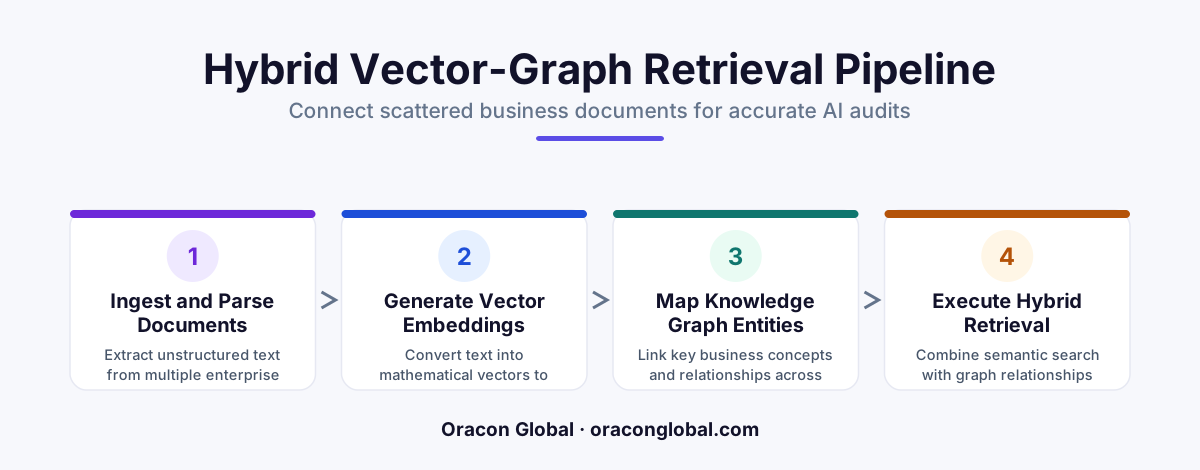
Standard RAG pipelines search for isolated text fragments, which causes AI agents to miss relationships spread across different audit files. A hybrid vector-graph retrieval pipeline solves this by mapping documents as nodes and relationships as edges, allowing the AI to query both semantic meaning and structural connections for accurate, multi-document business audits.
When you deploy custom AI agents to audit complex business operations, you expect them to read like a seasoned forensic accountant. You want them to look at a master services agreement, cross-reference it with a change-order PDF from six months later, match both against an ERP ledger entry, and flag any discrepancies. This process requires understanding multi-document relationships.
Yet, many companies build their audit agents using standard vector-based Retrieval-Augmented Generation (RAG) only to find the AI missing obvious compliance violations. The agent can summarize single documents beautifully, but it completely fails to connect the dots across different files. This is not a failure of the underlying Large Language Model (LLM). It is a failure of the data retrieval architecture.
To solve this, engineering teams are moving toward a hybrid vector-graph retrieval pipeline. By combining the semantic flexibility of vector databases with the explicit, structured relationship mapping of knowledge graphs, you can build custom AI agents that conduct deep, highly accurate business audit AI workflows without losing the thread.
Why Standard Vector Search Fails in Complex Audits
Standard vector search operates on mathematical proximity. It takes your documents, chops them into small text blocks, converts those blocks into numbers called embeddings, and stores them in a vector database. When your AI agent asks a question, the system looks for text blocks that sound conceptually similar to the query.
This works well for basic search, but fails during a multi-document retrieval audit for three reasons:
- Disconnected Context: If a vendor contract says "Net 30 terms apply to all transactions under Exhibit B," and Exhibit B is a separate PDF file uploaded three weeks later, a vector search query about "payment terms violations" might pull the contract snippet but completely miss the corresponding Exhibit B.
- Fragmentation: Chunking long PDFs into arbitrary 500-word blocks often cuts off vital context. The system loses the relationship between a clause at the top of a document and a signatory page at the bottom.
- Lack of Structural Logic: Vector search does not understand explicit relationships like "Document A superseded Document B" or "Company X is a parent entity of Company Y." It only understands semantic closeness.
For a rigorous business audit, close is not good enough. Your AI needs a map of how your data fits together.
The Solution: What is Hybrid Vector-Graph Retrieval?
A hybrid vector-graph retrieval pipeline (often referred to as GraphRAG) combines two distinct database technologies to feed your AI agent the absolute best context:
- The Vector Layer: Handles semantic search. It excels at finding unstructured concepts, sentiment, and broad topics across your document library.
- The Knowledge Graph Layer: Handles structural relationships. It maps your business data as "nodes" (entities like vendors, employees, dates, or contract IDs) and "edges" (the explicit relationships between them, such as "signed_by," "amended_by," or "billed_to").
By blending these two layers, your custom AI agents gain a superpower. They can search for a concept using natural language, identify the exact nodes associated with that concept in your business graph, and then instantly traverse the graph edges to pull every related document, transaction, and email—even if those related files do not contain the original search terms.
Step-by-Step: Building the Hybrid Pipeline
Implementing a hybrid pipeline requires a shift in how you process and ingest business files. Here is how a high-performance system is structured:
Step 1: Joint Entity and Relationship Extraction
When a document is uploaded to your system, it undergoes a dual-processing pipeline. While the document is chunked and embedded for your vector database, an LLM-driven parser extracts key entities and relationships to build the graph. For example, if the system reads an invoice, it extracts "Vendor: Acme Corp," "Invoice Number: INV-102," and "Amount: $50,000," creating node links to your master contract database.
Step 2: Linking Graph Nodes to Vector Embeddings
Instead of keeping the vector database and the graph database isolated, you link them. Every node in your knowledge graph is assigned a vector embedding. This allows your retrieval system to jump seamlessly between the two. Your agent can perform a vector search to find a specific clause, locate the corresponding node in the graph, and immediately see every document connected to that node.
Step 3: Hybrid Query Execution
When your audit agent runs an analysis, the system executes a two-pronged search. It queries the vector database for semantic relevance and queries the graph database for structural connections. The system then merges these results, ranks them for relevance, and passes a highly structured, perfectly contextualized payload to the LLM's context window.
"By grounding your AI agent in a hybrid vector-graph network, you eliminate the guesswork. The agent no longer has to guess if two files are related; the system provides the mathematical and logical proof of their relationship."
Real-World Impact: Auditing with Precision
Consider a complex corporate compliance audit. A human auditor might spend days searching through shared drives to verify if a series of consultancy payments violated internal procurement caps. They have to find the vendor contract, locate the statement of work, pull the corresponding invoices, and cross-reference them with bank transaction receipts.
A custom AI agent backed by a hybrid vector-graph retrieval pipeline can run this audit in seconds. Because the relationships between the contracts, statements of work, invoices, and bank records are explicitly mapped in the graph, the agent retrieves the entire chain of custody instantly. It can flag that "Invoice C exceeded the limit set in Statement of Work B, which is governed by Master Contract A," with 100% accuracy.
Own Your AI Architecture
Building high-fidelity AI tools requires deep, custom engineering. Out-of-the-box wrappers and simple vector databases are fine for basic search tools, but they crumble under the weight of complex, multi-document enterprise workflows like corporate audits.
At Oracon Global, our senior in-house engineering team builds production-grade custom AI agents, AI-native ERP platforms, and advanced retrieval architectures tailored to your unique data structures. We do not use cookie-cutter templates, and our clients retain 100% ownership of their code and intellectual property.
If you are ready to build business-critical AI tools that do not miss the details, contact Oracon Global today to discuss your architecture.
Frequently asked questions
Why does standard vector search fail during complex business audits?
Standard vector search retrieves individual snippets of text based on semantic similarity, but it cannot understand how a clause in a vendor contract on page 50 relates to a transaction entry in an invoice PDF from a different folder.
What is a hybrid vector-graph retrieval pipeline?
It is an architecture that combines a vector database (which finds documents by conceptual meaning) with a structured knowledge graph (which maps how entities, dates, and contracts are explicitly linked across your business).
Does implementing a knowledge graph mean we lose the flexibility of unstructured data search?
No. The hybrid model uses vector search to handle unstructured language queries, while the graph layer steps in to trace the relationships, giving your AI agent the best of both worlds.
Do we need to rewrite our entire document database to use this architecture?
No. A hybrid pipeline acts as an intelligent retrieval layer that sits on top of your existing cloud storage, document management systems, or enterprise databases.
Read next
Beyond Chatbots: How to Build AI Agents That Actually Do Work for Your Business
Most businesses use AI to answer questions. Here is how to build custom AI agents that actually take action, connect to your internal tools, and handle complex workflows.
Beyond the Wrapper: How to Build Custom AI Agents for Business That Actually Work
Many businesses invest in basic AI wrappers only to find they lack the security and context needed for real work. Here is how to build custom AI agents that integrate deeply with your workflows and databases.
Enterprise AI Maintenance Costs: Budgeting for Year Two and Beyond
Building an AI system is only half the battle. Discover the practical, ongoing operational costs of enterprise AI, including token management, model drift, and continuous security audits.
Oracon Global builds production-grade AI agents, automation and apps — and you own the code and IP. Tell us what you want to automate.
Book a call →See our work