

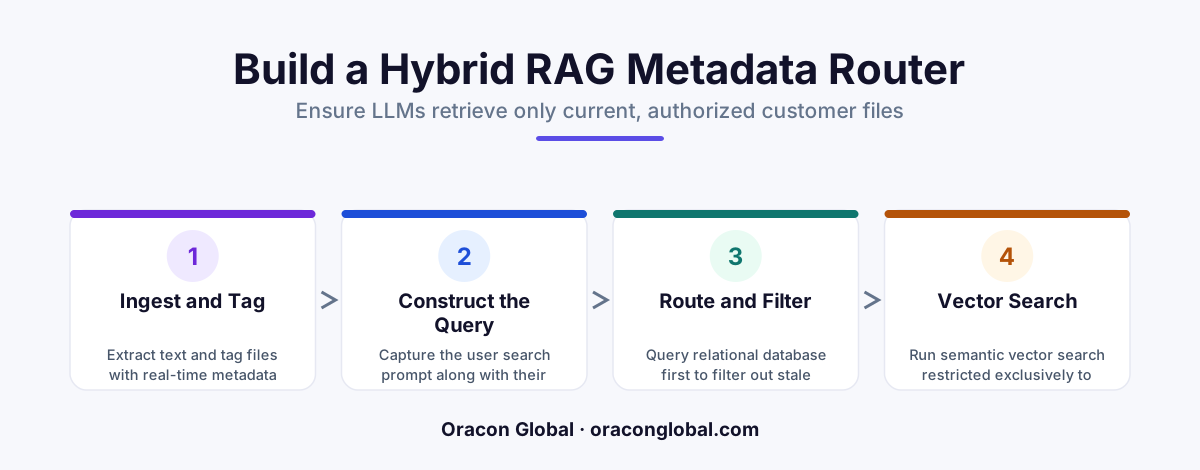
Standard vector search cannot reliably filter files by temporal status or tenant ownership, leading to AI hallucinations based on stale data. By placing a hybrid vector-relational metadata router in front of your vector database, you force the system to perform hard relational filters first, ensuring the LLM only receives active, accurate documents.
Most enterprise teams building custom RAG systems share a common, frustrating realization a few weeks after deployment: their AI agent is giving customers outdated information. Despite having a highly capable language model and a state-of-the-art vector database, the system routinely pulls pricing sheets from 2023, archival policy PDFs, or stale account files.
The root of this problem lies in how standard semantic search works. Vector databases calculate mathematical similarity, not chronological relevance or relational truth. If a customer asks about a billing policy, an archived PDF from four years ago might have a higher semantic similarity score than a brief, modern update. To prevent these costly retrieval errors, you need a structured gatekeeper. Here is how to build a hybrid vector-relational metadata router to ensure your AI always references the source of truth.
The Semantic Trap: Why Vector Search Ignores Document Recency
In a standard Retrieval-Augmented Generation (RAG) pipeline, documents are chopped into chunks, converted into vector embeddings, and stored in a vector database. When a user asks a question, the system converts the query into an embedding and finds the closest matching vectors.
This process is entirely blind to database state, document lifecycle, and tenant boundaries. A vector database does not inherently understand that "active_status = false" means a document should be ignored, nor does it naturally prioritize a file modified ten minutes ago over one modified ten months ago unless explicitly instructed. Without strict relational boundaries, your AI agent will eventually pull stale customer files, leading to incorrect answers, compliance violations, and broken user trust.
What is a Hybrid Vector-Relational Metadata Router?
A hybrid vector-relational metadata router is an architectural layer that sits between the user's query and your vector database. Instead of sending raw queries directly to a vector index, the router performs a two-step evaluation:
- The Relational Pass: The router evaluates the context of the query against your system's relational database rules (such as Tenant ID, Document Version, Expiration Date, and Active/Archived Status).
- The Vector Pass: The router construct a scoped query, applying hard relational metadata filters to the vector database search, ensuring the semantic search only runs against eligible, current documents.
By shifting from raw semantic search to structured, filtered search, you guarantee that archival PDFs and deactivated customer records are programmatically invisible to the LLM.
Step-by-Step Architecture for the Metadata Router
Building a robust metadata router does not require overcomplicating your tech stack. It requires enforcing strict data engineering disciplines across three key phases.
1. Designing the Unified Metadata Schema
Every document ingested into your system must be tagged with a consistent, relational metadata payload. This payload should be stored alongside the vector embeddings in your database (or mapped via a relational database like PostgreSQL using pgvector). Your schema should include at least these five fields:
- tenant_id: Ensures absolute data isolation between different customers or organization units.
- document_status: A hard state indicator (e.g., "active", "superseded", "archived").
- valid_from / valid_to: Timestamp boundaries that define the lifespan of the document's authority.
- version_sequence: An integer that increments with every document update, allowing the router to identify the latest iteration.
- document_category: Broad categorization (e.g., "internal_policy", "customer_contract") to prevent cross-contamination of contexts.
2. The Pre-Query Parsing Engine
When an application receives a user query, the metadata router intercepts it. Before running any vector calculations, the router determines the operational context. For example, if a logged-in user in Organization B asks about their active contract, the router immediately locks down the query parameters to:
tenant_id = "org_b" AND document_status = "active" AND current_timestamp BETWEEN valid_from AND valid_to
This parsing step happens at the application code level, utilizing your session state and relational user tables, meaning it executes in milliseconds without touching the LLM.
3. Executing the Filtered Vector Search
With the relational boundaries established, the router translates these constraints into the specific syntax of your vector database. Instead of a generic top-k vector search, the database executes a filtered index scan. The vector index search is restricted exclusively to the chunks that match your relational metadata. Stale, expired, or unauthorized documents are filtered out at the database level, ensuring they never enter the LLM's context window.
The Technical and Operational Benefits
Implementing a hybrid vector-relational metadata router does more than just fix hallucination errors. It introduces several system-wide improvements to your custom RAG systems:
- Reduced LLM Token Costs: By preventing the retrieval of redundant or outdated document chunks, you avoid sending unnecessary text to the LLM, lowering your per-query API costs.
- Deterministic Security: Relying on an LLM to self-select the "correct" or "most modern" document from a mixed pool of chunks is highly risky. A metadata router guarantees tenant isolation and document authorization at the database query layer.
- Faster Query Latency: Filtering down your search space prior to running high-dimensional vector math significantly reduces query processing times.
Building Production-Grade AI Architectures
Moving an AI application from a simple proof-of-concept to a reliable tool that your team or customers can trust requires addressing these structural data challenges. When you build with a focus on strict data boundaries, hybrid retrieval, and deterministic rules, your software performs consistently under real-world conditions.
At Oracon Global, our senior in-house engineering team designs and delivers custom AI agents, robust RAG pipelines, and enterprise-grade web and mobile applications that prioritize security, accuracy, and performance. We build systems where you retain 100% ownership of your code and intellectual property.
If you are ready to build an AI-native solution that handles complex, real-time business data without failing, contact us at Oracon Global today to discuss your architecture.
Frequently asked questions
Why does standard vector search pull outdated files even when we update our database?
Vector databases measure semantic similarity, not chronological status. If an old PDF matches the user's query conceptually, the vector search will retrieve it regardless of whether a newer version exists, unless a hard relational filter is applied first.
What is a hybrid vector-relational metadata router?
It is an architectural layer that sits between your user query and your database. It intercepts queries, checks relational rules (like tenant ID, active status, or creation date), applies these as strict metadata filters, and then executes the vector search only on the qualified subset of documents.
Does this architecture increase latency in production RAG systems?
No, it actually improves query performance. By filtering down the document corpus using indexed relational metadata before performing the high-dimensional vector search, you reduce the search space and speed up retrieval times.
Can we implement this with existing SQL databases?
Yes. Modern relational databases with vector extensions (like PostgreSQL with pgvector) or dedicated vector databases that support advanced metadata filtering are ideal for implementing a hybrid router.
Read next
Beyond Chatbots: How to Build AI Agents That Actually Do Work for Your Business
Most businesses use AI to answer questions. Here is how to build custom AI agents that actually take action, connect to your internal tools, and handle complex workflows.
Beyond the Wrapper: How to Build Custom AI Agents for Business That Actually Work
Many businesses invest in basic AI wrappers only to find they lack the security and context needed for real work. Here is how to build custom AI agents that integrate deeply with your workflows and databases.
Enterprise AI Maintenance Costs: Budgeting for Year Two and Beyond
Building an AI system is only half the battle. Discover the practical, ongoing operational costs of enterprise AI, including token management, model drift, and continuous security audits.
Oracon Global builds production-grade AI agents, automation and apps — and you own the code and IP. Tell us what you want to automate.
Book a call →See our work